
Introduction: Not Knowing What Matters Anymore

There is a particular experience that has become more common in times of rapid change. Not a crisis, exactly — more a quiet disorientation. I’m not sure what I care about anymore.
This is not the same as losing one’s values. When work shifts unpredictably, when the social metrics of success keep moving, when comparison is constant and unavoidable — values do not disappear. They become inaccessible. The internal compass is still there. Something else is running louder.
Why this happens, and how the compass becomes readable again, is where neuroscience and social psychology offer two different layers of the same explanation.
Session 1: Why Values Become Hard to Reach

When values feel distant, the instinct is to treat it as a personal failing. A loss of clarity, a weakness of character. But what is actually happening operates at a more structural level.
The brain processes uncertainty as threat. An unpredictable work environment, shifting social evaluations, change arriving faster than adaptation allows — these register in the nervous system as conditions requiring vigilance. Under threat conditions, the brain reorganizes its processing priorities: short-term danger avoidance moves to the front, and long-term self-referential judgment moves back. The question what do I care about, across time requires exactly the kind of extended self-referential processing that the threat system deprioritizes. Values do not go missing. The nervous system temporarily assigns them a lower processing priority than the immediate signals demanding attention.
A second layer compounds this. When internal reference points become uncertain, the pull toward external comparison intensifies. If the question is am I moving in the right direction, and internal criteria feel unstable, the reactions and evaluations of others appear to offer an answer. The more heavily that external reference is weighted, however, the more the internal standard recedes. What begins as a search for orientation becomes a process of measuring oneself against a moving external standard — one that was never designed to provide the stability being asked of it.
Values function not as goals to be achieved but as directional reference points — a basis for action that does not depend on external conditions remaining stable. That distinction is what makes them accessible even when the environment is not.
Session 2: Returning to Values

STEP 1: Check the current state (1–2 minutes)
Before directing attention anywhere else, notice what the nervous system is doing right now.
Is there tension somewhere in the body? Around the chest, the shoulders, the jaw. Is there a background sense of urgency — something needs to be decided, something needs to be done?
Confirm this without evaluation. If the threat system is running, that is the starting point for this practice.
STEP 2: Confirm one core value (2–3 minutes)
From that position, bring a single question inward:
What do I want to still be holding onto when this settles?
Let one word or phrase surface. Connection. Honesty. Curiosity. Contribution. There is no correct answer. The task is not to construct the right response but to confirm what is already there.
This is something I care about.
That confirmation — quiet, without performance — is the operation.
STEP 3: Choose one small alignment today (1 minute)
Connect the value just confirmed to a single small action available today. The scale does not matter. The direction does.
If the value is connection: put the phone down during one conversation and be fully present in it.
If the value is curiosity: spend ten minutes on something that has been quietly interesting for a while.
If the value is honesty: send the reply that has been postponed.
The action is not the proof of the value. It is a single instance of moving in its direction.
Session 3: Uncertainty and the Nervous System, Social Comparison and Self-Concept, the Experimental Case for Value Confirmation, and the Long-Term Structure
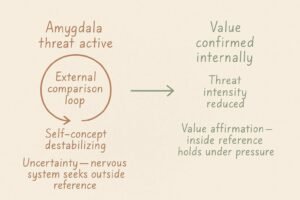
Tali Sharot’s research on uncertainty and neural prioritization showed that conditions of high uncertainty trigger amygdala overactivation and shift the brain’s processing priorities away from long-term value-based judgment toward short-term threat avoidance. This shift is adaptive in genuinely dangerous situations — rapid avoidance serves survival better than extended self-reflection. In environments of chronic uncertainty, however — where employment is unstable, social evaluations shift continuously, and change outpaces adaptation — the shift becomes a persistent state rather than a temporary one. The experience of not knowing what one cares about is not evidence that values have been lost. It is evidence that the nervous system has temporarily reassigned processing priority to something else.
The social environment adds a second layer to this neural state. Leon Festinger’s social comparison theory, introduced in Human Relations (1954), established that when objective standards for evaluating one’s own opinions and abilities are unavailable, people turn to comparison with others as a substitute. The higher the uncertainty, the stronger this pull becomes. Jennifer Campbell’s research on self-concept clarity, published in Journal of Personality and Social Psychology (1990), adds that people with less clearly defined self-concepts are more vulnerable to destabilization by external change and evaluation. In conditions where social media has expanded the reference group to a near-infinite scale, the comparison mechanism Festinger described runs continuously rather than episodically — a threatened nervous system seeks external reference, external reference further destabilizes self-concept, and the internal compass becomes harder to read precisely when it is most needed.
The direct intervention into this cycle is where Claude Steele’s self-affirmation theory, introduced in Advances in Experimental Social Psychology (1988), provides the experimental basis. Steele’s research showed that under threat conditions, a brief act of confirming a core personal value — one unrelated to the source of the threat — restores the integrity of the self-system and reduces the intensity of threat response. The key finding is that value confirmation does not work by resolving the threat. It works by providing the self-system with a reference point that the threat cannot destabilize. This is something I care about does not solve the uncertain situation. It gives the nervous system a different signal to organize around — one that comes from inside rather than from the shifting external field.
Why that operation has lasting structural effects is where Edward Deci and Richard Ryan’s self-determination theory, from Psychological Review (1985), provides the longer-term account. Deci and Ryan’s research established that people who pursue values rooted in autonomy, competence, and relatedness — intrinsic values — show consistently higher long-term wellbeing than those who organize their lives around external evaluation and reward. The more heavily external metrics are weighted, the more vulnerable the self becomes to the fluctuations of those metrics. Andrew Gloster and colleagues’ meta-analysis in Journal of Contextual Behavioral Science (2020), drawing on 96 studies and approximately 17,000 participants, confirmed that psychological flexibility — acting in accordance with values regardless of internal or external conditions — shows consistent positive associations with mental health, work performance, and subjective wellbeing. What Steele’s research shows at the level of a single moment and what Deci and Ryan’s research shows across years of living converge on the same structure: an internal reference point that does not depend on external conditions remaining stable is the architecture that holds under pressure.
Conclusion: The Compass Was Always There

Uncertainty shifts the nervous system’s priorities. Social comparison pulls self-concept toward an external standard that was never designed to provide stability. Where these two overlap is where values become hardest to access — and where they are most needed.
Value confirmation does not resolve the uncertainty. It returns the nervous system to a reference point that the uncertainty cannot reach.
The compass was never gone. The threat system just got there first.
What the practice restores is not the compass. It was always there. What it restores is the signal.
KEY TERMS
Psychological Flexibility
The capacity, central to Acceptance and Commitment Therapy as developed by Steven Hayes and colleagues, to act in accordance with chosen values even under difficult internal or external conditions — adjusting behavior in response to context while maintaining directional consistency. Distinguished from rigidity, which fixes behavior regardless of context, and from instability, which abandons direction when conditions become difficult. Andrew Gloster and colleagues’ meta-analysis in Journal of Contextual Behavioral Science (2020) confirmed its associations with mental health and wellbeing across 96 studies, establishing it as one of the most empirically supported constructs in contextual behavioral science.
Uncertainty and Neural Prioritization
Tali Sharot’s research on how high-uncertainty conditions trigger amygdala overactivation and shift the brain’s processing priorities from long-term value-based judgment toward short-term threat avoidance. The reframing this offers is precise: values do not disappear under pressure — the nervous system temporarily assigns them a lower processing priority than immediate threat signals. Chronic uncertainty environments, where this shift becomes persistent rather than temporary, are the conditions in which value confirmation practices have their greatest functional relevance.
Social Comparison and Self-Concept Clarity
Leon Festinger’s social comparison theory, from Human Relations (1954) — the tendency to use others as evaluative reference points when objective internal standards are unavailable — combined with Jennifer Campbell’s research on self-concept clarity, from Journal of Personality and Social Psychology (1990), showing that less clearly defined self-concepts are more vulnerable to external destabilization. Together, these two frameworks describe the social-psychological layer that compounds neural threat states: uncertainty drives comparison, comparison further erodes internal reference, and the compass becomes harder to read precisely when its clarity is most needed.
Self-Affirmation Theory
Claude Steele’s account, from Advances in Experimental Social Psychology (1988), of how briefly confirming a core personal value under threat conditions restores self-system integrity and reduces threat reactivity — without requiring the threat itself to be resolved. The mechanism is not distraction or reappraisal but the provision of an internal reference point that the threatening situation cannot destabilize. Subsequent research has shown effects on cognitive performance and decision quality under stress, and the theory provides the experimental basis for understanding why value clarification practices in ACT and contemplative traditions produce measurable changes in how threat is processed.
Self-Determination Theory
Edward Deci and Richard Ryan’s framework, from Psychological Review (1985), establishing that values rooted in autonomy, competence, and relatedness — intrinsic values — support higher long-term wellbeing than values organized around external evaluation and reward. The structural implication is that the more self-evaluation depends on external metrics, the more vulnerable it becomes to their fluctuation. In conjunction with Steele’s account of value confirmation’s immediate effects and Hayes’s psychological flexibility model, self-determination theory provides the longer-term basis for understanding why an internal reference point that does not depend on external stability is the architecture most likely to hold under chronic uncertainty.