
Introduction: Why the Mind Goes Blank After a Mistake

A stumble during a presentation. A significant error found in submitted work. A poor judgment call at a critical moment.
In the immediate aftermath, many people find that what begins is not reflection but self-attack — How embarrassing. I keep doing this. I’m just not cut out for this. And the louder that voice becomes, the harder it gets to see clearly what actually happened.
This is not a failure of willpower. The emotional response that follows a mistake has a neurological structure. The brain is designed to process failure as a learning signal — but a specific kind of emotion interrupts that processing before it can complete.
This article explains what is happening in the brain after a failure, identifies the conditions under which learning resumes, and shows why the three practices in Session 2 work.
Session 1: Failure Was Never an Error Message — It Was an Update Signal

Treating failure as evidence of personal deficiency is a widely shared habit. The brain’s actual design is something different.
The brain operates by continuously predicting what will happen next. When a prediction is wrong — when a failure occurs — the nervous system records that discrepancy as a prediction error. This signal is the input that drives learning circuits to update. By design, failure is not noise to be eliminated but data that improves the system.
The problem is that this processing gets interrupted by a specific emotional state. When failure triggers shame, the brain enters threat-detection mode, and the cognitive resources needed for learning get redirected toward a different purpose: self-defense. The result is that seeing clearly what happened becomes genuinely difficult — not because the person is unwilling, but because the neural architecture is occupied elsewhere.
Shame attacks the whole self — I am the problem. Guilt stays focused on the action — I did this. That single difference determines whether learning can resume.
Session 2: Turning Failure into Learning Data
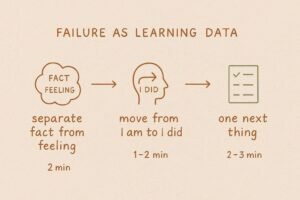
STEP 1: Separate the fact from the feeling label (2 minutes)
In the immediate aftermath of a failure, fact and interpretation are fused together in the mind. The first move is to separate them.
Put what happened into one concrete sentence.
A numerical error in the presentation was pointed out in the meeting. The submission arrived thirty minutes late. The other person’s intention was misread.
Then name what is being felt right now.
There is shame here. There is anxiety here. There is a sense of defeat here.
Putting fact and feeling into separate sentences shifts the brain’s processing mode. Naming an emotion is a cognitive intervention that partially reduces threat-circuit activation — a move from I’m such a failure to there is shame present right now. Observation, not merger.
STEP 2: Move from “I am” to “I did” (1–2 minutes)
Using the fact from STEP 1, redirect the self-evaluation toward the action.
Notice the critical voice — I failed again. I knew I wasn’t capable of this.
Then ask: Is this a problem with who I am, or with what I did this time?
This time, the check wasn’t thorough enough. This time, the preparation window was too short. This time, the decision came too quickly.
The move from shame (I am) to guilt (I did) is a single shift in focus — and it reopens the learning circuit. Releasing the attack on the whole self creates the space to actually see what happened.
STEP 3: Identify one next thing (2–3 minutes)
With attention back on the action, identify one thing that can be changed next time.
If there is one thing this failure makes available to change, what is it?
One thing only — not a comprehensive overhaul. Build in fifteen minutes for review. Let a draft sit overnight before sending. Ask for clarification in the moment rather than assuming. Small and specific works better than broad and ambitious.
This one thing is the step that converts the prediction error into an actual learning update. What the moment is asking for is not self-correction — it is the willingness to look again.
Session 3: Four Findings That Change What Failure Means

The signal the brain was already sending
Wolfram Schultz, Peter Dayan, and P. Read Montague’s research, published in Science (1997), rewrites the neurological meaning of failure at the most fundamental level. By recording dopamine neuron activity in primates, Schultz and colleagues showed that the brain encodes the difference between predicted and actual outcomes as a prediction error signal in the dopamine system, and that this signal drives the updating of learning circuits. When a prediction fails, dopamine neurons reduce their firing — and this reduction functions as a teaching signal that modifies subsequent behavior. In the brain’s design, failure is not an exception to be filtered out but a necessary input that increases the system’s accuracy over time.
Why the same failure leads to learning in some cases and avoidance in others
June Price Tangney’s research, published in Personality and Social Psychology Bulletin (1992), explains why identical failures produce such different outcomes. Tangney showed that shame and guilt, though often treated as interchangeable, serve distinct psychological functions: shame — a global negative evaluation of the self — generates withdrawal and defensive behavior, while guilt — a focused evaluation of a specific action — maintains the motivation to repair and correct. The same event processed as shame produces one behavioral trajectory; processed as guilt, it produces another.
How shame occupies the system
Paul Gilbert’s threat system account, synthesized in the British Journal of Clinical Psychology (2014), identifies the neural pathway through which shame interrupts learning. As Gilbert showed, shame activates evolved threat-detection circuitry — triggering the stress response that redirects cognitive resources away from analysis, planning, and correction toward self-protection. The experience of going blank after a failure, of being unable to think clearly about what happened, is the result of this redirection: the system that would process the prediction error is occupied by a defensive function it was not designed to run simultaneously.
The belief that sets the condition
Carol Dweck and Ellen Leggett’s research, published in Psychological Review (1988), identifies the belief-level condition that determines whether failure gets processed as prediction error or as self-indictment. Dweck and Leggett showed that individuals who hold a fixed view of ability tend to interpret failure as evidence of a personal deficit and respond with avoidance, while those who hold an incremental view treat failure as information about a developing skill and respond with continued engagement. It should be noted that replication of mindset effects has shown variability across studies, and effect sizes differ depending on context and population. What remains consistent is the directional principle: whether failure is framed as evidence of what one is or data about what one did sets the cognitive condition under which Schultz’s prediction error either completes as a learning update or gets absorbed into the threat response that Tangney and Gilbert describe.
Conclusion

After a failure, the brain is already trying to learn. What prevents it is not the failure itself but the processing of failure as evidence of a deficient self. Returning to the facts, shifting focus from self to action, identifying one next thing — these three moves create the conditions under which prediction error becomes an actual update rather than a trigger for shutdown.
The brain already knows what to do with failure. Shame is what interrupts the process.
KEY TERMS
Prediction Error
Wolfram Schultz, Peter Dayan, and P. Read Montague’s finding that the brain encodes the gap between predicted and actual outcomes as a dopamine signal that drives learning circuit updates. Establishes the neurological basis for treating failure as a necessary input to the learning system rather than evidence of deficiency. Published in Science (1997).
Shame vs. Guilt: Functional Distinction
June Price Tangney’s finding that shame — a global negative self-evaluation — generates avoidance and defense, while guilt — a focused evaluation of a specific action — maintains the motivation to correct. The same failure produces different behavioral outcomes depending on which emotional channel processes it. Published in Personality and Social Psychology Bulletin (1992).
Threat System and Learning Interruption
Paul Gilbert’s account that shame activates evolved threat-detection circuitry and redirects cognitive resources away from analysis and correction toward self-protection. Provides the neurological explanation for why failure processed as shame makes clear thinking about what happened genuinely difficult rather than merely unwanted. Synthesized in the British Journal of Clinical Psychology (2014).
Fixed vs. Growth Mindset
Carol Dweck and Ellen Leggett’s finding that treating ability as fixed leads to interpreting failure as self-indictment and avoidance, while treating ability as developable leads to engaging with failure as learning information. Replication has shown variability in effect sizes across contexts. The directional principle — whether failure is framed as evidence of what one is or data about what one did — sets the cognitive condition under which prediction error either completes as a learning update or is absorbed into threat response. Published in Psychological Review (1988).