
Introduction: The Exhaustion Isn’t Your Fault

I should be better at this by now. Why does this feel so draining? I’m surrounded by people and still somehow alone. These thoughts about relationships are more common than most people admit.
The default explanation is personal — a deficit in communication skill, a mismatch in personality, a failure to try hard enough. That explanation accounts for part of the picture. It misses the rest.
Much of what makes modern relationships difficult is not individual ability or compatibility. It is a structural mismatch between the environment the human brain evolved for and the environment most people now live in. Understanding that mismatch is the first step toward designing relationships that don’t exhaust.
Session 1: The Brain Has a Blueprint for Relationships — and Modern Life Broke It

The human brain evolved within a specific social structure. Not as an isolated individual, but as a member of a small group of familiar people — known to each other, mutually dependent, embedded in ongoing relationships. The brain developed for that context.
Within that structure, relationships were organized in layers — a small innermost core with the deepest bonds, widening outward through circles of decreasing intimacy and increasing size. This is not a cultural preference. It is a pattern determined by the cognitive limits of the brain itself, confirmed repeatedly across cultures, historical periods, and social settings.
Contemporary urban life puts this blueprint under structural stress. For most of human history, the emotional, practical, and social needs that people carry were distributed across a wide network — extended family, religious community, occupational guild, neighborhood. Emotional support, intellectual stimulation, a sense of belonging, practical mutual aid — these were met by many different relationships simultaneously. As those communal structures dissolved, the same needs became concentrated in a small number of relationships, sometimes in a single person.
Asking one person to be best friend, romantic partner, intellectual companion, emotional safe harbor, and co-navigator of life is a structural overload. The exhaustion that follows is not a sign of weakness. It is the predictable result of using a system outside its design parameters.
Session 2: Diagnosing Your Own Relationship Network
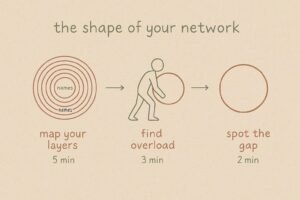
STEP 1: Map your layers (5 minutes)
Most people carry a rough sense of who matters to them — but have never looked at the actual shape of it. This step makes it visible.
On paper or in a note, answer the following question honestly.
Who would I actually contact if something went seriously wrong?
Write the names. Three to five is the expected range. Then:
Who do I stay in regular contact with — people whose general situation I know?
Ten to fifteen is the expected range here.
This is the actual shape of my relationships right now.
Too many or too few — neither is a problem. This is simply an honest look at what is present.
STEP 2: Find the overload (3 minutes)
The list from STEP 1 often reveals something that has been felt but not named. This step names it.
From the list, identify the person on whom the most is concentrated.
Write down what is being asked of that relationship.
Emotional support. Someone to listen. Shared laughter. Intellectual exchange. A sense of safety. Validation.
Then ask one question:
Is this a realistic amount for one person to carry?
This is not criticism of the other person or of the relationship. It is an honest assessment of scale.
STEP 3: Spot the gap (2 minutes)
Return to the list from STEP 1.
Which layer is most thinned out in my current network?
Has the layer of fifteen become hollow — people who exist in the list but haven’t been genuinely contacted in months? Is the inner layer of five concentrated entirely on one person?
There is a gap here.
This gap is carried forward as a question, not a problem to solve today. Recognition is enough for now.
Session 3: Three Findings That Reframe the Problem
The cognitive architecture underneath
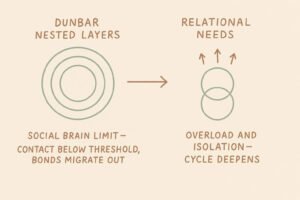
Robin Dunbar’s social brain hypothesis, presented in Behavioral and Brain Sciences (1993), provides the foundational account of why human relationships are structured the way they are. By analyzing neocortex-to-group-size ratios across 38 primate genera, Dunbar showed that cognitive capacity sets an upper limit on the number of stable social relationships an animal can maintain — and that extrapolating from the human neocortex yields a predicted group size of approximately 150. In research published in Trends in Cognitive Sciences (2018), Dunbar showed that this outer limit organizes into nested layers of approximately five, fifteen, fifty, and one hundred and fifty — each requiring a different contact frequency to remain functional. The innermost five require weekly contact to maintain their bond quality; the fifteen layer, monthly; the fifty layer, roughly annually. When contact falls below that threshold, the relationship migrates outward to a less intimate layer, or dissolves. Contemporary urban life makes maintaining these contact frequencies structurally difficult in ways that have little to do with personal commitment.
The scale of what has already dissolved
Miller McPherson, Lynn Smith-Lovin, and Matthew Brashears’ research, published in the American Sociological Review (2006), documents the scale of contemporary relationship erosion in measurable terms. Comparing national survey data from 1985 and 2004, McPherson and colleagues showed that the proportion of Americans reporting no one with whom they could discuss important matters more than doubled — from 10% to 24.6%. The proportion naming a friend as a trusted confidant fell from 73.2% to 50.6%. The structural reason lies in the dissolution of the institutions that once distributed relational functions — extended family, religious community, neighborhood — leaving the same needs to concentrate in one partner or a handful of close friends. Romantic relationships and family come with social scripts: institutions, rituals, and cultural frameworks that support maintenance. Friendship has none of these. A relationship without structural support requires deliberate investment to survive — and in the absence of that investment, it thins.
What isolation costs the body
John Cacioppo and Louise Hawkley’s research — synthesized in Trends in Cognitive Sciences (2009) and Annals of Behavioral Medicine (2010) — establishes that the structural isolation documented by McPherson and colleagues is not a psychological inconvenience but a biological state. Cacioppo and Hawkley showed that chronic perceived social isolation is associated with impaired immune function, elevated inflammatory markers, degraded sleep quality, and accelerated cognitive decline. What their research identified as particularly significant is the self-reinforcing mechanism: loneliness increases sensitivity to social threat, which raises the perceived cost of initiating or maintaining contact, which deepens isolation. Making visible how much is being asked of a single relationship functions as an early intervention in this cycle — a structural recognition before the biological consequences consolidate. The account is accessible in Cacioppo and Patrick, Loneliness (Norton, 2008).
Conclusion

The human brain was designed for a specific kind of social structure. That structure has largely dissolved, leaving people managing the same relational needs with far fewer distributed relationships — and the resulting overload and erosion concentrated in the few that remain.
Mapping the layers, locating the overload, finding the gap: these are acts of structural recognition, not self-criticism.
We didn’t become worse at relationships. We just started asking two people to do what a village used to.
KEY TERMS
Social Brain Hypothesis and Network Layers
Robin Dunbar’s finding, from Behavioral and Brain Sciences (1993), that neocortex size constrains the number of stable relationships an animal can maintain — approximately 150 for humans. Dunbar’s research in Trends in Cognitive Sciences (2018) showed this outer limit organizes into nested layers of 5, 15, 50, and 150, each requiring different contact frequencies to maintain. Provides the evolutionary basis for understanding why modern relational structures produce overload and erosion.
Institutional Deficit of Friendship
McPherson, Smith-Lovin, and Brashears’ finding, published in the American Sociological Review (2006), that the proportion of Americans with no trusted confidant more than doubled between 1985 and 2004. Unlike romantic relationships and family, friendship lacks the social scripts and institutional frameworks that support maintenance — making deliberate investment the only mechanism for preservation.
Biological Cost of Loneliness
John Cacioppo and Louise Hawkley’s account, synthesized in Trends in Cognitive Sciences (2009) and Annals of Behavioral Medicine (2010), that chronic perceived social isolation impairs immune function, elevates inflammation, degrades sleep quality, and accelerates cognitive decline. Loneliness also activates a self-reinforcing cycle: heightened social threat sensitivity increases the perceived cost of connection, deepening isolation. Accessible in Cacioppo and Patrick, Loneliness (Norton, 2008).
Relationship Maintenance Cost and Layer Structure
Dunbar’s finding, from Trends in Cognitive Sciences (2018), that each network layer requires a distinct contact frequency to remain functional — weekly for the innermost five, monthly for fifteen, annually for fifty. When contact falls below threshold, relationships migrate outward or dissolve. Contemporary life structurally undermines these contact patterns in ways that are architectural rather than personal.