
Introduction: Stop Looking for the Right Person

I want deeper connections. There’s no one I can really talk to. I think I’m relying too much on one person. These are among the most common things people say about their relationships — and in almost every case, the solution is framed as finding better people.
But the problem is usually structural rather than personal. Too much being asked of one person. A particular layer of the network hollowed out. No deliberate investment, and relationships thinning naturally as a result.
This guide addresses the whole: how to design a relationship network intentionally. Before that, one thing needs to be recognized — the feeling of it’s too late to change this or I don’t want to break what’s there that most people encounter when they try to redesign their networks. Understanding where that feeling comes from is the entry point to everything that follows.
Session 1: The Resistance to Change Isn’t a Character Flaw

When someone tries to deliberately reshape their relationship network, a specific kind of resistance appears. Guilt about pulling back from a long-standing connection. Hesitation about investing in new ones. A pull toward leaving things as they are.
This is not a failure of resolve. It is a predictable output of a well-documented cognitive pattern: the brain processes losses as approximately twice as significant as equivalent gains. In relational terms, the pain of potentially losing or weakening an existing connection registers as far heavier than the anticipated benefit of building a new one.
Layered on top of this is the sunk cost effect. Relationships into which time and emotion have already been invested generate a sense of obligation — we’ve known each other too long to change this now — that operates independently of whether the relationship is actually serving either person well.
Recognizing this as a cognitive pattern rather than a moral signal is the first move in deliberate design. The feeling of I don’t want to change this may not be evidence that the relationship is in the right state. It may be the brain’s loss-avoidance system running its default program. Distinguishing between the two is what makes intentional redesign possible.
Session 2: Designing the Network in Practice
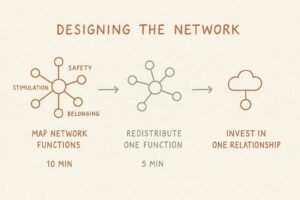
STEP 1: Map the functions of your current network (10 minutes)
Bring to mind the people closest to you — the small inner group you would contact in a crisis, and the wider circle you stay in genuine contact with.
For each relationship, ask one question: What do I actually get from this connection?
Emotional safety — someone with whom vulnerability is possible. Intellectual stimulation — someone who offers a genuinely different perspective. A sense of belonging — a relationship in which being present feels like enough. Practical support — someone who can help in concrete, tangible ways. Enjoyment — someone whose company is simply good.
Write down what each relationship provides. Then look at the map: Which function is concentrated in one person? Which function is carried by no one?
STEP 2: Identify the most overloaded function and begin redistributing it (5 minutes)
From the map in STEP 1, select the single function that is most concentrated in one relationship.
Emotional safety resting entirely on one person. Intellectual stimulation absent from the network entirely.
Then ask:
Is there someone in the wider circle who could carry part of this function? Or someone in a relationship currently being developed — someone who might be able to hold this?
Redistributing a function is not a reduction of the original relationship. It is a release of structural pressure from it.
One function, redistributed to one other person. That’s the scope of this step.
STEP 3: Choose one relationship for intentional investment (as occasions arise)
Using the graduated disclosure approach — starting with something slightly deeper than what has been shared before, reading the response, deciding what comes next — select one relationship that seems worth deepening.
Is there a relationship here where more investment feels right?
A complete network does not need to be constructed at once. One relationship, one deliberate investment. That is where design begins.
Session 3: Four Findings That Ground the Design
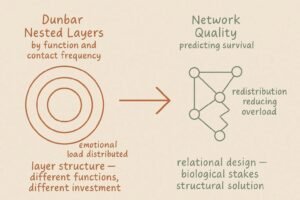
The biological stakes
Julianne Holt-Lunstad, Timothy Smith, and J. Bradley Layton’s meta-analysis, published in PLOS Medicine (2010), establishes that relationship network design is a biological necessity rather than an emotional preference. Analyzing data from 148 studies comprising 308,849 participants, Holt-Lunstad and colleagues showed that individuals with stronger social relationships had a 50% greater likelihood of survival — an effect size comparable to established mortality risk factors including smoking, obesity, and physical inactivity. A further finding is that relationship quality — perceived emotional support, satisfaction with relationships — predicts mortality outcomes more strongly than relationship quantity alone. It is not the number of connections that matters most but the structural quality of how those connections function.
Layer structure as a design tool
Robin Dunbar’s layer maintenance research, from Trends in Cognitive Sciences (2018), provides the practical design framework. Dunbar showed that the 5, 15, 50, and 150 layers of a personal social network each carry distinct emotional functions and require different levels of contact investment to remain viable. The innermost five require weekly contact and carry the heaviest emotional load; the fifteen layer sustains on monthly contact and can carry a broader range of social functions. The design implication is that not every relationship requires the same investment — and that the network functions best when different layers carry different kinds of relational weight. Emotional safety in the five layer, intellectual stimulation and belonging in the fifteen, broader social context in the fifty.
The logic of redistribution
Miller McPherson, Lynn Smith-Lovin, and Matthew Brashears’ research, published in the American Sociological Review (2006), provides both the evidence of contemporary network erosion and the design logic that follows. The proportion of Americans with no trusted confidant more than doubled between 1985 and 2004 — not as a result of individual failures but as the structural outcome of friendships that, lacking institutional support, thin without deliberate investment. The redesign this guide proposes is the conscious redistribution of functions across a wider network: different people in different layers, each carrying what they are suited to carry, none of them asked to be everything.
Why the network matters beyond the individual
Nicholas Christakis and James Fowler’s research on social network contagion, published in the New England Journal of Medicine (2007), adds a further dimension. Analyzing a densely interconnected social network of 12,067 people across 32 years as part of the Framingham Heart Study, Christakis and Fowler found that behaviors and states — including obesity and, in subsequent research published in the *British Medical Journal* (2008), happiness — showed clustering that extended to three degrees of separation. It should be noted that subsequent methodological critiques have raised questions about whether these associations reflect genuine social contagion or shared environmental factors, and the causal interpretation remains debated. What the findings point toward, even under a conservative reading, is that the quality of one’s immediate network has consequences that extend beyond the relationship itself.
Conclusion

The brain evolved for a social structure that contemporary life does not automatically provide. Loss aversion resists redesign, unstructured friendships thin without investment, and concentrated overload exhausts the relationships that remain.
But design is possible. Mapping the functions, distributing the weight, choosing one relationship for deliberate investment — this is what building a village looks like now.
The village didn’t disappear. It just stopped being built automatically. Now it has to be chosen.
KEY TERMS
Social Relationships and Mortality Risk
Julianne Holt-Lunstad, Timothy Smith, and J. Bradley Layton’s finding, published in PLOS Medicine (2010), that stronger social relationships are associated with a 50% greater likelihood of survival across 148 studies and 308,849 participants — an effect comparable to smoking, obesity, and physical inactivity. Relationship quality predicts outcomes more strongly than quantity alone, establishing the biological basis for deliberate network design.
Network Layers as Design Tool
Robin Dunbar’s finding, from Trends in Cognitive Sciences (2018), that the 5, 15, 50, and 150 network layers carry distinct emotional functions and require different contact investment to remain viable. Provides the structural framework for distributing different relational functions across different layers, so that no single relationship is asked to carry what the whole network should hold.
Functional Distribution and Network Erosion
McPherson, Smith-Lovin, and Brashears’ finding, from the American Sociological Review (2006), that the proportion of Americans with no trusted confidant more than doubled between 1985 and 2004 — a structural outcome of friendships that lack institutional support and thin without deliberate maintenance. Provides both the evidence of contemporary erosion and the design logic for redistributing functions across the network so that each relationship carries what it is suited to carry.
Social Network Contagion
Nicholas Christakis and James Fowler’s finding — published in the New England Journal of Medicine (2007) and British Medical Journal (2008) — that behaviors and states including obesity and happiness show clustering extending to three degrees of separation in a longitudinal network of 12,067 people. Subsequent methodological critiques have raised questions about whether associations reflect genuine contagion or shared environmental factors; the causal interpretation remains debated. Under a conservative reading, the findings suggest that the quality of one’s immediate network has consequences that extend beyond the relationship itself.