
Introduction: The Sigh Is Not a Sign of Weakness

There’s an old superstition that sighing brings bad luck — that something escapes with the breath. What the research actually shows is closer to the opposite.
A sigh is the body attempting to reset itself. But an automatic sigh — the kind that happens after the fact, without awareness — captures only part of what the mechanism can do. The same physiological reset, initiated deliberately and at the right moment, produces a measurably different result.
This practice is about taking the mechanism the body already uses — and deciding, in advance, to use it on purpose.
Session 1: Why the Exhale

Breathing is one of the very few physiological systems that operates both automatically and under conscious control. Heart rate, digestion, immune response — these can’t be directly commanded. Breathing can. And because the breath is directly coupled to the autonomic nervous system, conscious changes in breathing produce measurable changes in physiological state.
The specific lever is the length of the exhale relative to the inhale. Inhalation activates the sympathetic nervous system slightly — heart rate rises. Exhalation activates the parasympathetic system — heart rate falls. When the exhale is longer than the inhale, the net effect across a breath cycle tips toward parasympathetic dominance: lower heart rate, reduced muscular tension, a shift in the autonomic balance that the body registers as safety rather than threat.
This is why taking twice as long to exhale as to inhale produces a measurable shift in autonomic state. It’s not a relaxation ritual. It’s a specific physiological input designed to produce a specific output.
Session 2: Three Steps
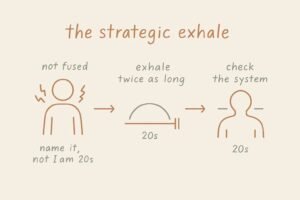
STEP 1: Name what’s happening (20 seconds)
When tension, pressure, or stress is present — notice it without trying to resolve it. There is tension right now. Not I am stressed as an identity, but there is a stress response occurring in this body, right now. This distinction matters: the first fuses you with the state, the second creates just enough distance to act rather than react.
STEP 2: Exhale for twice as long as you inhale (20 seconds)
Inhale quietly through the nose — about two seconds. Then exhale slowly through slightly parted lips — four to six seconds, emptying the lungs fully. The moment at the end of the exhale, when the lungs are empty and the next inhale hasn’t begun yet — stay there briefly. That’s the reset point.
Repeat once or twice if needed.
STEP 3: Check the system after (20 seconds)
After the exhale, take a moment to compare. Where are the shoulders relative to where they were? How does the breath feel now versus before? Has the pace of thought changed at all? The difference — however small — is the body registering a change in state.
Session 3: Why You Forget to Breathe When You Need It Most — and How to Fix That in Advance
Most people know that deep breathing helps with stress. Fewer people do it consistently when stress actually arrives. Understanding why — and what to do about it — is more useful than another reminder to breathe.
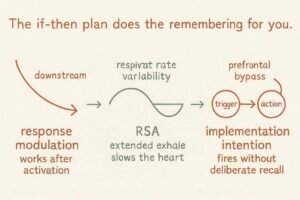
Psychologist James Gross’s process model of emotion regulation maps out the stages at which different strategies intervene. Situation selection — leaving a stressful environment. Attentional deployment — focusing on something else. Cognitive reappraisal — reframing what the situation means. These are upstream strategies: they work best before an emotional response has fully activated. The strategic sigh is a downstream strategy — specifically, response modulation: intervening directly on the physiological response after it has already begun. This distinction matters practically. Cognitive reappraisal requires cognitive resources, which are exactly what stress degrades. Response modulation works on the body directly, which is why it remains available when thinking clearly isn’t easy.
The physiological mechanism is respiratory sinus arrhythmia (RSA) — the natural variation in heart rate that tracks the breath cycle. A healthy heart beats slightly faster during inhalation and slightly slower during exhalation, reflecting the continuous influence of the vagus nerve on cardiac pacing. Deliberately extending the exhale amplifies this variation: the heart rate slows more during the longer exhalation, the vagal signal is stronger, and the autonomic balance shifts accordingly. RSA amplitude — the size of this heart rate variation — correlates positively with emotion regulation capacity, and intentional extended exhalation has been shown to improve this measure in real time. This is not a vague relaxation effect, but a specific input to a specific physiological mechanism. The body performs this same reset automatically through the spontaneous sigh — the breath pattern it runs without being asked under conditions of respiratory stress. This practice is about triggering the same mechanism consciously, on demand.
The remaining question is why this is hard to remember to do when it’s most needed. Under acute stress, prefrontal cortex function is impaired — the very system responsible for retrieving and executing planned responses becomes less available exactly when planned responses are most needed. This is where implementation intentions offer a practical solution. Psychologist Peter Gollwitzer’s research shows that forming a specific if-then plan — if situation X occurs, then I will do Y — produces significantly higher follow-through rates than simply intending to do Y. The critical feature is the specificity of the condition: linking a particular trigger to a particular action creates a contingency that fires more automatically when the trigger appears, with less need for deliberate prefrontal initiation. If I feel tension before a meeting, I will exhale once for six seconds is a more effective plan than I will remember to breathe when I’m stressed — not because the action is different, but because the if-then structure partially automates the retrieval.
Conclusion: Set It Before You Need It

Once today — not the sigh itself, but the plan. Choose one specific situation where tension tends to arrive. Attach one specific action to it: one exhale, twice as long as the inhale. When the situation arrives, the decision will already have been made — and the prefrontal cortex won’t need to find it under pressure.
The exhale was always available. You just hadn’t decided in advance to use it.
KEY TERMS
Process Model of Emotion Regulation
James Gross’s framework categorizing emotion regulation strategies by the stage of the emotional response they target. Upstream strategies — situation selection, attentional deployment, cognitive reappraisal — intervene before the response fully activates. Downstream strategies, including response modulation, intervene after activation. The strategic sigh is response modulation: it works on the body directly, without requiring cognitive resources that stress has already degraded.
Respiratory Sinus Arrhythmia (RSA)
The natural variation in heart rate across the breath cycle — slightly faster during inhalation, slightly slower during exhalation — reflecting vagal influence on cardiac pacing. Intentionally extending the exhale amplifies this variation, strengthening the vagal signal and shifting autonomic balance toward parasympathetic dominance. RSA amplitude correlates with emotion regulation capacity. The body performs a version of this mechanism automatically through the spontaneous sigh — this practice is its conscious, on-demand equivalent.
Implementation Intention
The if-then planning format — if situation X, then action Y — that produces significantly higher follow-through rates than simple behavioral intentions. Developed by psychologist Peter Gollwitzer. Effective under stress because the specificity of the trigger-action link partially automates retrieval, reducing dependence on prefrontal initiation at the moment it’s most impaired. The design principle behind this practice’s instruction to choose a specific condition in advance.
Response Modulation
The category of emotion regulation strategy that intervenes directly on physiological and behavioral responses after they have already activated — as opposed to upstream strategies that prevent or redirect the response before it occurs. More immediately effective under conditions of acute stress, when cognitive reappraisal is resource-constrained.
Defusion
A core skill in Acceptance and Commitment Therapy (ACT): the capacity to observe thoughts and impulses as passing mental events rather than accurate assessments. When this won’t actually help arrives during the exhale, recognizing it as a thought that stress generated — rather than an evaluation to be trusted — and returning attention to the physical sensation of the breath emptying is defusion applied at the moment of highest resistance.