
Introduction: That Sigh Knows What It’s Doing

It escapes before you notice it — a quiet haaa that you didn’t plan and probably didn’t want. We tend to read it as defeat. A sign of exhaustion, frustration, or losing ground.
It isn’t. It’s the body running a repair sequence it knows by heart.
Today’s practice takes that involuntary moment and makes it conscious. One breath. Thirty seconds. The sigh was already doing the work. This practice is simply the decision to be present for it — and to run it once more, deliberately, on your own terms.
Session 1: What a Sigh Actually Is

When stress or sustained focus compresses the breath, something happens at the far reaches of the lungs: the alveoli — the tiny air sacs responsible for oxygen exchange — begin to collapse. Slowly, incrementally, with each shallow breath that doesn’t quite fill them. Gas exchange efficiency drops. Carbon dioxide accumulates.
The body’s response is automatic and precise: a sigh. A deep inhale followed by a long, slow exhale that reinflates the collapsed alveoli and clears the accumulated CO₂. The brainstem initiates it without consulting the conscious mind. It runs this program every five to ten minutes, whether you notice or not.
A sigh is not a sign of weakness. It’s a sign that the system is working. The body doesn’t wait for permission — it reads the internal conditions and acts. The only thing this practice adds is awareness: catching the repair as it runs, and choosing to run it once more.
Session 2: Making the Unconscious Conscious
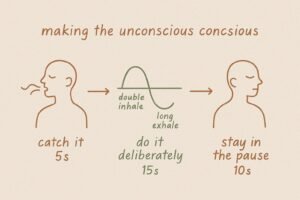
STEP 1: Catch it (5 seconds)
The moment a sigh escapes — notice it. Not as a failure, not as a symptom. Just: the body just ran its reset. That recognition is the whole of this step. Nothing needs to change yet. Just register what happened.
STEP 2: Do it again, deliberately (15 seconds)
This time, initiate the sigh yourself.
Inhale through the nose — full, unhurried. At the top of the inhale, take one small extra sip of air. Then open the mouth slightly and let the exhale go: long, slow, complete. Don’t push it. Just let it empty.
Initiating a sigh on purpose may feel slightly artificial the first time — less like a release and more like a performance. That’s expected. The physiological effect doesn’t depend on the feeling of spontaneity. The double inhale reinflates the alveoli regardless of whether it arrived on its own. The long exhale resets the nervous system either way.
Feel the chest and shoulders release as the breath leaves. Both halves of the breath matter — the sip at the top and the length of the exhale are doing different things, and both are necessary.
STEP 3: Stay in the pause (10 seconds)
When the exhale is complete, don’t rush the next breath. Rest in the empty moment — the body quiet, the lungs light. Notice what arrives before the next inhale begins.
Session 3: What the Body Already Knew Before the Breath Was Conscious
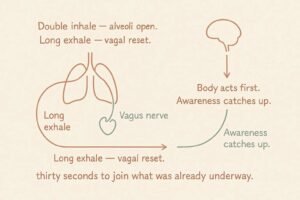
The mechanism behind this practice was identified by researchers at Stanford, who described what they called the physiological sigh — a hardwired respiratory reflex essential for maintaining lung function and regulating the nervous system.
The defining feature of the physiological sigh is the double inhale: a normal inhalation followed immediately by a short secondary inhale. This two-stage inflation is what collapsed alveoli require — a single breath doesn’t generate enough pressure to reinflate them, but the added volume of the second inhale does. The extended exhale that follows clears the accumulated CO₂ and restores blood gas balance. This sequence runs automatically every five to ten minutes and represents the body’s most efficient single-breath nervous system reset.
What makes the exhale neurologically significant is its direct effect on cardiac function and the parasympathetic pathway. During exhalation, the volume of blood returning to the right atrium of the heart changes in a way that the vagus nerve detects and responds to — triggering a measurable shift toward parasympathetic dominance. This is the precise mechanism behind the physical release felt after a long exhale: the sympathetic activation that created the tension is directly countered by the vagal response the exhale produces. The instruction to let the exhale go long and complete is not a relaxation metaphor. It is a physiological one.
There is a further dimension worth noting. The sigh arrives before awareness does. The brainstem has already assessed the internal conditions, initiated the response, and begun the repair — all before the conscious mind has registered that anything was happening. What this practice adds is not the repair itself, but the recognition of it: catching the body mid-sequence, joining what’s already underway, and choosing to extend it by one deliberate repetition. The body’s intelligence precedes the decision to use it. The thirty seconds this practice takes is simply the interval in which awareness catches up to what the system was already doing.
Conclusion: The Repair Was Already Running

This practice doesn’t ask for a technique or a training period. It asks for the moment after the sigh — the recognition that something just happened, and the willingness to do it once more with full attention. That’s the entire requirement. The body has been running this sequence since before you knew it had a name. The awareness is the only thing that’s new.
The repair was already running. The thirty seconds was just the moment you joined it.
KEY TERMS
Physiological Sigh
A hardwired respiratory reflex consisting of a double inhale followed by an extended exhale, identified by researchers at Stanford. Designed to reinflate collapsed alveoli and restore blood gas balance. Runs automatically every five to ten minutes during waking hours. The deliberate version in STEP 2 replicates this reflex with full awareness — same mechanism, same physiological effect, initiated consciously rather than automatically.
Alveoli
The tiny air sacs at the far reaches of the lungs where oxygen and CO₂ are exchanged with the bloodstream. Partially collapse during sustained shallow breathing, reducing gas exchange efficiency. Reinflated by the double inhale of the physiological sigh — the added pressure of the secondary inhale reaches what a single breath cannot.
Vagus Nerve
The primary pathway of the parasympathetic nervous system, running from the brainstem through the chest and abdomen. Detects changes in blood return to the heart during exhalation and responds by shifting the autonomic nervous system toward parasympathetic dominance. The neurological basis for the physical release felt after a long, complete exhale — and the reason the length of the exhale matters as much as the depth of the inhale.
Double Inhale
The defining structural feature of the physiological sigh: a full inhale followed immediately by a short secondary inhale. The combined volume generates sufficient pressure to reinflate alveoli that have partially collapsed during shallow breathing — something a single full breath typically cannot accomplish. Reproduced deliberately in STEP 2’s instruction to take a small extra sip of air at the top of the inhale.
Ānāpānasati
A foundational breath-awareness practice in the Theravāda Buddhist tradition. Its earliest described stage involves recognizing what the body is already doing with the breath — knowing a long breath as long, a short breath as short — before any attempt to refine or direct it. This guide operates at that same threshold: the sigh arrives before awareness does, and the practice begins at the moment of recognition. Catching the body mid-repair is itself the entry point.
Defusion
A core skill in Acceptance and Commitment Therapy (ACT). The capacity to observe thoughts as passing mental events rather than facts requiring immediate response. When the thought *this sigh means I’m failing* arrives, noticing it — “there’s that judgment” — without acting on it, and returning attention to the breath and the reset it carries, is defusion in its most immediate and physical form. The thought is present. The repair is also present. Both can be true at once.