
Introduction: The Reply You’ll Regret Is Already Being Written

The name appears in the inbox and something tightens. You read the message and the irritation arrives — sharp, immediate, entirely convincing. And then, because the keyboard is right there, you start typing.
The email that follows is technically a response. But it’s really a reflex. And the cost of that reflex — in damaged relationships, in follow-up messages walking things back, in the slow erosion of how you’re read by people who matter — tends to be invisible until it isn’t.
The few seconds between reading and replying are the most consequential moment in professional communication. Today’s practice is about what to do with them.
Session 1: Why the Gap Matters

When a message reads as threatening — critical, dismissive, unreasonable — the amygdala responds before the prefrontal cortex has finished evaluating what the message actually means. The body prepares for defense. The fingers move toward the keyboard. The reply that emerges reflects the amygdala’s assessment, not a considered one.
The prefrontal cortex can intervene in this sequence, but not instantly. The circuit that allows higher cognition to modulate the amygdala’s reactivity requires time to engage — on the order of tens of seconds. Three deliberate breaths create that time. They also actively support the shift: slow exhalation stimulates the vagus nerve, parasympathetic activation begins, and the physiological conditions for prefrontal re-engagement improve.
The three breaths don’t suppress the emotion. They create the window in which a response becomes possible.
Session 2: Three Breaths Before the Reply
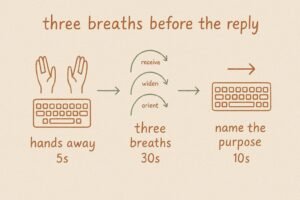
STEP 1: Move your hands away from the keyboard (5 seconds)
Physical distance first. Push back slightly from the desk, or simply place the hands in the lap. Internally: three breaths before I respond. The declaration itself is part of the intervention — it brings the prefrontal cortex online before the breathing begins.
STEP 2: Three intentional breaths (30 seconds)
Each breath carries a direction.
First breath: receive the emotion as it is. Inhale and let the feeling be there — don’t analyze it, don’t push it away. Exhale and release the urgency to act on it immediately.
Second breath: widen the frame. Inhale and create space around the situation. Exhale and ask, without pressure: what is actually being asked of me here?
Third breath: orient toward the other person. Inhale and consider what might be driving their message — pressure, miscommunication, a bad day. Exhale and ask: what response would actually be useful?
STEP 3: Name the purpose of the reply (10 seconds)
Before returning to the keyboard: what is the one thing this reply needs to accomplish? Not what it needs to express — what it needs to accomplish. The distinction tends to change what gets written.
Session 3: Why the Reply Sent Thirty Seconds Later Is a Different Reply
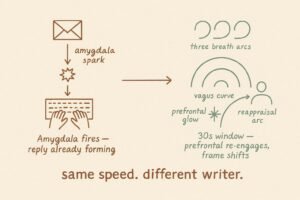
The amygdala’s threat-detection response operates on a millisecond timescale. When an incoming message is flagged as socially threatening — criticism, dismissal, an implied accusation — the amygdala activates before conscious evaluation is complete. This is the mechanism behind the experience of knowing you should wait and typing anyway: the preparatory response has already begun.
Prefrontal modulation of this response — what emotion researcher James Gross calls cognitive emotion regulation — is real and effective, but it isn’t instantaneous. Gross’s research on the timing of emotion regulation strategies shows that prefrontal re-engagement with an emotionally activated state requires a processing window of roughly thirty to forty seconds to become meaningfully effective. Within that window, the prefrontal cortex can recontextualize the amygdala’s initial assessment: is this message actually an attack, or is it someone under pressure communicating badly? Outside that window — with the reply already sent — the recontextualization comes too late.
Three deliberate breaths span approximately that window. They also actively support the neurological shift: slow exhalation stimulates the vagus nerve, parasympathetic activation counteracts the sympathetic arousal the amygdala initiated, and the physiological conditions for sustained prefrontal engagement improve. The breath is both a timer and an intervention.
Giving each breath a specific cognitive direction draws on what Gross identified as reappraisal — the most prefrontally demanding and cognitively effective emotion regulation strategy. Reappraisal involves actively reconsidering the meaning of the situation generating the emotion, rather than suppressing or venting the emotion itself. The third breath’s orientation toward the other person’s perspective is reappraisal in its most practical form: what is driving this message? shifts the frame from threat to context, and the reply that follows tends to reflect that shift.
The reply sent three breaths later is, objectively, sent at nearly the same time. What changes isn’t the speed. It’s who’s writing it.
Conclusion: The Keyboard Will Still Be There

The emotion doesn’t need to disappear. Feeling the irritation while choosing how to respond to it — that’s the whole practice. Every difficult email is the same invitation: hands off the keyboard, three breaths, then back. The reflex was always going to fire. The three seconds are what make it optional.
The reply can wait thirty seconds. What those thirty seconds do to the reply cannot be undone.
KEY TERMS
Cognitive Emotion Regulation
The prefrontal cortex’s modulation of the amygdala’s automatic emotional response. Not instantaneous — requires a processing window of roughly thirty to forty seconds to engage effectively. The three-breath pause is a deliberate creation of that window.
Reappraisal
James Gross’s term for the emotion regulation strategy of actively reconsidering the meaning of a situation generating an emotional response. More prefrontally demanding than suppression, and more effective over time. The third breath’s orientation toward the other person’s perspective — what is driving this message? — is reappraisal applied to professional communication.
Processing Window
The interval between emotional activation and prefrontal re-engagement during which cognitive emotion regulation becomes effective. Approximately thirty to forty seconds. The period during which the amygdala’s initial assessment can be recontextualized before a response is committed to.
Prefrontal-Amygdala Circuit
The primary neural pathway for emotion regulation. The amygdala flags social threats on a millisecond timescale; the prefrontal cortex recontextualizes and modulates that response on a seconds-to-minutes timescale. The mismatch in speed is what makes the deliberate pause necessary.
Vagus Nerve
The body’s primary parasympathetic pathway, running from the brainstem through the heart, lungs, and abdomen. Deliberate exhalation stimulates vagal tone, counteracting sympathetic arousal and supporting the physiological shift from threat-response mode to the calmer state in which prefrontal re-engagement becomes possible.
Defusion
A core skill in Acceptance and Commitment Therapy (ACT): the capacity to observe thoughts, emotions, and urges as passing mental events rather than commands requiring immediate action. When this person is impossible arrives as a conviction rather than a thought, noticing it as a thought — and returning to the breath — is defusion applied to the specific pressure of reactive communication.