
Introduction: Is the Noise the Problem, or the Judgment?

The keyboard clatter from across the room. A nearby conversation you’re not part of. The photocopier cycling through its rhythm.
But what exactly is generating the irritation? The physical properties of the sound? Or the evaluation — this sound is in my way?
In most cases, the stress is produced not by the decibels but by the assessment. Today’s practice intervenes directly in that assessment.
Session 1: Why the Same Office Sounds Louder on Hard Days
The brain does not receive sound passively. It processes sound against a continuously updated predictive model — building expectations from patterns, then comparing each new input against what was anticipated. Sounds that match the prediction fade into background. Sounds that deviate from it attract automatic attention, and the amygdala evaluates them for relevance and threat.
Under stress or fatigue, this evaluation system becomes sensitized. Sounds that would normally be filtered through arrive in full force. A colleague’s sudden voice, an irregular mechanical noise — each is processed as a deviation from prediction and assessed for urgency before conscious perception has fully formed. The office has not gotten louder. The evaluation circuit has changed state.
Session 2: The Three-Step Listening Practice
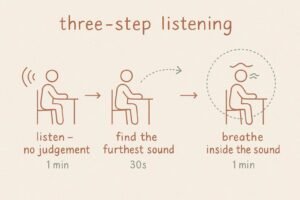
No preparation needed. This works at the desk, right now.
STEP 1: Listen without judging (1 minute)
Close your eyes gently and let all the sounds in the room simply arrive. Don’t sort them or resist any of them. Instead, get curious about their physical properties: Is the keyboard sound high-pitched or low? Does the air conditioning have a rhythm? Can you hear nearby voices as pure sound — tone, cadence, texture — rather than as words carrying meaning? Observe the acoustic environment the way a scientist would observe data.
STEP 2: Find the furthest sound (30 seconds)
Shift attention deliberately toward the most distant sound you can detect. What is beyond this room? Down the corridor? On another floor? Outside the building?
This intentional redirection moves focus away from the reactive foreground and outward, into a wider, more neutral acoustic field.
STEP 3: Breathe inside the sound (1 minute)
Let all the sounds exist simultaneously — not as intrusions, but as the environment you’re sitting inside. And within that environment, find the breath.
Not to block the noise out. To locate yourself within it. The sounds continue. You remain.
Session 3: The Predictive Brain and the Sound It Cannot Ignore
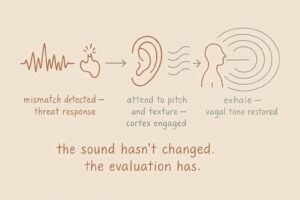
Karolinska Institute researcher Arne Öhman’s work established that the amygdala evaluates threat-relevant stimuli automatically — before conscious perception has fully formed. This is an evolutionarily designed defense mechanism, built for rapid detection of danger. In a modern office, the same system partially activates in response to a colleague’s sudden voice, an irregular mechanical noise, the unexpected sound that breaks the acoustic pattern. The judgment this is in my way is not consciously decided. It is generated by the amygdala before the deliberate mind has been consulted. The sound itself is not the source of the stress response. The automatic evaluation is.
What determines which sounds get evaluated as threatening — and how strongly — connects to the brain’s predictive processing of the auditory environment. Finnish psychologist Risto Näätänen’s research established what became known as the mismatch negativity (MMN): a measurable brain response that occurs automatically whenever an incoming sound deviates from the pattern the auditory cortex has built as a predictive model. The brain continuously compares new auditory input against a memory trace of what has been occurring, and when a discrepancy is detected, attention is involuntarily redirected toward it. The “annoying sound” is not necessarily louder than its surroundings. It is more discrepant from the prediction. Under stress and fatigue, this mismatch detection system becomes hypersensitized — sounds that would normally be absorbed into the background register instead as prediction errors requiring evaluation. The office has not changed. The threshold for what counts as a mismatch has lowered.
Attending to sound as pure acoustic data — pitch, rhythm, texture, without classification as a problem — redirects processing away from the amygdala’s threat-evaluation pathway and toward the neutral analysis of the auditory cortex. The sound is no longer categorized as interference; it is received as sensory information. Deliberately shifting attention to a distant sound activates intentional attentional direction, moving focus out of the reactive zone and into a broader acoustic field that the mismatch detection system is not currently primed to flag. From there, a slow conscious exhale — extending the out-breath — stimulates vagal tone directly, reducing the amygdala arousal that Öhman described. The sound has not changed. The evaluation has — and with it, the entire character of the acoustic environment.
Conclusion

The goal is not silence. It is a different relationship with sound — one where the background conversation and the keyboard clatter are no longer processed as interference, but simply as features of the environment being worked in.
The sound was never the problem. It was always just sound. The friction was the evaluation that arrived first.
KEY TERMS
Mismatch Negativity (MMN)
The electrophysiological brain response established by Risto Näätänen and colleagues — an automatic neural signal generated whenever an incoming sound deviates from the predictive model the auditory cortex has built from prior input. Sounds that match prediction fade into background; sounds that deviate from it attract involuntary attention. The “annoying sound” is usually more discrepant from expectation than it is louder than its surroundings.
Automatic Threat Evaluation
The process identified by Arne Öhman in which the amygdala assesses the relevance and threat-status of stimuli before conscious perception is complete. An evolutionarily adaptive mechanism for rapid threat detection that, in modern office settings, can generate low-grade stress responses to sounds that are merely unexpected rather than dangerous.
Sensory Gating
The brain’s built-in mechanism for suppressing repetitive, low-priority sensory input — effectively closing a gate on stimuli assessed as non-essential. When functioning well, background noise fades from conscious awareness within minutes. Under stress or fatigue, sensory gating degrades: the gate stays open, and sounds that would normally be filtered through arrive in full force.
Auditory Cortex
The temporal lobe region responsible for analyzing the physical properties of sound — pitch, rhythm, volume, duration. Non-evaluative listening engages this region’s neutral processing, and by attending to acoustic properties rather than meaning, the pathway to the amygdala’s threat-evaluation system is relatively bypassed.
Vagus Nerve
The primary parasympathetic pathway, running from the brainstem through the heart, lungs, and abdomen. Deliberate, extended exhalation stimulates vagal tone, directly reducing amygdala arousal and shifting autonomic nervous system state away from threat-response mode — the physiological basis for why the breath is the most accessible exit from the evaluation cycle.