
Introduction: That Flash of Irritation Has a Use

A single line in an email. A comment that lands wrong. Suddenly there’s heat in the chest, and a response is already being composed — one that will probably be regretted.
There is no need to eliminate irritation. It cannot be eliminated. But between this feeling and the next action, three seconds of space can be created.
In those three seconds, the circuit changes.
Session 1: The Reactive Response Is Not a Moral Failure

A difficult message, an unexpected criticism, a situation that feels unfair — in response to these, the brain reacts before it evaluates.
This is a design issue. The circuits responsible for automatic emotional response move faster than the prefrontal cortex, which handles deliberate evaluation and judgment. The experience of sending a reply and already regretting it is not weakness. It is the result of one circuit finishing before the other has caught up.
This practice is not designed to eliminate irritation. It is designed to create three seconds between the automatic response and the action. The choice lives in that gap.
Session 2: The Three-Second Centering Practice
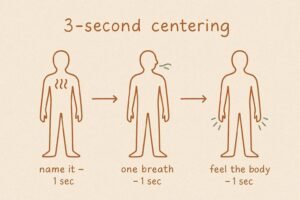
No seat required. No closed eyes. When the alarm fires, try this — right where you are.
STEP 1: Name it (1 second)
The heat in the chest, the tightening, the pressure rising — notice it, and inwardly acknowledge:
There’s irritation.
No judgment. No story about whether it should be there. Just recognition — the way a weather forecaster notes an approaching system without taking it personally. A small distance opens between the feeling and the self.
STEP 2: One breath (1 second)
Immediately after naming it, one conscious breath. Inhale through the nose, exhale slowly through the mouth.
That single breath is enough.
STEP 3: Feel the ground (1 second)
In the final second, bring attention to the body.
The weight of the feet on the floor. The warmth of the hands. The contact of the body with the chair.
The attention that was occupied by the internal storm returns to present-moment physical reality.
Session 3: What the Three Seconds Are Actually Doing
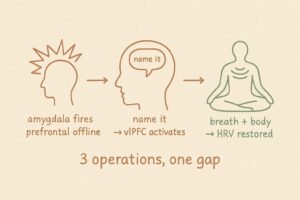
Yale neuroscientist Amy Arnsten’s research established that under stress, catecholamine release in the prefrontal cortex directly weakens its network connections, shifting behavioral control from thoughtful top-down regulation to faster, reflexive subcortical circuits. The amygdala’s threat response moves faster than the prefrontal cortex’s deliberate evaluation — which is why the reply gets sent before the decision to send it has been consciously made. The reactive response is not a character flaw or a failure of self-control. It is a structural outcome of a speed difference between two circuits operating on different timescales.
The first intervention into that speed difference is naming the emotion. Jared Torre and Matthew Lieberman’s review in Emotion Review (2018) synthesized research showing that putting a feeling into words — even silently, even in a single phrase — functions as implicit emotion regulation: a process that attenuates emotional experience without requiring conscious effort or intent. The neural mechanism involves increased activation of the ventrolateral prefrontal cortex and decreased amygdala activity. No deliberate attempt at control is required. The act of labeling is sufficient to begin shifting the circuit relationship between the emotional signal and the behavioral response.
Breath and bodily attention consolidate this shift physiologically. Julian Thayer and Richard Lane’s neurovisceral integration model proposes that heart rate variability — the variation in time between heartbeats — reflects the functional flexibility of the connection between the prefrontal cortex and the autonomic nervous system. Higher HRV is associated with greater capacity to recover from emotional reactivity; deliberate breathing and interoceptive attention improve HRV and restore prefrontal regulatory function. The three steps work as a chain: Arnsten’s speed difference establishes why the reactive response happens before the choice is made; Torre and Lieberman’s affect labeling provides the cognitive interruption; Thayer and Lane’s model explains why the breath and the body are not metaphors for calm but direct physiological interventions into the circuit that makes calm structurally possible.
Conclusion

Three seconds is short enough to use anywhere — mid-meeting, at the desk, in a conversation starting to go sideways. No one needs to know.
The measure of success is not whether the irritation disappears. It is whether it was noticed, whether one breath was taken, whether the ground was felt. That is the complete practice.
The irritation was never a character flaw. It was a speed difference between two circuits. Three seconds was the smallest possible interruption.
KEY TERMS
Affect Labeling
The practice of putting emotional experience into words. Torre and Lieberman’s 2018 review synthesized neuroimaging and behavioral research showing that naming an emotion — even silently — activates the ventrolateral prefrontal cortex and reduces amygdala activity. Classified as implicit emotion regulation: the regulatory effect occurs without conscious intent or effort.
Neurovisceral Integration Model
Developed by Julian Thayer and Richard Lane. Proposes that heart rate variability reflects the functional flexibility of the connection between the prefrontal cortex and the autonomic nervous system — the degree to which the prefrontal cortex can regulate emotional and physiological reactivity. Higher HRV is associated with greater resilience to emotional stress. Deliberate breathing and interoceptive attention improve HRV and restore this prefrontal-autonomic connection.
Heart Rate Variability (HRV)
The variation in time between heartbeats — an index of autonomic nervous system flexibility and prefrontal regulatory capacity. In the context of this practice, increased HRV is the physiological correlate of the gap between impulse and action that the three steps are designed to create.
Prefrontal Cortex
The brain region responsible for deliberate judgment, emotional regulation, and behavioral control. Arnsten’s research established that stress-induced catecholamine release directly weakens prefrontal network connections, shifting control to faster, reflexive subcortical circuits. Affect labeling and breath-focused attention work to restore this prefrontal function.
Implicit Emotion Regulation
A concept formalized by Torre and Lieberman. Emotion regulation that occurs without conscious effort or the subjective experience of regulating — in contrast to deliberate strategies like reappraisal. Affect labeling is its clearest example: the neural and physiological effects occur whether or not the person intends them to.