
Introduction: The Body Moved. The Mind Didn’t

Back-to-back meetings. One tab closed, another opened. But something carries over — the unresolved comment, the tension that didn’t land anywhere, the question that got deferred.
The body moves easily between rooms. The mind follows more slowly, and often incompletely.
What happens in the gap between meetings — those few minutes, or even seconds — determines the quality of what comes next.
Session 1: Why the Last Meeting Is Still Running

The brain is not designed to switch cleanly between tasks. Whatever occupied working memory in the previous meeting continues to occupy it — the unresolved threads, the emotional texture of the exchange, the things left unsaid.
Emotionally charged content compounds this. A tense exchange or an unexpected challenge doesn’t simply end when the meeting does. The brain actively works to retain experiences it has assessed as significant. The feeling that a difficult conversation is still present an hour later is not weakness. It is the nervous system doing exactly what it was built to do.
Understanding this changes how the transition is approached — not as a willpower problem, but as a neurological one with a practical solution.
Session 2: Three Ways to Reset in Under Two Minutes
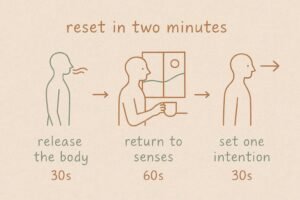
None of these require privacy, equipment, or explanation to anyone around you.
STEP 1: Release the body (30 seconds)
Before moving anywhere, change the physical state. Straighten the spine — not rigidly, but with intention. Roll the shoulders back once. Feel the floor under the feet.
One full breath: inhale slowly, exhale with a deliberate release of tension.
The body and nervous system are not separate systems. Shifting one shifts the other.
STEP 2: Return to the present through sensation (60 seconds)
Use present-moment sensory input to displace what’s still running. Look at something real — the color of the sky, the green of a plant, the grain of a surface. Feel the temperature of a door handle, a coffee cup, the fabric of a sleeve. Hear the sounds around you without labeling them.
This is not distraction. It is a deliberate redirect of cognitive resources toward present-moment processing — which interrupts the residual content still running in working memory.
STEP 3: Set one intention
Before entering the next meeting, ask one quiet question:
What is my primary role here? How do I want to show up?
No elaboration needed. One clear direction is enough.
Session 3: Why the Previous Meeting Is Still in the Room
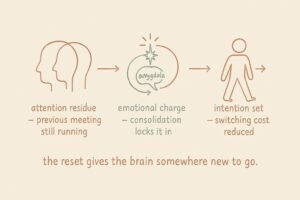
Sophie Leroy’s research, published in Organization Science (2009), identified attention residue — the phenomenon in which cognitive resources remain partly allocated to a previous task even after attention has nominally shifted to a new one. When a meeting ends with unresolved threads, or with the sense that something was left incomplete, working memory continues processing those threads in the background. Switching to the next meeting doesn’t close that process. It runs alongside it. The difficulty concentrating in a second meeting is often not a failure of attention — it is the first meeting still running, competing for the same limited cognitive capacity.
Emotionally significant content makes attention residue harder to release. James McGaugh at UC Irvine, reviewing decades of research in the Annual Review of Neuroscience (2004), established that emotional arousal triggers the release of adrenal stress hormones, which in turn activate norepinephrine release in the basolateral amygdala, actively strengthening the consolidation of the associated memory. The more emotionally charged the meeting — conflict, pressure, surprise — the more actively the brain works to retain it. This is the mechanism behind the experience of a tense exchange from an hour ago feeling more present than something neutral that happened five minutes ago. Willpower alone cannot override a consolidation process the nervous system has already initiated.
Rubinstein, Meyer, and Evans, publishing in the Journal of Experimental Psychology (2001), identified two stages in task switching: goal shifting — deciding to engage with a new task — and rule activation — mentally preparing the cognitive resources that task requires. Their experiments showed that switching costs are measurably reduced when the upcoming task is explicitly cued in advance. The sensory practice in Step 2 interrupts the emotional memory’s hold by redirecting cognitive resources away from residual content — not through suppression, but through competition for working memory capacity. The intention-setting in Step 3 executes the goal-shifting stage that Rubinstein’s research identified as the key leverage point in reducing switching cost: entering the next context with a clear direction already set, rather than arriving without one and waiting for the situation to orient the brain. The reset is not about creating emptiness. It is about giving the brain somewhere new to go.
Conclusion

The reset doesn’t need to be complete. It needs to exist. Even ten seconds — one breath, one moment of feeling the ground — interrupts the automatic carry-over.
The previous meeting had its time. The next one deserves full presence.
The meeting was over. The brain hadn’t registered it yet. The reset was the smallest possible way of passing that information along.
KEY TERMS
Attention Residue
Identified by Sophie Leroy (Organization Science, 2009). When a task ends with unresolved threads or incomplete closure, cognitive resources remain partly allocated to it even after attention has shifted. Back-to-back meetings without transition time create cumulative attention residue — each meeting carrying the unprocessed weight of the previous one.
Emotional Memory Enhancement
The mechanism identified by James McGaugh (Annual Review of Neuroscience, 2004) in which emotional arousal triggers stress hormone release that activates norepinephrine in the basolateral amygdala, actively strengthening memory consolidation. The more emotionally significant the meeting, the more actively the brain works to retain it — which is why difficult meetings are harder to leave behind.
Task Switching Cost
The measurable performance degradation identified by Rubinstein, Meyer, and Evans (Journal of Experimental Psychology, 2001) when shifting between tasks without preparation. Increases with task complexity; reduced significantly by advance cueing about the upcoming task — which is the neurological basis for intention-setting before a meeting.
Goal Shifting
The first of two stages in task switching identified by Rubinstein and colleagues — the executive decision to engage with a new task rather than the previous one. Intention-setting before a meeting executes this stage in advance, reducing the cognitive overhead of the transition itself.
Working Memory
The brain’s active processing workspace — where information is temporarily held and manipulated during ongoing cognition. Limited in capacity. When occupied by attention residue from a previous meeting, less is available for the current one.