
Introduction: It’s Different Every Time. You Just Haven’t Been There to Notice

Making coffee. Steeping tea. Filling a cup with hot water before anything else happens in the morning.
This takes maybe thirty seconds. It happens multiple times a day. And from the moment the water starts moving to the moment it stops, nothing about it stays the same — the sound shifts, the steam moves, the kettle gets lighter, the surface rises.
Most of the time, this all happens while attention is somewhere else entirely. The sensory event completes itself without a witness. Today’s practice is just about being in the room when it happens.
Session 1: Why This Particular Moment

Pouring hot water isn’t a static event. It’s a continuous sensory sequence — one that changes from beginning to end and never repeats in exactly the same way.
As water fills a container, the sound changes pitch. This happens because the resonant frequency of the vessel shifts as the air column inside shortens — a physical process the auditory system tracks automatically, without being asked. At the same time, steam rises and carries volatile compounds to olfactory receptors. Radiant heat reaches the skin. The weight in the hand decreases, continuously, until the pour is done.
These aren’t separate events happening in sequence. They’re simultaneous, interwoven, and all moving in the same direction: toward completion.
The reason none of this registers is straightforward. When attention is already on what comes next — the meeting, the inbox, whatever the morning holds — the sensory event runs entirely in the background. The brain processes it, acts on it, and discards it without forwarding anything to awareness.
This practice is the decision to catch it before it disappears.
Session 2: The Pour — Three Steps
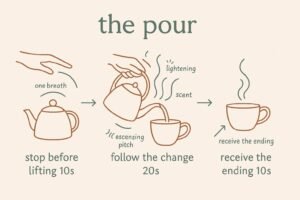
STEP 1: Stop before lifting (10 seconds)
Before picking up the kettle, pause. One breath. A light internal shift: I’m going to follow this from start to finish. Nothing more elaborate than that.
STEP 2: Follow the change (20 seconds)
As the water moves, stay with what’s shifting.
Sound — the pitch dropping as the cup fills, the rhythm of the pour, the particular sound of this water in this vessel today
Vision — steam rising and moving, the surface climbing, light changing as the angle of the water shifts
Smell — whatever the heat is releasing: coffee, tea, or just the clean smell of hot water itself
Touch — the kettle becoming lighter in the hand, warmth radiating outward, the slight resistance of controlling the flow
Not one at a time. All of it, moving together.
If “just finish it” shows up as a thought, notice it as a thought, and come back to the sound.
STEP 3: Receive the ending (10 seconds)
When the pour stops — actually stop with it. The sound disappears. The steam steadies. The surface settles. Set the kettle down and feel the weight leave the hand.
Something that was changing has completed. Let that register before moving on.
Session 3: What the Brain Is Tracking When You Hear a Pour
As liquid fills a container, the air column above it shortens, raising the resonant frequency’s lower bound and shifting the dominant pitch of the sound downward. The auditory cortex doesn’t just register discrete sounds — it tracks the trajectory of change, processing how pitch, intensity, and rhythm evolve across time. This capacity, auditory temporal processing, is what allows the brain to follow not just what a sound is, but where it’s going.
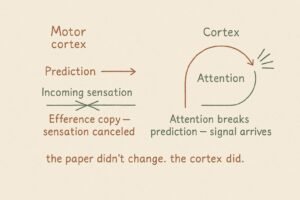
What makes this neurologically interesting is that the auditory cortex runs predictive models alongside its real-time processing. Based on prior experience with similar pours, it generates an expectation of how the pitch trajectory will unfold. When the prediction holds, the signal is treated as expected and deprioritized. When attention is directed toward the change deliberately, the predictive process itself becomes the object of awareness. The trajectory that was running silently in the background comes forward.
Simultaneously, a separate sensory pathway activates. Unlike every other sense, olfaction bypasses the thalamus entirely, routing directly to the olfactory cortex and amygdala. This is why the smell of coffee or tea can shift mood within seconds of the first steam — the signal reaches emotional processing centers before it reaches conscious identification. The pitch tracking of the auditory cortex and the direct emotional routing of olfaction are running in parallel during the same thirty seconds, through entirely different neural architectures.
When the pour ends, something quieter engages. Sound stops. Motion stops. What was continuously changing arrives at stillness. The insular cortex, which integrates interoceptive signals with moment-to-moment awareness, is particularly active during exactly this kind of transition: the shift from dynamic sensory input to its absence. Receiving that completion — not moving on immediately, but actually registering the ending — is its own distinct perceptual act, and one the insular cortex is specifically positioned to support.
Conclusion: Every Pour, Once

Once today. Whatever cup, whatever reason. Lift, pour, follow the sound down — and when it stops, stop with it for one breath before moving on.
The practice doesn’t ask for a changed relationship with every kettle. Just one pour, followed all the way to its ending. That tends to be enough.
The sound was always changing. The only question was whether anyone was following it down.
KEY TERMS
Auditory Temporal Processing
The auditory cortex’s capacity to track how sound changes over time — not just what a sound is, but the trajectory of its evolution in pitch, intensity, and rhythm. The pitch drop during a pour is a clean example: the brain isn’t registering a single sound, it’s following a curve. The instruction to follow the sound as it drops is designed to engage this tracking process consciously.
Resonant Frequency
The frequency at which a container vibrates most efficiently, determined by its shape and the length of the air column inside. As liquid fills the vessel, the air column shortens and the resonant frequency shifts — producing the characteristic pitch drop of a pour. The physics behind what the auditory cortex is tracking.
Olfactory Direct Pathway
Unlike all other senses, olfaction bypasses the thalamus and routes directly to the olfactory cortex and amygdala. This architectural shortcut is why scent — steam from coffee, tea, or hot water — produces immediate emotional and memory responses, reaching affective processing centers before conscious identification is complete. No other sensory pathway operates with the same speed and directness.
Defusion
A core skill in Acceptance and Commitment Therapy (ACT): the capacity to observe thoughts and impulses as passing mental events rather than directives. When just get it done arrives mid-pour, recognizing it as a thought rather than a command — and returning to the sound of the water — is defusion in one of its most ordinary forms.