
Introduction: Why Does Handwriting Feel Different From Typing?

Most people who’ve taken notes both ways have noticed something: the handwritten ones tend to stick. Not always, not perfectly — but there’s a quality of retention and understanding that shows up more often with pen and paper than with a keyboard.
This isn’t nostalgia or coincidence. The physical resistance of pen on paper — the slight drag, the sound, the slower pace it enforces — changes how the brain processes what’s being written. The feeling of handwriting is not incidental to what handwriting does. It’s part of the mechanism.
Today’s practice is about being present for that mechanism while it runs.
Session 1: Why the Pen
Typing is fast enough to transcribe speech in real time. This is useful, and it’s also the problem: when recording keeps pace with hearing, the information can be captured without being understood. The hand simply transfers what the ears receive.
Handwriting can’t keep up. Something has to be left out, compressed, reworded. The writer has to decide what matters, put it in their own language, and connect it to what they already know. This process — summarizing, reconstructing, integrating — is exactly what cognitive psychologists call generative processing: active mental engagement with material, rather than passive transfer of it.
Generative processing produces deeper encoding — a stronger, more retrievable memory trace — than transcription does. The slowness of handwriting isn’t a limitation to work around. It’s what makes the processing happen.
The tactile feedback of the pen plays a role here too. The resistance of paper against the tip, the sound the pen makes, the slight pressure changes as the hand moves — these signals naturally regulate writing speed, keeping pace with thought rather than running ahead of it. The sensory experience of handwriting and the cognitive depth it enables are not separate. They’re connected.
Session 2: Three Steps
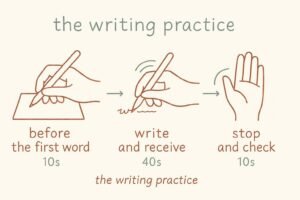
STEP 1: Start before the first word (10 seconds)
With pen in hand and page in front of you, pause before writing anything. Feel the weight of the pen. The texture of the grip. The surface of the paper under the heel of the hand. Notice that writing hasn’t started yet, and let that be the beginning of the practice.
STEP 2: Write and receive simultaneously (40 seconds)
As the pen moves, keep the sensory channels open.
Touch — the specific resistance of this pen on this paper, the pressure changes as letters form, the way the grip shifts through different strokes
Sound — the particular sound this pen makes, how it changes with speed and pressure, the rhythm of a word versus a pause
Vision — ink becoming line, line becoming letter, letter becoming meaning, watched as it happens rather than after
Don’t slow down artificially. Write at whatever pace the observation allows.
STEP 3: Stop and check (10 seconds)
After a sentence or a natural pause, set the pen down. What’s in the hand — any residual sensation? What’s in the mind — is the thought that was just written clearer than it was before writing it? The act of writing sometimes completes a thought that wasn’t finished before it started. Check whether that happened.
Session 3: Why the Hand That Writes Participates in the Understanding
In 2014, psychologists Pam Mueller and Daniel Oppenheimer ran a series of experiments comparing students who took lecture notes by hand against those who used laptops. For straightforward factual recall, the two groups performed similarly. For questions requiring conceptual understanding and application — the harder cognitive work — the handwriters outperformed consistently.
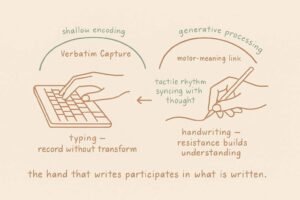
The explanation wasn’t that handwriters paid more attention or tried harder. It was that they had no choice but to process differently. The laptop users, able to type fast enough to capture the lecturer’s words verbatim, largely did exactly that — recording without transforming. The handwriters, unable to keep up, had to continuously decide what to keep, how to abbreviate it, and how to connect it to what came before. This continuous deciding is generative processing, and generative processing produces deeper encoding: memory traces that are richer, more connected to existing knowledge, and more available for later use.
The pen’s physical resistance is part of this story, not just its backdrop. The tactile feedback from the paper surface — the specific drag of different papers, the way the pen tip catches slightly on texture — continuously modulates writing speed. This modulation isn’t just mechanical: it provides a sensory rhythm that keeps the pace of recording loosely synchronized with the pace of thinking. When writing feels like it’s working with thought rather than racing ahead of it, that synchrony is part of what’s producing the effect. Attending to the tactile and auditory dimensions of writing is an invitation to experience this regulation consciously rather than let it run in the background.
There’s a further layer in the motor system. Writing by hand engages specific motor sequences — learned programs for each letter and word — that are stored as procedural memory and linked to the semantic content they produce. Research in developmental psychology shows that learning to write letters by hand strengthens letter recognition in ways that tracing or typing does not: the motor act and the meaning become associated through the movement itself. In adult writing, this association persists. The hand that writes a word participates in the understanding of it in ways that a hand moving across a keyboard does not.
For most of recorded human history, the act of writing was slow, physical, and deliberate — constrained by the tools available and the effort required. Scribes, scholars, correspondents: they had no option but to engage with what they were writing as they wrote it. The felt sense that handwriting produces a different quality of thought is not romantic attachment to an older technology. It’s an accurate perception of what happens when resistance is built into the process.
Conclusion: The Slowness Was the Feature

Once today. One minute, pen on paper, full attention. Write something, feel the resistance, and stay with it long enough to check whether the thought arrived clearer at the end than it was at the start.
The keyboard kept pace with the thought. The pen made the thought worth keeping.
KEY TERMS
Generative Processing
The active mental engagement required when information cannot simply be transferred — when it must be summarized, reworded, connected to existing knowledge, and selectively retained. Handwriting enforces this by being too slow for verbatim transcription. The cognitive work that makes handwritten notes more conceptually useful than typed ones, even when the typed notes contain more information.
Depth of Encoding
The principle that memory traces vary in strength and retrievability depending on how deeply the information was processed during initial engagement. Surface processing — recording without transformation — produces shallow encoding. Generative processing produces deep encoding: richer, more connected, more available for later use. The mechanism behind the Mueller and Oppenheimer findings.
Tactile Feedback and Processing Synchrony
The physical resistance of pen on paper — drag, texture, pressure variation — modulates writing speed in a way that keeps recording loosely synchronized with thinking. Not just a sensory experience but a functional regulation mechanism. The reason the feel of handwriting and its cognitive effects are connected rather than separate.
Motor-Semantic Association
The link between the motor sequences used to write letters and words and the semantic content those letters and words represent. Established through repeated association during learning, and persistent in adult writing. Part of the reason handwriting engages understanding in ways that keyboard input does not — the movement and the meaning are bound together in procedural memory.
Defusion
A core skill in Acceptance and Commitment Therapy (ACT): the capacity to observe thoughts and impulses as passing mental events rather than practical conclusions. When I should just type this, it’s faster arrives mid-practice, recognizing it as a thought rather than a directive — and returning attention to the pen and the page — is defusion applied to the specific impatience of productivity-oriented work habits.