
Introduction: Have You Ever Tried to Tie Your Shoes Slowly — and Found It Harder?
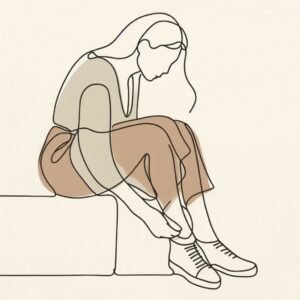
Most people have had this experience at some point. The deliberate attempt to slow down a motion that normally runs automatically — and suddenly the fingers don’t quite know what to do. Something that requires zero effort when done without thinking becomes strangely effortful when watched.
This isn’t a failure of coordination. It’s a specific neurological event, and it happens for a reason that turns out to be worth knowing.
Today’s practice works with that paradox rather than around it.
Session 1: Why This Particular Motion
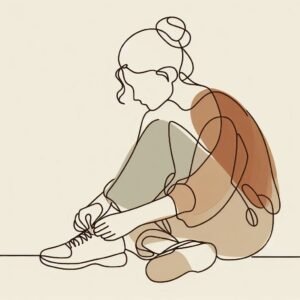
Tying shoelaces is a textbook example of what cognitive neuroscience calls procedural memory — a motor skill acquired through repetition and gradually transferred from conscious cortical control to subcortical automation. In the early stages of learning, the prefrontal cortex and motor cortex lead: each movement requires attention, errors require correction, the whole process is effortful and slow. With enough repetition, control shifts to the basal ganglia and cerebellum. The basal ganglia chunk the entire sequence into a single integrated program. The cerebellum handles sensory feedback matching. The prefrontal cortex is released to do other things — which is why it’s possible to tie shoes while thinking about something else entirely.
This automation has a secondary consequence: sensory suppression. The basal ganglia’s automatic program uses sensory feedback during execution primarily for error detection, not for conscious experience. As long as the sequence is proceeding as predicted, the sensory signals — the texture of the lace, the changing tension as the knot forms, the tactile progression of the loop — are processed but not forwarded to awareness. The sensory event is complete. The conscious experience of it is not.
Session 2: Three Steps
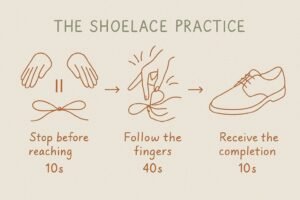
STEP 1: Stop before reaching for the lace (10 seconds)
Before the hands move, pause. The intention is simply this: do the motion without making speed the goal. That’s the only change from the ten thousand times before.
STEP 2: Follow the fingers and the lace (40 seconds)
Move through the tying slowly enough to track what’s available.
Touch — the texture of the lace material, its surface quality, the way tension changes under the fingertips as the knot progresses
Proprioception — the specific feel of crossing, looping, pulling through — each sub-movement has its own sensory signature
Vision — the shape changing, the knot forming, the lace going from loose to structured
If awkwardness arrives — and it may — observe it rather than correcting for it. It’s information, not failure.
STEP 3: Receive the completion (10 seconds)
At the final tightening, stay with the moment the knot sets. The tension resolving into a fixed form. The shoe fitting differently against the foot. The particular feel of finished versus unfinished. Let the completion register before standing up.
Session 3: Why the Fingers Know More Than the Brain That’s Watching Them
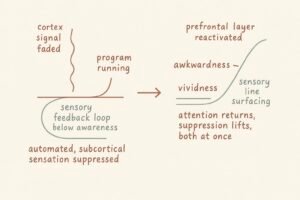
The transfer of motor control from cortical to subcortical systems — from prefrontal and motor cortex to basal ganglia and cerebellum — is one of the most well-documented processes in motor learning. Early in skill acquisition, the prefrontal cortex maintains explicit control: each step is consciously sequenced, attention is continuously required, errors are consciously detected and corrected. With repeated practice, the basal ganglia extract the statistical regularities of the movement sequence and consolidate them into an integrated program — a single unit of execution that can be triggered and run without step-by-step cortical supervision. This is why complex skills feel effortless once automated: they’ve been moved off the cortex entirely.
The sensory suppression that accompanies this automation is a feature, not a bug. The basal ganglia program monitors incoming sensory feedback during execution, but only to verify that the sequence is proceeding as expected. Feedback that matches prediction is treated as redundant and not forwarded to conscious processing. The texture of the lace, the tension progression through each sub-movement, the tactile feedback of the knot forming — these are received and processed subcortically every single time, and almost never surface. The information arrives. It just doesn’t land.
The deliberate slowing re-engages the supplementary motor area and prefrontal cortex in a sequence they haven’t been needed for in years. This is where attentional interference occurs — the phenomenon described by the explicit monitoring hypothesis in cognitive psychology. When conscious attention is directed at a highly automated skill, it introduces an additional monitoring layer that interferes with the smooth execution of the automatic program. The subcortical sequence was designed to run without oversight; the sudden presence of oversight disrupts the timing and coordination of sub-movements. The resulting awkwardness is the felt experience of two control systems — automatic and conscious — simultaneously active and getting in each other’s way.
The same re-engagement that produces the awkwardness also lifts the sensory suppression. With the prefrontal cortex and supplementary motor area back in the loop, sensory feedback is no longer processed solely for error detection — it’s available for conscious experience. The texture of the lace that has been arriving and being discarded for years becomes something that can actually be felt. The awkwardness and the vividness are two sides of the same interruption. The same mechanism operates across practiced hand motions generally — but here it runs on a skill far more deeply automated, one transferred to subcortical control in childhood and running there, unexamined, ever since.
Conclusion: Ten Thousand Times, and This One Is Different

Once today. Any time shoes need tying. Pause before reaching for the lace, slow the motion down, follow the texture and the tension all the way to the knot — and stay with the moment it sets before standing up.
The motion was automated so the mind could go elsewhere. The practice is just the one time it came back.
KEY TERMS
Procedural Memory
Motor skill memory acquired through repetition, stored and executed by the basal ganglia and cerebellum with minimal cortical involvement once automated. The reason complex learned skills feel effortless — and the reason their sensory details stop reaching awareness. Shoelace tying is a near-perfect example: acquired consciously in childhood, running subcortically ever since.
Skill Automatization and Sensory Suppression
As motor control transfers to the basal ganglia, sensory feedback during execution is used primarily for error detection rather than conscious experience. Signals that match prediction are processed but not forwarded to awareness. The sensory richness of the motion is present every time — it simply doesn’t surface. The mechanism behind why familiar skills stop feeling like anything.
Attentional Interference (Explicit Monitoring Hypothesis)
The disruption of automated skill execution that occurs when conscious attention is directed at the movement. The prefrontal cortex’s monitoring presence interferes with the smooth running of the subcortical program, producing temporary degradation in fluency and coordination. The neurological explanation for why trying to tie shoes slowly feels harder than doing it automatically — and simultaneously, why the sensory suppression lifts when it happens.
Somatosensory Representation of the Hand
The hand and fingers occupy a disproportionately large region of the somatosensory cortex relative to their physical size — the cortical real estate that makes fine tactile discrimination possible. Directing conscious attention to lace texture, tension, and form accesses this representation in a way that automatic execution never does.
Defusion
A core skill in Acceptance and Commitment Therapy (ACT): the capacity to observe thoughts and impulses as passing mental events rather than facts. When just tie it and go arrives with the force of urgency, recognizing it as a thought rather than a requirement — and staying with the motion for its full duration — is defusion applied to the specific impatience of morning routines.