
Introduction: Something Is Missing. Notice What Happens Next

The keys aren’t where they should be. The phone has disappeared. A document you need right now isn’t anywhere you’ve looked.
In the seconds that follow, the body responds with remarkable consistency. Heart rate climbs. Breathing shallows. Vision narrows. The mind locks onto a location — it has to be there — and returns to it again and again even after confirming it isn’t.
This isn’t a character flaw or a lapse in attention. It’s a predictable sequence of neurological events that unfolds the same way in virtually everyone.
Today’s practice is about watching it happen.
Session 1: Why This Particular Situation

The anxiety of losing something is one of the most vivid stress responses available in ordinary daily life — which makes it unusually useful as an object of observation.
When the amygdala detects a threat signal, norepinephrine is released and the attentional system shifts into high-alert mode. Heart rate increases, muscles tighten, breathing becomes shallow — a preparation response designed for physical danger. The modern brain runs the same circuit for a missing set of keys.
What makes this worth understanding is that the stress response actively undermines the search. Norepinephrine at elevated levels impairs prefrontal cortex function — specifically the broad, flexible scanning that allows the mind to hold multiple possibilities simultaneously and shift between them. The Yerkes-Dodson law describes this as an inverted-U relationship: arousal improves cognitive performance up to an optimal point, then degrades it. Past that threshold, the harder the search, the worse the search becomes. Checking the same spot repeatedly isn’t carelessness — it’s a direct consequence of what stress does to the attentional system.
Knowing this doesn’t immediately stop the response. But observing it in real time changes the relationship to it.
Session 2: Three Steps for Turning the Search Into a Practice
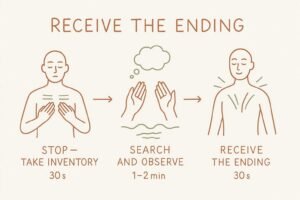
STEP 1: Stop moving and take inventory (30 seconds)
The moment you register that something is missing, pause. Before doing anything else, check the body.
What is the heart rate doing?
Where is the breath — chest or abdomen?
Where is the tension sitting — jaw, shoulders, hands?
Receive this information as data. Not as a problem to solve, not as evidence of something wrong — just as the current state of the system.
STEP 2: Search and observe simultaneously (1–2 minutes)
Continue looking. But maintain the dual awareness.
Thoughts — watch the predictions arise and dissolve: it must be there, I definitely left it there, where else could it be
Body — the feel of hands moving objects, feet on the floor, the physical act of searching
The emotional texture — noticing that the anxiety isn’t constant, that it moves in waves, that it shifts as the search continues
When “just find it already” arrives as a thought, recognize it as a thought, and return to sensation.
STEP 3: Observe the moment it’s found (30 seconds)
When the object appears — stay with what happens in the body. Where does the tension release from first? How does the breath change? Where does relief show up physically?
The stress response has a beginning, a middle, and an end. This step is about being present for the ending.
Session 3: Why Searching Harder Makes the Search Worse
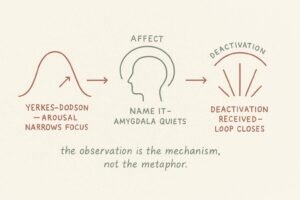
Cognitive tunneling is the stress-induced narrowing of attention that causes the mind to fixate on a specific hypothesis and struggle to abandon it even when evidence suggests it’s wrong. The mechanism involves the interaction between norepinephrine and prefrontal cortex function. At moderate levels, norepinephrine sharpens attentional focus. At elevated levels — the kind produced by genuine frustration or urgency — it suppresses the prefrontal cortex’s broad exploratory function: the capacity to hold multiple possibilities in working memory and switch flexibly between them.
This is the Yerkes-Dodson relationship in practice. Arousal and cognitive performance follow an inverted-U curve. On the ascending side, stress helps. Past the peak, the same stress that mobilized attention begins to constrain it. The loop closes: the longer the search fails, the higher the arousal, the narrower the attention, the less likely the search is to succeed. Checking the same spot a fourth time isn’t stubbornness. It’s the nervous system doing exactly what elevated norepinephrine tells it to do.
The pause and body inventory interrupt this loop at a specific point. Directing attention inward and placing a verbal label on the emotional state — internally registering I’m anxious right now — is a process called affect labeling. fMRI studies have shown that affect labeling produces measurable reductions in amygdala activity while activating the medial prefrontal cortex. The act of observing and naming an emotional state engages neural circuitry that modulates the state itself. This is not a metaphor for calming down — it is the mechanism by which the observation produces the calming.
There is a subtler layer underneath the emotional response. Before the feeling of this is unpleasant solidifies, there is a brief window in which the raw sensory data simply exists: the elevated heart rate, the tight chest, the shallow breath. These are sensations before they are evaluations. The body inventory creates contact with that layer — the input before the judgment. The discomfort doesn’t disappear, but the relationship to it shifts. What was fused with urgency becomes, briefly, something that can be observed.
The deactivation of a stress response — parasympathetic reengagement, the release of muscular tension, the return of full breathing — is as neurologically specific as its activation. Receiving that deactivation consciously, rather than simply moving on the moment the object is found, closes a loop that usually goes unwitnessed. The whole cycle — onset, escalation, resolution — becomes something the nervous system experienced with awareness rather than something it ran through automatically.
Conclusion: The Search Was Always Going to End

Once today. Whatever goes missing — pause, check the body, stay with it through the finding. The stress response was already running before awareness arrived. What changes is whether the resolution gets witnessed too.
The search was always going to end. What changed was who was present for it.
KEY TERMS
Cognitive Tunneling
The stress-induced narrowing of attention that causes fixation on a specific hypothesis — checking the same location repeatedly despite evidence it’s empty. Produced by norepinephrine’s suppression of prefrontal exploratory function under elevated arousal. The neurological explanation for why searching harder often means searching worse.
Yerkes-Dodson Law
The inverted-U relationship between arousal and cognitive performance. Moderate arousal improves focus and performance; arousal past the optimal threshold degrades it. The loop of searching-failing-escalating-searching-worse is a direct expression of this curve operating in real time.
Affect Labeling
The act of placing a verbal label on an emotional state — internally registering I’m anxious rather than simply being anxious. fMRI research shows measurable reductions in amygdala activity and activation of the medial prefrontal cortex. Observation and naming of an emotional state engage the circuitry that modulates it.
Vedanā
A Pali term referring to the automatic quality of pleasant, unpleasant, or neutral that accompanies every sensory experience at the moment it arises — before conscious evaluation begins. The body inventory in this practice creates contact with this layer: elevated heart rate, chest tension, and shallow breath as raw sensory data, before the evaluation of this is unpleasant is applied. Awareness of Vedanā is considered foundational to understanding how reactivity arises and how it can be interrupted.
Defusion
A core skill in Acceptance and Commitment Therapy (ACT): the capacity to observe thoughts and impulses as passing mental events rather than facts requiring immediate response. When it has to be there or this is a disaster arrives with the force of conviction, recognizing it as a thought — and returning to physical sensation — is defusion applied under conditions of genuine urgency rather than mild distraction.