
Introduction: Does Smiling Make You Happy, or Does Being Happy Make You Smile?

This turns out to be a genuinely open question in psychology — and the answer, after decades of research, is more interesting than either direction alone would suggest.
The simple version — move the muscles, change the mood — has been both enthusiastically supported and sharply contested in the scientific literature. What’s emerged from that debate is a more nuanced picture of how body and mind actually relate to each other. The debate itself turns out to be the more interesting finding — because what it revealed is that the relationship runs in more directions than the question assumed.
Today’s practice is about experiencing that relationship directly, rather than waiting for the science to settle.
Session 1: Why a Smile

In 1988, psychologist Fritz Strack published a now-famous experiment: participants holding a pen between their teeth — which engages the smile muscles — rated cartoons as funnier than those holding it between their lips. The facial feedback hypothesis had its landmark study.
In 2016, a large-scale replication across 17 countries and more than 2,000 participants failed to reproduce the effect. The simple muscle-to-mood pipeline didn’t hold up at scale.
But the story doesn’t end there. Multiple meta-analyses since 2019 have found that a small but statistically significant effect does exist — the question has shifted from whether the effect is real to which mechanism produces it and under what conditions. Science arguing with itself, in the way science does when something is genuinely complicated.
What is well-established is the broader principle: body and mind are not separate systems with a one-way relationship. They influence each other continuously. The direction this practice runs — body first, then inner state — is not a paradox. It’s one expression of a system that always runs both ways.
Session 2: Three Steps
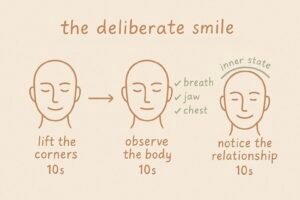
STEP 1: Lift the corners of the mouth (10 seconds)
Deliberately and slightly. It doesn’t need to look like a smile to anyone else, or feel like one internally. The muscles moving is enough. Notice that you’re doing it consciously rather than spontaneously.
STEP 2: Observe what happens in the body (10 seconds)
While holding the position, check inward.
Breath — any change, or none
The face as a whole — do other muscles shift in response? The eyes, the jaw, the brow?
The chest or abdomen — any sensation, however faint?
Whether something changes or nothing does — both are valid observations. The practice is the noticing, not the result.
STEP 3: Turn the attention inward (10 seconds)
Shift focus from the muscular act to whatever internal state is present. Is there any gap between the manufactured expression and what’s actually being felt? Is there any closing of that gap? Just observe the relationship between the two, without trying to force an outcome.
Session 3: Why the Body and Mind Were Never Taking Turns
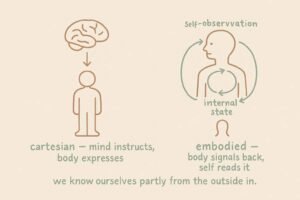
For most of Western intellectual history, body and mind were treated as categorically separate. The Cartesian framework — mind as one kind of thing, body as another — made the idea that a facial muscle could influence an emotional state seem almost category-violating. Emotions belonged to the mind. The body expressed them. That was the assumed direction.
What embodied cognition proposes — developed across cognitive science, philosophy, and neuroscience over the past several decades — is that this separation was always a simplification. Mental states don’t happen in a brain that happens to be attached to a body. They happen in a system that includes the body, its posture, its movement, its physiological state, and the environment it’s embedded in. Thinking, feeling, and perceiving are not purely neural events. They are bodily events. From this perspective, a change in facial musculature influencing an emotional state isn’t paradoxical — it’s exactly what you’d expect from a system with no clean boundary between the physical and the mental.
The current leading explanation for how the facial feedback effect might work is self-perception theory, proposed by psychologist Daryl Bem. The core idea is that people infer their own internal states partly by observing their own behavior — the same way they’d infer something about another person from watching them. When you notice yourself smiling, even deliberately, part of your mind reads that signal and updates its model of how you’re feeling. The emotion doesn’t change because the muscle fired. It may change because you observed yourself doing something that smiling people do. This is a subtler mechanism than direct physiological feedback, but it’s consistent with a broader truth about self-knowledge: we know ourselves partly from the outside in.
There’s also an evolutionary dimension worth noting. The smile is not just an emotional expression — it’s a social signal, shaped by millions of years of primate communication. A relaxed, open facial expression signals safety to others and, through that social function, may signal something to the self as well. An intentional smile activates some of the same neural and social machinery as a spontaneous one. What that does internally may have as much to do with self-signaling as with neurochemistry.
The instruction to observe whether something changes — without assuming it will — is the intellectually honest version of this practice. The science doesn’t guarantee an outcome. It suggests a direction worth investigating, in your own nervous system, right now.
Conclusion: The Data Point Is You

Once today. Thirty seconds, mouth corners up, full attention inward. Something may shift. Something may not. The observation itself is the practice — not the outcome it produces.
The body moved first. What happened next was the data.
KEY TERMS
Facial Feedback Hypothesis
The proposal that facial muscle movements influence emotional states — not just express them. Supported by Strack’s 1988 pen study, challenged by a large 2016 replication failure, partially rehabilitated by post-2019 meta-analyses showing a small but significant effect. The current scientific debate is about mechanism and conditions, not whether the phenomenon exists at all.
Embodied Cognition
The framework — developed across cognitive science, philosophy, and neuroscience — holding that mental states are not purely neural events but arise from the continuous interaction of brain, body, and environment. Challenges the Cartesian assumption of a clean mind-body boundary. Within this framework, physical states influencing mental ones is not a special case — it’s the default operating mode of the system.
Self-Perception Theory
Daryl Bem’s proposal that people infer their own emotional states partly by observing their own behavior, rather than through direct introspective access. A deliberate smile may shift mood not by triggering neurochemistry directly, but by providing the self with behavioral evidence that gets incorporated into its model of its own current state. Currently among the more empirically supported explanations for facial feedback effects.
The Smile as Social Signal
Across primate species, the relaxed open-mouth expression functions as a safety and affiliation signal — communicating non-threat to others. Intentional smiling activates some of the same social and neural machinery as a spontaneous one, with possible self-signaling effects that may be as relevant to the internal experience as any direct physiological pathway.
Defusion
A core skill in Acceptance and Commitment Therapy (ACT): the capacity to observe thoughts and impulses as passing mental events rather than verdicts. When this is fake and pointless arrives during the practice, recognizing it as a thought rather than a conclusion — and returning attention to what’s actually happening in the body — is defusion applied to the specific skepticism this practice tends to generate.