
Introduction: When Did You Last Actually Feel the Water?
You wash your hands several times a day. You turn the tap, wait for the temperature, reach for the soap — and somewhere in that sequence, you disappear. The motion completes itself. The hands get clean. But the actual experience of water against skin, of temperature and pressure and the particular sound of this tap in this moment — that’s already gone before it arrives.
The thirty seconds are already there. They happen whether you’re present for them or not. Today’s practice is just about showing up for what’s already happening.
Session 1: Why the Sensation Disappears

The brain is an efficiency machine. When an action is performed repeatedly in the same context, the neural response to the sensory information it generates gets progressively suppressed. Not at the level of the skin — the nerve endings in your hands detect water temperature and pressure with the same accuracy every time. The suppression happens higher up, in the cortex, where the signal gets flagged as already known, not worth processing consciously.
This is habituation. It’s not inattention. It’s the brain doing exactly what it’s designed to do.
The consequence is that the richness of the sensation — the specific temperature of this water, right now, against these hands — gets routed around awareness entirely. The hands get washed. Nothing is felt.
Session 2: Thirty Seconds at the Sink
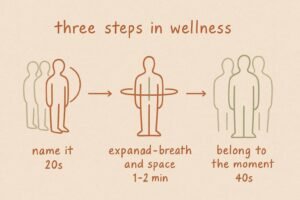
STEP 1: Meet the water (10 seconds)
The moment your hands enter the stream, pause the automatic motion. What temperature is this water? Cooler than expected, or warmer? What does the pressure feel like against the center of the palm versus the fingers? No evaluation — just receiving the data that’s already arriving.
STEP 2: Stay with the texture and sound (15 seconds)
As the soap goes on and the hands begin to move — notice the shift in sensation. The slipperiness of the foam. The friction of skin against skin underneath it. The sound the water makes against your hands, and how that sound changes as the lather builds. Take it in as a single experience rather than a list of separate details.
STEP 3: Feel the rinse (5 seconds)
As the water clears the soap away, follow that sensation. The foam leaving. The water running clean. The slight temperature change as the skin becomes fully wet. Let it register as a physical event rather than an image.
Session 3: Why Familiar Sensations Disappear — and How to Get Them Back
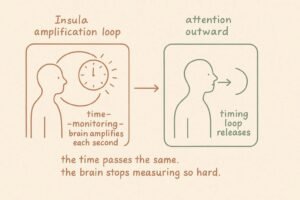
Habituation is the progressive reduction in cortical response to repeated, predictable stimuli. The sensory receptors in the skin continue detecting accurately; the suppression occurs in the transmission from primary somatosensory cortex to prefrontal cortex, where incoming signals are evaluated for novelty and relevance. A stimulus encountered hundreds of times in the same context is downgraded: predictable, low priority, route around conscious processing. The hands get washed. The brain files it as done and moves on.
What interrupts this is the orienting response — the cortical attention reflex triggered by novelty, and subsequently mapped at the neural level through mid-twentieth-century electrophysiology. The orienting response can also be deliberately initiated by directing focused attention toward a habituated stimulus. The question — what temperature is this water? — is precisely this: an instruction to the prefrontal cortex to treat a familiar stimulus as if it were new. The suppression lifts. The signal comes through.
What arrives when that happens is richer than it might sound. Touch information from the hands travels through the somatosensory cortex to the insular cortex, where it’s integrated into the brain’s running model of the body’s current state. Deliberately attending to one part of the body — the hands, under running water — functions as a point of re-entry into present-moment bodily awareness. The hands come into focus. Something in the broader sense of being here updates with them. A single deliberate question, asked at a sink, produces a measurable shift in how present the body feels — not because the water changed, but because the cortical gate opened.
Conclusion: It Was Always There

No perfect attention required. One moment of actually feeling the water — the temperature, the foam, the rinse — is enough. The motion was always completing itself. The practice is just deciding to be inside it.
The sensation never stopped arriving. The attention just wasn’t home.
KEY TERMS
Habituation
The progressive reduction in neural response to a repeated, predictable stimulus. Occurs not at the level of the sensory receptors — which continue detecting accurately — but in the cortical processing stages where signals are evaluated for novelty and relevance. Familiar stimuli are downgraded and routed around conscious awareness.
Orienting Response
The brain’s automatic attention reflex triggered by novelty or unexpected change in the sensory environment. Can also be deliberately initiated by directing focused attention toward a habituated stimulus — which is what the question “what temperature is this water?” is designed to do.
Primary Somatosensory Cortex
The cortical region that processes tactile information — touch, pressure, temperature, texture. Receives continuous input from the skin; its output to the prefrontal cortex is suppressed during habituation and restored during deliberate sensory attention.
Insular Cortex
A region of the cerebral cortex that integrates bodily sensation into the brain’s ongoing model of the body’s current state. Activation of the insular cortex through deliberate tactile attention is associated with increased present-moment bodily awareness and emotional grounding.
Interoception
The brain’s capacity to consciously register and interpret signals from inside the body. Deliberate attention to tactile sensation — as in this practice — functions as a point of re-entry into interoceptive awareness, using the hands as an anchor for broader bodily presence.
Somatosensory Cortex
The cortical region processing touch, pressure, and temperature from skin, muscle, and joints. Receives accurate signals from sensory receptors during every handwash; the habituation occurs in downstream processing, not here. Reactivated by the orienting response.
Defusion
See Guide 5. When I need to get back to work arrives mid-rinse, noticing it as a thought and returning attention to the sensation of water on skin is defusion in its most compressed form — a few seconds, at a sink.