
Introduction: The Cup Was There. Were You?

Busy morning. A gap between tasks. The cup is in your hand, and somehow it’s already half empty — you’re not sure when that happened.
The drink was there. The experience mostly wasn’t.
This practice doesn’t ask for extra time or a quieter environment. It asks for one minute and one cup — the one already in your hand.
Session 1: Why a Cup Makes a Surprisingly Good Anchor

The mind tends to drift — toward yesterday’s unresolved conversation, today’s task list, next week’s worry. This drift accumulates across a day, and by evening there’s a specific kind of exhaustion: not from effort, but from having been somewhere other than where the body was.
Sensory experience is one of the most reliable ways to interrupt this drift. The warmth of a cup, the smell of coffee, the texture of a first sip — these are immediate, physical, happening right now. They cannot be moved to the past or the future. When attention lands on them fully, the mind has less room to wander.
The useful thing is that the cup is already there. No special condition needs to be created. A familiar object, held in both hands, can become an anchor — not because of what it is, but because of the quality of attention brought to it.
Session 2: One Minute, Three Steps
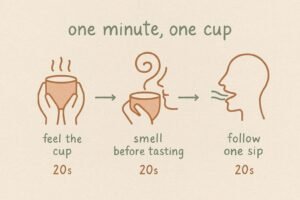
STEP 1: Feel the cup before drinking (20 seconds)
Pick up the cup and stop before drinking. The warmth spreading into the palms. The weight of it. The texture of the surface — smooth ceramic, a paper sleeve, the slight roughness of a mug held hundreds of times before. The steam, if there is any.
This pause tends to feel slightly awkward the first time. There is a pull to just drink — that’s the habit. Simply noticing the cup for twenty seconds, without lifting it to the mouth, is already a small interruption of the automatic.
When “I should just get on with it” arrives — notice it, and return to the warmth in the hands.
STEP 2: Smell before tasting (20 seconds)
Bring the cup toward the nose and inhale slowly. What is there? Something sharp or rounded? Something that opens at the edges? Notice what happens in the body when the scent arrives — whether anything shifts, loosens, responds.
This step does more than it appears to.
STEP 3: Follow one sip to the end (20 seconds)
Let the liquid rest on the tongue before swallowing. The temperature, the texture, the way the flavor develops and changes. Follow it all the way through.
If a thought arrives — I need to get back to work — notice it without following it. Return to the warmth, the taste, the cup in the hands. That return is the practice.
Session 3: The One Sense That Reaches the Emotional Brain First
Rachel Herz at Brown University has spent decades documenting something that most people have experienced but couldn’t explain: why smell evokes emotion and memory more powerfully than any other sense. In studies published in the American Journal of Psychology (2002) and Chemical Senses (2004), Herz and colleagues presented the same memory cues — campfire, fresh-cut grass, coffee — in olfactory, visual, and auditory form, and found consistently that memories recalled through smell were significantly more emotional and evocative than those triggered by the same cue through sight or sound. The experience of a coffee scent bringing back a particular morning, a particular feeling, before any conscious recognition has formed — this is what Herz described as a privileged relationship between olfaction and emotion.
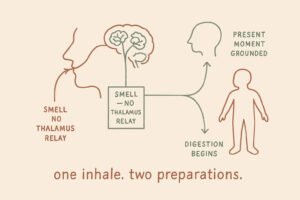
The reason is anatomical. As Herz’s research group notes, olfaction is the only sense that does not route its signals through the thalamus — the brain’s central relay station — before reaching the cortex. Every other sense passes through this filtering and directing step. Olfactory information travels from the receptors in the nasal cavity directly to the olfactory bulb, which connects immediately to the amygdala and hippocampus: the brain’s centers for emotional processing and the formation of associative memory. No relay. No filtering step. Straight to the emotional core. Herz’s neuroimaging research (Neuropsychologia, 2004) confirmed this anatomically: during recall triggered by a personally meaningful scent, amygdala and hippocampal activation was significantly greater than during recall triggered by visual cues of the same content. The scent reaches the emotional brain before the thinking brain has caught up.
This direct route gives Step 2’s slow inhale a function beyond sensory observation. Deliberately attending to a scent activates the olfactory bulb’s direct connection to the amygdala and hippocampus — landing the emotional and memory systems in the present moment through the fastest pathway the brain has available. At the same time, the act of smelling a drink before consuming it initiates the body’s anticipatory digestive response: saliva production increases, gastric acid and digestive enzymes begin to be released, the body preparing to receive what is coming. The pause before the first sip is doing two things simultaneously — grounding awareness in the present through the brain’s most direct emotional route, and preparing the body to absorb what follows. Rushing past it forfeits both.
Conclusion

This practice is not about analyzing coffee. It is about being present for something that is already happening — something done hundreds of times without quite arriving for it.
The cup was there every morning. The scent reached the emotional brain every time. The only thing missing was someone to be present for it.
KEY TERMS
Privileged Olfactory Pathway
The neuroanatomical feature identified in Herz’s research: olfaction bypasses the thalamus — the brain’s central sensory relay station — and connects directly from the olfactory bulb to the amygdala and hippocampus. This direct routing, absent in every other sense, is why smell triggers emotional and autobiographical memory more powerfully and immediately than vision, hearing, or touch.
Olfactory Bulb
The brain structure that receives signals from the nasal olfactory receptors and connects immediately to the amygdala and hippocampus. Its direct wiring — bypassing the thalamus — gives olfactory stimulation a faster and more emotionally direct pathway than any other sense provides.
Odor-Evoked Autobiographical Memory
The phenomenon studied by Rachel Herz across multiple publications: memories recalled through smell are consistently more emotional and evocative than the same memories recalled through visual or auditory cues. Herz’s neuroimaging research showed greater amygdala and hippocampal activation during scent-triggered recall than during visually triggered recall of the same content.
Cephalic Phase Response
The body’s anticipatory preparation for digestion, triggered by sensory engagement with food or drink before consumption begins. Smelling a drink before drinking it activates salivary, gastric, and enzymatic responses that prepare the digestive system for what is coming. The slow inhale in Step 2 is both neurologically grounding and physiologically productive.
Thalamus
The brain’s central sensory relay station. All sensory input except smell passes through here before reaching the cortex. Olfaction’s bypass of this structure gives it a faster, more emotionally direct connection to the amygdala — which is why a scent can shift emotional state before conscious recognition has formed, while the sight of the same object cannot do the same thing in the same way.