
Introduction: That Moment Focus Slips Has a Way Back

“I’ve been staring at this document and nothing’s moving.” “I’ve read the same email three times and still don’t know what it says.”
These moments are not a failure of willpower. They are the result of a specific circuit in the brain moving first.
There is something that can be done in sixty seconds, without leaving the chair. No equipment, no technique to master. Just the breath, and a small amount of attention.
Session 1: Why Focus Cuts Out

At some point in a working day, the thinking stops having traction. This is not a matter of effort.
A difficult message, a deadline closing in, a meeting that didn’t go well — in response to these pressures, the brain generates a stress signal. What follows is a functional reduction in the prefrontal cortex: the region responsible for judgment, attention, and sequential thinking. Thoughts start cycling without resolution. Decisions feel uncertain. The next step becomes unclear. These are not signs of mental weakness. They are what prefrontal impairment looks like in practice.
Breath is one of the few available direct interventions. Deliberately slowing the pace of breathing produces simultaneous changes in the nervous system and the brain. Even within sixty seconds, the shift begins.
Session 2: The One-Minute Centering Practice
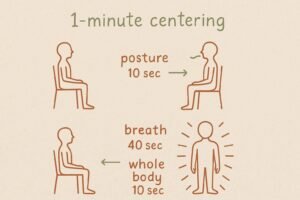
This works at a desk, in a meeting room, or anywhere with a chair and sixty seconds.
STEP 1: Reset your posture (10 seconds)
Sit slightly forward from the back of the chair. Both feet flat on the floor. Spine lengthened — not rigid, just upright enough to feel alert. Hands resting on the thighs.
Just this: the simple physical fact of sitting here.
STEP 2: Follow the breath (40 seconds)
Eyes closed or gaze softened downward.
Inhale — breathe in through the nose. The slight coolness of air at the nostrils. The lungs expanding.
Exhale — breathe out slowly. The small release of tension as the body settles.
No effort to breathe correctly. Simply observing what is already happening.
STEP 3: Widen the awareness (10 seconds)
From the breath, let attention expand to include the whole body — the weight in the chair, the contact of the feet with the floor. Then gently open the eyes.
Session 3: What One Minute of Breath Does to the Brain
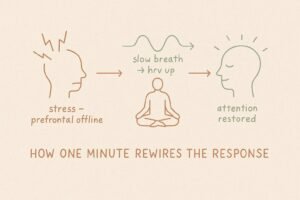
Yale neuroscientist Amy Arnsten’s research, published in Nature Reviews Neuroscience (2009), identified what stress does to the brain at the molecular level. Under pressure, excessive catecholamine release in the prefrontal cortex directly weakens the network connections between neurons. Arnsten described this as a shift from thoughtful top-down control to reflexive subcortical circuits — the regions handling judgment, attention, and sequential reasoning go offline, and faster, more habitual response circuits move forward. The cycling thoughts, the uncertainty, the inability to identify the next step: these are not motivational failures. They are the observable output of this neurochemical switch.
Breath intervenes directly in this process. Andrea Zaccaro and colleagues’ systematic review, published in Frontiers in Human Neuroscience (2018), examined the research on slow breathing techniques — defined as fewer than ten breath cycles per minute — and found that this deliberate reduction in breathing pace produces simultaneous changes in the autonomic nervous system and the central nervous system: increased heart rate variability, increased prefrontal cortical activity, and increased alpha wave power occurring in parallel. The simple act of slowing the breath moves the neurological conditions described by Arnsten in the opposite direction. At a desk, settling into posture and following a few slow breaths is sufficient to begin that reversal.
Breath also offers a second kind of recovery. Environmental psychologists Rachel and Stephen Kaplan’s attention restoration theory describes directed attention — the sustained, effortful concentration that desk work requires — as a finite resource that depletes with continuous use. The pathway to recovery is not rest in the passive sense, but brief engagement with stimuli that capture attention without cognitive effort: the rhythm of breath, the quality of light, the sound of rain. One minute of attention directed inward, away from the screen, can meaningfully restore the capacity that returns to the task. What Theravāda Buddhism systematized as Ânâpânasati — mindfulness of breathing — describes the same operation across a longer arc: the repeated act of returning to the breath cultivates the quality of attention itself, not just in the moment of practice, but across a day structured by small returns.
Conclusion
Use this whenever focus slips — before a difficult conversation, between tasks, when frustration starts to build. It is small enough to actually do, and that is why it works.
The focus didn’t fail. The stress circuit moved first. Breath was always the shortest route back.
KEY TERMS
Prefrontal Cortex
The brain region responsible for judgment, attention, and sequential reasoning. Arnsten’s research (Nature Reviews Neuroscience, 2009) established that even mild uncontrollable stress produces excessive catecholamine release in the prefrontal cortex, directly weakening neuronal network connections and shifting behavioral control toward faster, reflexive subcortical circuits. The observable result is the familiar experience of thoughts cycling without resolution.
Heart Rate Variability (HRV)
A measure of the variation in time between heartbeats, used as an index of autonomic nervous system flexibility. Zaccaro and colleagues’ systematic review (Frontiers in Human Neuroscience, 2018) showed that slow breathing increases HRV in parallel with increased prefrontal cortical activity — a simultaneous restoration of both autonomic and cognitive function.
Attention Restoration Theory (ART)
Developed by Rachel and Stephen Kaplan. Directed attentional capacity — the kind required for sustained focused work — depletes with continuous use and recovers through brief engagement with stimuli that capture attention effortlessly, without cognitive demand. The breath, as an object of attention, is one such stimulus.
Slow Breathing
Breath paced at fewer than ten cycles per minute. Zaccaro and colleagues’ systematic review established that this deliberate reduction in breathing rate produces parallel changes in autonomic function (increased HRV) and central nervous system activity (increased prefrontal cortical activity and alpha wave power), directly reversing the neurological conditions associated with stress-induced prefrontal impairment.
Ânâpânasati
Pāli for “mindfulness of breathing.” One of the foundational practices in the Theravāda tradition, using the breath as an anchor for present-moment attention. The structure it describes — returning to the breath, repeatedly, as the unit of practice — maps precisely onto what Arnsten identified as the mechanism of impairment and what Zaccaro’s research established as the mechanism of recovery.