
Introduction: Are You Actually Sitting Right Now?

You’ve been in this chair for hours, probably. The pressure of the seat against the body, the stack of the spine, the weight of the feet on the floor — when did you last feel any of that?
Somewhere in the third hour at a desk, the body stops being something you inhabit and becomes something you’re vaguely attached to. The screen holds the attention. The chair holds everything else. The body has been here the whole time — present, signaling, waiting. This practice is just about catching up to it.
Session 1: Why the Sensation of Sitting Disappears
Repeated sensations get suppressed at the cortical level through habituation — the brain’s mechanism for flagging familiar, predictable stimuli as low priority and routing them around conscious awareness. Sitting is among the most thoroughly automated physical states there is: the body maintains it continuously, without instruction, without complaint, largely without awareness.
But maintaining a seated posture isn’t passive. The muscles, joints, and tendons throughout the body are sending a continuous stream of positional information to the brain — what neuroscientists call proprioception. This signal is being processed constantly, mostly below the threshold of consciousness, by the cerebellum and somatosensory cortex. The data is arriving. The awareness just hasn’t. The body is already fully present. The attention is somewhere else entirely.
Session 2: One Minute of Seated Practice
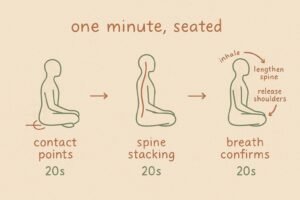
STEP 1: Find the contact points (20 seconds)
Without moving, bring attention to the places where the body meets the chair and the floor. The surface area of the seat against the back of the thighs and the base of the pelvis — not a point, a field. The degree of contact between the back and the backrest, if there is any. The pressure of the soles of the feet against the floor. Receive each of these as information rather than evaluation.
STEP 2: Feel the spine stacking (20 seconds)
Bring attention to the vertical axis of the body. The pelvis as the base. The vertebrae stacking upward, one on the next. The skull resting at the top. Not as an image — as a felt sense. Notice what it actually feels like to be organized around gravity rather than collapsed into it.
STEP 3: Let the breath confirm the posture (20 seconds)
On the inhale, notice whether the spine lengthens slightly. On the exhale, notice whether the shoulders release. Don’t correct the posture — let the breath find it. There’s a difference between the two, and the body knows it.
Session 3: What the Body Has Been Doing While You Weren’t Watching
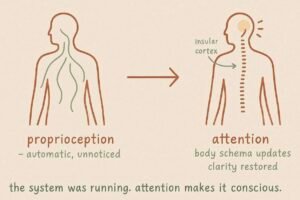
Proprioception — the continuous sensory input from muscle spindles, Golgi tendon organs, and joint receptors throughout the body — provides the brain with real-time data on position, movement, and tension in every part of the musculoskeletal system. This information is integrated in the cerebellum and somatosensory cortex and used to make the constant micro-adjustments that keep an upright posture stable. Most of this processing never reaches conscious awareness. It doesn’t need to. The system runs reliably without it.
What changes when conscious attention is directed toward proprioceptive sensation is the orienting response: the cortical attention reflex that lifts suppression and brings automatically processed signals into conscious experience. The instruction to feel the seat as a field rather than a point recruits both cutaneous touch receptors and the deeper proprioceptive system simultaneously, activating the somatosensory cortex in a way that sustained desk work never does. A familiar surface — the chair you’ve sat in for three hours — becomes, briefly, new information.
Proprioceptive signals from the spinal musculature travel through the insular cortex, where they contribute to the ongoing construction of what neuroscientists call the body schema — the brain’s continuously updated three-dimensional model of the body in space. Attending to the felt sense of the spine stacking is a deliberate access point into this model. A body scan traverses this map from head to toe; tactile attention at the hands uses one peripheral anchor to re-enter it. This practice uses the vertical axis of the seated body — the spine under gravity — as its thread back to present-moment bodily awareness.
There is a bidirectional relationship between postural awareness and prefrontal cortex activity worth noting. Consciously attending to posture activates prefrontal engagement — which is part of the neurological reason that a brief moment of postural awareness tends to restore a sense of clarity and presence after extended periods of task-focused work. In Sati practice, the instruction to attend to the body as it is — kayanupassana, the contemplation of the body — is understood to support the arising of clear knowing. The language is different. The territory is the same.
Conclusion: The Desk Was Always a Practice Space

No perfect posture required. One moment of actually feeling the seat against the body, the spine in its stack, the floor underfoot — that’s enough to interrupt the drift. The body was transmitting the whole time. The practice is just deciding to receive.
The signals were never the problem. The attention that receives them was the only thing missing.
KEY TERMS
Proprioception
The continuous sensory input from muscle spindles, Golgi tendon organs, and joint receptors providing real-time positional data throughout the musculoskeletal system. Processed constantly by the cerebellum and somatosensory cortex, mostly below conscious awareness. Conscious attention brings this processing into awareness without changing the underlying signal.
Body Schema
The brain’s continuously updated three-dimensional model of the body in space, constructed from proprioceptive and interoceptive input via the insular cortex. Attending to the felt sense of the spine stacking is a deliberate access point into this model — a way of making the brain’s ongoing positional map available to conscious experience.
Muscle Spindle
The primary proprioceptive receptor within muscle tissue, detecting length and rate of change. One of the key receptors recruited when attention is directed toward the felt sense of the spine and the integration of breath with posture.
Interoception
The brain’s capacity to consciously register and interpret signals from inside the body — distinct from proprioception, which tracks position and movement. Both systems converge in the insular cortex, together forming the unified sense of being present in a body. This practice draws on both: proprioception through postural awareness, interoception through breath.
Kayanupassana
The first foundation of Sati practice: contemplation of the body as it is. The neurological basis for why attending to physical sensation — posture, breath, contact points — supports the arising of clear knowing maps onto the prefrontal-proprioceptive circuit described in this guide. The language is different. The territory is the same.
Defusion
A core skill in Acceptance and Commitment Therapy (ACT): the capacity to observe thoughts, sensations, and emotions as passing events rather than facts requiring response. When discomfort or tension arrives during this practice, noticing it as sensation rather than verdict — and returning attention to the whole postural field — is defusion applied to physical experience.