
Introduction: The Sound You’ve Been Ignoring Is the Best Cue You Have

Every morning, you power up your laptop and — before the startup sound has finished — you’re already reaching for email, already picking up where yesterday left off. The day hasn’t begun yet, and you’re already behind it.
That sound has been trying to get your attention. Today, you’re going to let it.
This practice takes thirty seconds. It requires nothing beyond what’s already happening. The computer needs a moment to start. So do you. Not to clear your mind completely, not to arrive in some ideal state of calm — just to choose how the day begins rather than inherit how yesterday ended.
Session 1: Why the Startup Sound? Because Your Brain Runs on Cues

Habits don’t begin with decisions. They begin with triggers. The brain operates on a loop — cue, routine, reward — and once a loop is established, the routine follows the cue almost automatically, with little conscious involvement.
For most people, the startup sound is already a cue. It just triggers the wrong routine: the immediate reach for email, the resumption of yesterday’s unfinished tension, the skip straight into reactive mode before the day has properly begun.
This practice doesn’t fight that loop. It redirects it. The cue stays the same — the startup sound — but the routine that follows changes: thirty seconds of breath, intention, and arrival. The morning gets a different first move.
What’s available in those thirty seconds is more than relaxation. It’s the gap between the machine starting and you deciding what to do with that fact. Most mornings, that gap disappears before anyone notices it was there.
Session 2: The 30-Second Ceremony
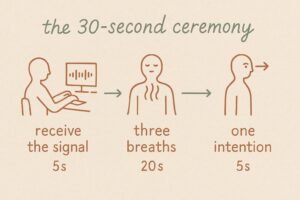
STEP 1: Receive the signal (5 seconds)
When you hear the startup sound, take your hands off the keyboard. Sit back slightly. Let the sound register as a cue rather than a starting gun — a signal that something is beginning, not that you’re already late. Straighten your posture, not rigidly, but with a small sense of arriving somewhere.
This may feel like a strange thing to do with five seconds. That strangeness is worth noticing. The pull to move straight to the screen is the habit. Pausing before it — even briefly — is already something different.
STEP 2: Three conscious breaths (20 seconds)
Close your eyes gently, or let your gaze drop softly toward the desk.
First breath: inhale slowly enough to feel the chest expand. Exhale fully, letting the shoulders drop. Whatever carried over from yesterday — let it sit there without chasing it.
Second breath: inhale with a little more length. Exhale with a little more release. Notice where the body is holding something. You don’t need to fix it. Just register it.
Third breath: inhale into a quiet question — *how do I want to work today?* Exhale without answering it. The intention doesn’t need to be formed yet. The question itself is the preparation.
No need to breathe deeply or perfectly. Your natural rhythm, slowed by one degree, is enough.
STEP 3: Set one intention (5 seconds)
Open your eyes and look at the screen before touching anything. Ask yourself: what’s the first thing that actually matters today?
Not a to-do list. Not a review of everything waiting. Just one direction — the thing you’d choose if you were choosing rather than reacting. There may be a sense that five seconds isn’t long enough to answer this well. It usually is.
Session 3: Why the Right Trigger Makes the Decision Before You Do
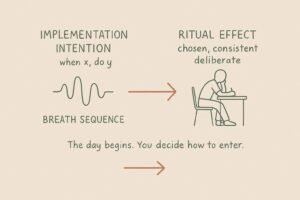
The reason this practice works — and why vague intentions like “I want to be more mindful at work” usually don’t — comes down to a concept in cognitive psychology called implementation intention.
Psychologist Peter Gollwitzer’s research demonstrated that pairing a goal with a specific situational trigger dramatically increases follow-through. The format is simple: when X happens, I will do Y. This structure — sometimes called an if-then plan — creates a conditional link in the brain between a cue and a behavior, reducing reliance on willpower or conscious decision-making at the moment of action. Across multiple meta-analyses, implementation intentions have been shown to roughly double or triple the rate at which people follow through on intended behaviors, compared to goal intention alone.
“When the startup sound plays, I take thirty seconds to breathe” is an implementation intention in its most functional form. The trigger is unambiguous, daily, and outside your control — which means the decision has already been made before the morning begins. The sound does the deciding. You simply follow.
The second mechanism at work here is what behavioral researchers call the ritual effect. Studies by Francesca Gino and colleagues found that engaging in a personal pre-performance ritual — a self-chosen sequence of actions performed with intention — reduces anxiety and improves both focus and self-efficacy. The content of the ritual matters less than its structure: the fact that it was chosen, that it is consistent, and that it is performed deliberately. The ritual creates a psychological container for the transition into a different mode of engagement. It signals, to the nervous system and to attention alike, that something is shifting.
Together, these two mechanisms explain why thirty seconds of intentional breathing before opening email is more than a relaxation technique. It is a structured behavioral intervention: a specific cue linked to a specific sequence, performed as a chosen ritual, that marks a transition between states. The day is beginning. You are deciding how to enter it rather than being pulled into it.
Conclusion: The Machine Restarts. So Do You

This practice doesn’t ask for a quieter morning or a different kind of discipline. It asks for thirty seconds with something that’s already happening — a sound that plays regardless, a gap that exists whether or not anyone uses it. The computer restarts clean every morning. The thirty seconds after the startup sound is the closest human equivalent most mornings offer.
The sound was always a signal. The only question was what it was signaling you toward.
KEY TERMS
Implementation Intention
A concept developed by psychologist Peter Gollwitzer. Rather than setting a general goal, an implementation intention specifies a situational trigger and a linked behavior: when X happens, I will do Y. Research consistently shows this format significantly increases follow-through compared to goal intention alone — roughly doubling or tripling rates of intended behavior in meta-analyses. “When the startup sound plays, I breathe for thirty seconds” is a textbook example.
Habit Loop
The cue-routine-reward cycle through which behaviors become automatic. A cue triggers a routine; the routine produces a reward; the reward reinforces the loop. This practice intercepts an existing cue — the startup sound — and replaces the default reactive routine with a deliberate one, without requiring the cue itself to change.
Ritual Effect
The finding that self-chosen, consistently performed sequences of intentional action reduce pre-performance anxiety and improve focus and self-efficacy. Studied by Francesca Gino and colleagues. The value lies not in the specific content of the ritual but in its deliberate, chosen, repeatable structure — the fact that it was designed rather than defaulted into.
Implementation Intention vs. Goal Intention
A goal intention specifies what you want to achieve: “I want to start the day more intentionally.” An implementation intention specifies when and how: “When the startup sound plays, I take three breaths before touching the keyboard.” The difference in follow-through is not motivational — it is structural. The situational trigger does the initiating; the person simply responds.
Defusion
A core skill in Acceptance and Commitment Therapy (ACT). The capacity to observe thoughts as passing mental events rather than facts requiring immediate response. When the thought *it’s going to be a long day* arrives during the breathing practice, noticing it without acting on it — and returning attention to the breath — is defusion in its most ordinary form. The thought is present. It does not have to be the first move.