
Introduction: What Arrives After

A request declined. An invitation turned down. I can’t take that on right now.
What follows — guilt, unease, the quiet worry that something has been damaged — is familiar to most people who have tried to hold a boundary. And each time that sequence runs, the next boundary becomes harder to draw.
This is not a failure of resolve. It is the result of two overlapping structures: the nervous system processing social rejection as pain, and a social process through which emotional labor gradually makes one’s own signals harder to read.
The difficulty of drawing a boundary is not evidence that the boundary was wrong. The difficulty has a structure. This article traces that structure — and describes what boundaries actually do to the relationships they appear to threaten.
Session 1: How Boundary-Setting Becomes Difficult

Two processes overlap to produce the state in which saying no feels impossible.
The first operates at the level of the nervous system. The fear of being disliked is not metaphorically painful. Social rejection is processed through circuitry that overlaps with physical pain. The dread that arrives before a refusal — the body’s resistance to the act of declining — is this circuit running. It developed in evolutionary contexts where exclusion from a group carried genuine survival consequences. In contemporary relationships, it runs on the same architecture.
The second is the gradual erosion of self-signal through emotional labor. In professional, familial, and social contexts, the continuous management of one’s emotional expression to match situational expectations quietly dissolves the boundary between what is being performed and what is actually being felt. The signal I did not want to agree to that arrives, if at all, only after the agreement has already been made. When self-signal becomes this unclear, the question of where a boundary should go loses its reference point.
Where these two overlap, a self-reinforcing cycle forms — one that produces the particular kind of exhaustion that is difficult to name.
Session 2: Working With Boundaries
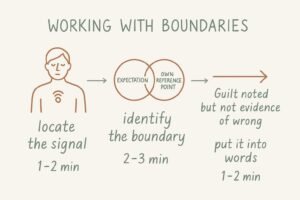
STEP 1: Locate the signal (1–2 minutes)
At some point this week, was there a moment of heaviness that arrived after agreeing to something?
Was there a physical location for that heaviness? Around the chest, the stomach, the shoulders.
Confirm it without evaluation. Not an assessment of whether it was justified — just the fact that it was there.
That moment — whatever its specific form — is the self-signal this practice is trying to recover.
STEP 2: Identify the boundary (2–3 minutes)
Choose one situation where that signal appeared.
Bring two questions inward, without requiring answers:
In this situation, what do I want to protect?
Given where I am right now, what can I offer without the signal arriving afterward?
The purpose is not to arrive at a decision. It is to separate — even slightly — the other person’s expectation from one’s own reference point. That separation is what emotional fusion has been making difficult.
STEP 3: Put the boundary into words (1–2 minutes)
Translate what was confirmed into simple language. The function is not to persuade — it is to state a condition accurately.
That isn’t something I can take on right now.
I’ll need to pass on this one.
I can help with this part, but not that one.
When guilt arrives afterward — and it may — that is not evidence the boundary was wrong. It is the pain circuit running as it was designed to run.
Session 3: Three Findings That Explain the Structure
Why boundary-setting feels like danger
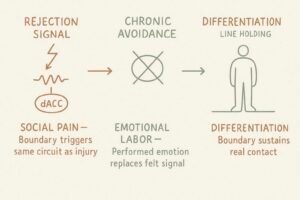
Naomi Eisenberger and colleagues’ social pain overlap theory, from Science (2003), established that social rejection activates neural circuitry overlapping with physical pain processing, specifically the dorsal anterior cingulate cortex and anterior insula. The fear of being disliked that makes boundary-setting feel dangerous is not a cognitive distortion. It is a pain signal, processed through the same architecture as a physical injury. The circuit’s evolutionary calibration was accurate — but contemporary social refusals carry none of the survival stakes that originally calibrated it. The guilt and dread that follow a boundary are this system doing precisely what it was built to do.
How pain-avoidance erodes the self-signal
The way that pain-avoidance generates a second problem — the erosion of self-signal — is where Arlie Hochschild’s account of emotional labor, from The Managed Heart (1983), provides the social layer. Hochschild described the management of one’s emotional expression to meet situational expectations — suppressing what is felt, performing what is required — as emotional labor. Her central observation was that when this management becomes chronic, the boundary between the performed emotion and the felt emotion begins to dissolve. What was once a deliberate performance becomes the default register, and the felt signal underneath it becomes progressively harder to access. In the context of boundary-setting, this erosion means that the internal signal I do not want to agree to this — the signal that would make a boundary’s location legible — arrives late, or not at all. Eisenberger’s pain circuit creates the motivation to avoid rejection; Hochschild’s account explains how that avoidance, practiced continuously, removes the instrument by which boundaries could be located in the first place.
Why the boundary strengthens rather than damages
Murray Bowen’s theory of differentiation of self, from Family Therapy in Clinical Practice (1978), extends the structure. Bowen defined differentiation as the capacity to maintain a distinct emotional position in the presence of another person’s emotional state — to remain in contact without merging. In less differentiated states, another person’s dissatisfaction registers as one’s own failure; another person’s expectation functions as one’s own obligation. Lower differentiation increases sensitivity to rejection, which increases emotional labor, which further erodes the self-signal that differentiation requires. Bowen’s clinical observations showed that increases in differentiation — the drawing of clearer boundaries — raise relational anxiety in the short term while increasing mutual autonomy and relational sustainability over time. A boundary does not end contact. It ends the version of contact in which one person’s actual state is not present in the exchange, and makes room for the version in which it is.
Conclusion: What the Guilt Was Signaling

The guilt after a boundary was the social pain circuit operating as designed — not a message that the boundary was wrong, but a nervous system event with evolutionary origins running in a context that no longer matches its original purpose.
Emotional labor had been dissolving the signal that would have made the boundary’s location clear. Fusion had been making another person’s expectations difficult to distinguish from one’s own.
The boundary didn’t end the relationship. The fusion was doing that — just slowly, and without either person noticing.
KEY TERMS
Social Pain Overlap Theory
Naomi Eisenberger and colleagues’ finding, from Science (2003), that social rejection activates neural circuitry overlapping with physical pain processing — specifically the dorsal anterior cingulate cortex and anterior insula. The theory reframes the dread and guilt associated with boundary-setting: these are pain responses with evolutionary origins, not evidence that the boundary was inappropriate. The circuit’s sensitivity developed in contexts where social exclusion carried survival consequences; in contemporary relationships, it activates with equivalent intensity in the absence of equivalent stakes.
Emotional Labor and Self-Signal Loss
Arlie Hochschild’s account, from The Managed Heart (1983), of the chronic management of emotional expression to meet situational expectations — and the progressive dissolution of the boundary between performed and felt emotion that results. In the framework of boundary-setting, Hochschild’s key observation is that chronic emotional labor erodes the self-signal that would make a boundary’s location legible — producing the experience of agreeing to something and registering the cost only afterward.
Differentiation of Self and Emotional Fusion
Murray Bowen’s concept, from Family Therapy in Clinical Practice (1978), of the capacity to maintain a distinct emotional position in the presence of another person’s emotional state. In less differentiated states, another person’s dissatisfaction registers as one’s own failure, and another person’s expectation functions as one’s own obligation — the condition Bowen termed emotional fusion. Lower differentiation increases sensitivity to rejection, which increases emotional labor, which further erodes the self-signal differentiation requires: the three dynamics form a mutually reinforcing cycle.
The Paradoxical Effect of Boundaries
The clinical and theoretical observation, grounded in Bowen’s differentiation research, that boundaries increase relational anxiety in the short term while improving relational quality and sustainability over time. A relationship maintained through continuous accommodation appears stable while accumulating emotional exhaustion on one side — exhaustion that produces gradual withdrawal. Boundaries make visible what fusion was concealing: that one person’s actual state was absent from the exchange. Their function is not to end contact but to replace performed contact with contact between two people whose actual positions are present.