
Introduction: The Harder You Are on Yourself, the Worse It Gets

After a failure, the internal voice arrives. I should have done better. Feeling this bad about it is weak. Next time, no mistakes.
This voice presents itself as motivation. The research shows the opposite. Self-criticism does not increase motivation. It reduces the willingness to try again, intensifies the fear of failure, and increases avoidance behavior.
This paradox is hardest to see in people with high achievement orientation — and in those from cultural contexts where demanding internal standards are the expected norm. Self-criticism feels like it is working because the belief underlying it is that without the criticism, there would be nothing to keep things moving. But that belief is itself a product of the state self-criticism produces.
This article traces what self-criticism is doing to the nervous system, and how self-compassion functions as an intervention in that circuit — not as a moral softening, but as the activation of a different system entirely.
Session 1: What Self-Criticism Is Actually Doing

When the self-critical voice arrives, two things are happening in the nervous system simultaneously.
The first is the activation of the threat system. Self-criticism uses the same circuit as external criticism — the internal voice saying I am not good enough is processed by the nervous system as a threat. Cortisol rises, thinking narrows, and the capacity for risk-taking contracts. The reason self-criticism feels like it is producing motivation is that while the threat system is running, alternatives to the critical stance become harder to access.
The second is the suppression of the affiliative system — the circuit that supports the sense that the current self is sufficient and that failure is recoverable. While self-criticism keeps the threat system activated, this system cannot function as it is designed to. The felt sense of safety that would make trying again feel possible is exactly what the threat system is suppressing.
Self-compassion is not a moral effort. It is the deliberate activation of a circuit different from the one self-criticism engages — one that processes failure as recoverable rather than as evidence.
Session 2: Activating the Other Circuit
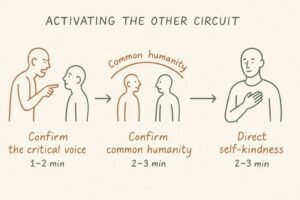
STEP 1: Confirm the critical voice (1–2 minutes)
Is a self-critical voice present right now? I should have done better. Why did this happen. I’m not enough. Any form counts.
Without trying to stop it, confirm that it is there.
Something in me is being critical right now. That confirmation is the first movement — from being inside the critical voice to observing that it has arrived.
STEP 2: Confirm common humanity (2–3 minutes)
The difficulty being felt right now — the shame around failure, the sense of falling short, the feeling of being behind — is not unique to this situation or this person.
Someone else is in a version of this moment right now. Many people are. This is not consolation. It is an accurate description of what the human experience of failure looks like across individuals.
This is something that happens to people. It is happening now.
When the sense of isolation loosens, the intensity of the threat system changes.
STEP 3: Direct self-kindness (2–3 minutes)
Bring the same quality of attention toward the self that would come naturally toward a close friend in the same situation.
Of course this is hard. This much effort, and it still didn’t work.
Failing at this and being a failure are not the same thing.
It is acceptable to rest for a moment before continuing.
If the words feel unfamiliar or hollow, that is where the practice begins — not after the feeling arrives, but in running the circuit that allows it to.
Session 3: The Threat System and Self-Criticism, Neural Circuits, the Motivation Paradox, and What Self-Compassion Opens
Paul Gilbert’s account of self-criticism and the threat system, developed in Clinical Psychology & Psychotherapy (2005), proposes that human emotional regulation is organized around three distinct systems: the threat and self-protection system, the drive and resource-acquisition system, and the affiliative and soothing system. What Gilbert’s research established is that self-criticism activates the threat system in the same way external criticism does — the internal voice I am not good enough is not distinguished by the nervous system from an external attack. Cortisol rises, attentional scope narrows, and the affiliative system is suppressed. In cultural environments where high academic and professional achievement are internalized as baseline expectations — and where demanding self-standards are treated as markers of seriousness rather than sources of harm — this threat system tends toward chronic activation. The belief that self-criticism is necessary for performance persists precisely because, in a persistently activated threat state, the alternative is difficult to imagine.
That self-criticism and self-compassion engage different neural circuits was confirmed by Longe and colleagues in a neuroimaging study published in NeuroImage (2010). Longe’s research found that self-critical processing activates the lateral prefrontal cortex and dorsal anterior cingulate cortex, while directing compassion toward the self activates the left temporoparietal junction and right inferior frontal gyrus — regions associated with empathic processing of others. The same experience — one’s own failure — is processed through different circuitry depending on whether it is met with criticism or with compassion. Self-compassion is not a softened version of self-criticism. It is a different neural operation, engaging systems that self-criticism suppresses.
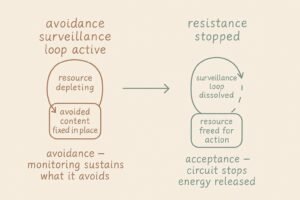
Why self-criticism reduces rather than increases motivation — and why high-achieving people are particularly susceptible to missing this — is where Gilbert and Procter’s research in Clinical Psychology & Psychotherapy (2006) and Neff and colleagues’ work in Journal of Research in Personality (2005) address the same paradox from complementary directions. Gilbert and Procter showed that when the threat system is running, safety behaviors and avoidance are reinforced — the drive to avoid failure suppresses the willingness to attempt. Neff and colleagues found that people higher in self-criticism show lower re-engagement motivation after failure and are more likely to process failure as evidence about their fundamental worth rather than as information about a specific attempt. The belief that self-criticism is the engine of performance is, from within the threat-activated state, nearly impossible to question — short-term tension and focus can look like evidence that the criticism is working, while the longer-term accumulation of avoidance and exhaustion remains invisible. High-achieving populations in performance-oriented cultural contexts are particularly likely to inhabit this pattern without recognizing it as a structural problem rather than a personal one.
Neff and Germer’s study of an eight-week Mindful Self-Compassion program, published in Journal of Clinical Psychology (2013), documents how this structure shifts with training. Their findings showed significant reductions in self-criticism, rumination, and emotional exhaustion following training, alongside increases in self-compassion, mindfulness, and life satisfaction. The mechanism, consistent with Gilbert’s three-system model, is not a direct reduction of the threat system’s activity but the strengthening of the affiliative circuit — the system that processes failure as recoverable rather than as dangerous. Re-engagement motivation and learning orientation recover not because the critical voice has been silenced but because a different system is now running alongside it, and processing the same material differently.
Conclusion: What the Critic Was Costing

Self-criticism was activating the threat system and suppressing the affiliative circuit. That state was reinforcing avoidance motivation and quietly reducing the willingness to try — the opposite of what the critical voice claimed to be producing.
Self-compassion is the other circuit. Not the absence of standards, and not the denial of failure — but the activation of the system that processes failure as something recoverable rather than something to be defended against.
Self-criticism was never the engine. It was the threat system — running continuously, at the cost of everything it claimed to protect.
KEY TERMS
Threat System and Self-Criticism
Paul Gilbert’s account, from Clinical Psychology & Psychotherapy (2005), of self-criticism as an activator of the threat and self-protection system — the same circuit engaged by external criticism. The finding reframes self-criticism as a nervous system event rather than a motivational strategy: cortisol rises, attentional scope narrows, and the affiliative system is suppressed. Gilbert’s three-system model — threat, drive, and affiliative — provides the evolutionary framework within which self-compassion functions not as moral leniency but as the activation of a suppressed regulatory system. His Compassion Focused Therapy applies this framework clinically, with particular attention to populations in whom the threat system has become chronically activated through early experience or sustained high-performance environments.
Neural Circuits of Self-Criticism and Self-Compassion
Longe and colleagues’ neuroimaging finding, from NeuroImage (2010), that self-criticism and self-compassion activate distinct neural circuits. Self-critical processing engages the lateral prefrontal cortex and dorsal anterior cingulate cortex; self-compassionate processing engages the left temporoparietal junction and right inferior frontal gyrus — regions associated with empathic processing of others. The finding provides the neural basis for understanding self-compassion as a different circuit activation rather than a modulated version of self-criticism, and connects to Gilbert’s three-system model by identifying which systems are engaged by each mode of self-relating.
The Self-Criticism and Avoidance Motivation Paradox
Gilbert and Procter’s finding, from Clinical Psychology & Psychotherapy (2006), that threat system activation reinforces safety behaviors and avoidance — suppressing the willingness to attempt — combined with Neff and colleagues’ finding, from Journal of Research in Personality (2005), that higher self-criticism predicts lower re-engagement motivation after failure. Together, these findings describe the structural paradox: self-criticism presents as a performance driver while functioning as an avoidance reinforcer. The belief that self-criticism is necessary for motivation is itself a product of the threat-activated state in which alternatives are difficult to perceive. High-achieving individuals in performance-oriented cultural contexts are particularly susceptible to this pattern remaining invisible.
Three Components of Self-Compassion
Kristin Neff’s framework, published in Self and Identity (2003), defining self-compassion as the integration of mindfulness — observing self-critical experience without over-identification — common humanity — recognizing that suffering and failure are universal human experiences rather than signs of individual deficiency — and self-kindness — responding to one’s own difficulty with the warmth and understanding one would offer a close friend. The framework generated the Self-Compassion Scale and a substantial empirical research program examining its mechanisms and clinical applications.
Effects of Self-Compassion Training
Neff and Germer’s findings from an eight-week Mindful Self-Compassion program, published in Journal of Clinical Psychology (2013), showing significant reductions in self-criticism, rumination, and emotional exhaustion alongside increases in self-compassion, mindfulness, and life satisfaction. The mechanism is consistent with Gilbert’s model: training strengthens the affiliative circuit rather than directly suppressing the threat system, shifting how failure is processed — from threat signal to recoverable experience. The recovery of re-engagement motivation and learning orientation following training provides the clinical basis for understanding self-compassion not as a performance compromise but as the condition under which sustained motivation becomes structurally possible.