
Introduction: It Was Only a Work Problem — So Why Does Everything Feel Like It’s Collapsing

The project failed. The evaluation came back lower than expected. The sense of being a reliable presence — for a partner, a team, a child — briefly gave way.
What arrived alongside that moment was not only the difficulty of what had happened in that specific domain. It was a larger feeling: that something about who you are had been called into question. A threat to a role became, somehow, a threat to the self.
This is not a sensitivity problem. It is a structural one — a question of how completely the role and the self have merged, and how rigid the self-concept holding them together has become.
This article traces that structure, and describes what changes when the boundary between role and self becomes legible again.
Session 1: How Role Identification Produces Exhaustion

I have to be a competent professional. I have to be a good parent. I need to be the person others can rely on. These are role expectations. The roles themselves are not the problem. What determines the degree of emotional exhaustion is how completely the role has been absorbed into the definition of self.
When role and self have merged, a threat to the role is processed as a threat to the entire self. A project that goes poorly becomes not this particular effort didn’t work but I am someone who fails. The role was the vehicle for the conclusion about the person. That processing happens because the boundary between the two has dissolved.
A second structure compounds this. The more rigid the self-concept — the narrower and more fixed the definition of who one is — the more vulnerable the whole self becomes to any single threat. When the self is defined primarily through one role, that role’s instability becomes the self’s instability. The intensity of the suffering that follows a role threat is determined not only by the role’s importance but by how much of the self-concept it is carrying.
Session 2: Stepping Back From the Role
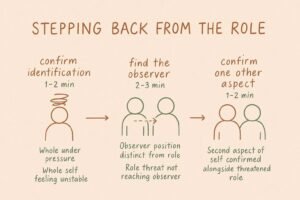
STEP 1: Confirm the degree of identification (1–2 minutes)
Is there a role or self-image that feels threatened right now? A version of I have to be this kind of person that is under pressure?
Notice how far the identification extends. When that role is threatened, does the whole self feel unstable?
Confirm this without evaluation. The strength of the identification is structural information, not a personal failure.
STEP 2: Find the one who is observing the role (2–3 minutes)
Choose one role that is currently under pressure.
Move from I am this role toward I am observing this role being threatened.
The role of “competent professional” is feeling threatened right now.
The role of “reliable presence” is registering as insufficient.
The one observing the role is not the role itself. This single step — however small — partially decouples the role’s stability from the self’s stability.
STEP 3: Confirm one other aspect of the self (1–2 minutes)
Identify one aspect of yourself that is separate from the role currently under pressure.
If a professional role is unstable, bring attention to a relational aspect of the self. If a relational role is under pressure, bring attention to something held as an interest or value. Any aspect, however minor, is sufficient.
This role is not the whole of what I am.
That confirmation does not require the role to stop mattering. It restores a degree of multiplicity to a self-concept that has narrowed around a single point.
Session 3: Four Findings That Explain the Spread
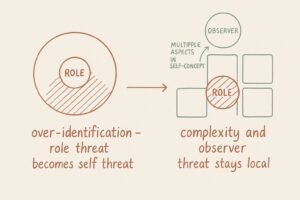
How role identification generates emotional exhaustion
Christina Maslach’s research on burnout, developed across her foundational work in the early 1980s, established the relationship between role over-identification and emotional exhaustion. Maslach’s finding was that emotional exhaustion — the central symptom of burnout — is closely associated with the degree to which a role has been absorbed into self-definition. The relevant variable is not depth of engagement with the role but degree of identification with it: people who are deeply engaged with their work while maintaining a distinction between role performance and self-worth process difficulty differently from those for whom the role and the self have merged. When the role is how the self is defined, the role’s instability becomes the self’s instability — and the emotional cost of role-related difficulty scales accordingly.
How self-concept rigidity determines how far the damage spreads
Jennifer Campbell’s research on self-concept clarity, published in Journal of Personality and Social Psychology (1990), identifies the psychological mechanism by which role threats spread to the whole self. Campbell’s finding was that the more fixed and rigid the self-concept — the narrower and more internally consistent the definition of who one is — the more vulnerable the whole self becomes to destabilization by external evaluation or change. In a rigid self-concept organized primarily around a single role, a threat to that role is processed as a threat to the defining structure of the self.
Why distributing the self-concept creates a buffer
Patricia Linville’s self-complexity research, published in Journal of Personality and Social Psychology (1987), identifies the structural buffer. Linville’s finding was that people whose self-concepts comprised multiple independent aspects — professional, relational, interests, values — showed less generalization of negative affect from a threat to one aspect across the others. When professional identity occupies most of the self-concept’s available space, a work failure becomes a self failure. When the self-concept is more complex, the same failure is processed within a smaller portion of the total structure. Releasing role attachment requires restoring the multiplicity that over-identification had compressed.
The observer position that decouples role from self
Ethan Kross and Ozlem Ayduk’s decentering research, synthesized in Perspectives on Psychological Science (2011), and Steven Hayes’s self-as-context framework, from Acceptance and Commitment Therapy (1999), address the same capacity from different directions. Kross and Ayduk showed that adopting a distanced observer perspective toward one’s own thoughts and emotional states — moving from I feel this to I notice that I am feeling this — reduces self-referential rumination and improves emotional regulation. Hayes’s self-as-context concept is the clinical formulation of the same operation: the capacity to observe thoughts, feelings, and roles as contents that arise within experience, rather than as definitions of the self that experiences them. The suffering that follows role threat is generated by the identification of self with role content. Both frameworks point toward the observer who was never identical with the role — the one who can notice the threat without being constituted by it.
Conclusion: The Role Was Never the Definition

Role over-identification was generating emotional exhaustion. Self-concept rigidity was ensuring that threats to the role reached the whole self. The suffering was proportional not to the role’s importance but to how completely the self had been absorbed into it.
Self-concept complexity restores the buffer. Decentering restores the observer. Neither requires the role to matter less — only that it occupy less of the total space in which the self is defined.
The role was never the self. The exhaustion came from treating it as if it were.
KEY TERMS
Role Identification and Burnout
Christina Maslach’s finding, developed across her foundational work in the early 1980s, that emotional exhaustion correlates with degree of role over-identification rather than depth of role engagement. When the role becomes the definition of the self, role instability is processed as self instability — scaling the emotional cost of difficulty beyond what the situation itself warrants.
Self-Concept Rigidity
Jennifer Campbell’s finding, from Journal of Personality and Social Psychology (1990), that a more fixed and narrow self-concept is more vulnerable to destabilization by external evaluation or change. When the self is primarily defined through one role, that role’s threat becomes a threat to the defining structure of the whole self — the mechanism through which role over-identification produces its widest effects.
Self-Complexity
Patricia Linville’s finding, from Journal of Personality and Social Psychology (1987), that self-concepts comprising multiple independent aspects show less generalization of negative affect from a threat to any one aspect. The buffer operates structurally: a threat reaches a smaller proportion of the total self-concept when that concept is more complex. Releasing role attachment requires restoring the multiplicity that identification had compressed.
Decentering and Self-as-Context
Ethan Kross and Ozlem Ayduk’s finding, from Perspectives on Psychological Science (2011), that observer-perspective reduces self-referential rumination, combined with Steven Hayes’s self-as-context framework (Acceptance and Commitment Therapy, 1999) — observing roles as contents arising within experience rather than definitions of the self. Both frameworks point toward the observer who was never identical with the role: the one who can notice the threat without being constituted by it.