
Introduction: The Processing That Fixes the Problem in Place

A colleague who is always critical. A partner who always gets defensive. A family member who always triggers the same argument.
The word always is the signal. When another person’s behavior is processed as a stable characteristic — this is who they are — the relationship pattern that both people are maintaining together becomes invisible. The attribution lands on the person. The loop keeps running.
This processing is not a moral failure. It is how the brain is built to explain other people’s behavior. But the explanation it generates — the problem is their personality — removes from view the part of the pattern that can change: the contribution this side of the exchange is making.
This article traces why the attribution happens, how the loop is maintained, and why a single change in one element of the system changes the pattern as a whole.
Session 1: The Pattern Is Running Between Two People, Not Inside One of Them

When a relational pattern repeats, two things are operating simultaneously.
The first is a cognitive tendency. When explaining another person’s behavior, the mind reliably favors personal explanations — their character, their intentions, their temperament — over situational ones. The context in which the behavior occurred, the history of interactions that preceded it, the way this side of the exchange may be shaping it — these tend to recede. The colleague’s criticism becomes they are a critical person rather than criticism and defensiveness are running as a loop between us. The attribution is clean and stable. The loop is neither.
The second is a structural feature of how relational patterns are maintained. What looks like one person’s characteristic behavior is frequently a pattern that two people are sustaining together through their responses to each other. Criticism generates defensiveness; defensiveness generates more criticism. Silence generates one-sided talking; one-sided talking generates more silence. The loop does not have a single origin point. It is a shared structure, running in the space between two people, maintained by both. The question of who started it is itself part of the loop — it keeps the focus on origin rather than on the pattern’s current operation.
Where these two features overlap is where the sense of this can’t change is produced. The attribution locates the problem in the other person’s fixed characteristics. The loop continues because neither person is looking at the loop — each is responding to what the other just did, without seeing the larger pattern both are running.
Session 2: Working With the Pattern
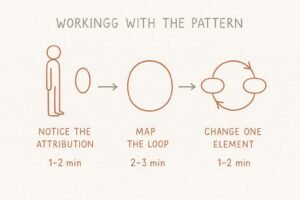
STEP 1: Notice the attribution (1–2 minutes)
Is there a repeating relational pattern present right now — something that feels like they are always this way?
Notice whether an attribution to the other person’s character or intention has arrived. The attribution itself is a natural cognitive response, not a problem to be corrected.
An attribution to their personality is running.
This noticing is the first movement — from inside the attribution to observing that it has arrived.
STEP 2: Map the loop (2–3 minutes)
From a slight distance from the attribution, observe the pattern as an interaction between two elements.
Bring two questions inward:
How am I responding to what they do?
How might my response be shaping what they do next?
No conclusion is required. The operation is tracing the loop — criticism, defensiveness, more criticism; silence, one-sided talking, more silence — as a shared structure rather than a fixed trait.
STEP 3: Change one element on this side (1–2 minutes)
Identify one small change available on this side of the loop — not an attempt to change the other person, but a single adjustment to this side’s contribution to the pattern.
Where the response has been defensive, try listening once. Where the response has been silence, try saying one brief thing. The change does not need to be large. When one element of a system shifts, the other elements are affected.
Session 3: Four Findings That Explain the Loop
Why the attribution lands on the person
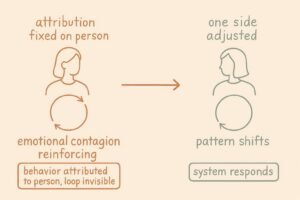
Lee Ross’s identification of the Fundamental Attribution Error, published in Journal of Experimental Social Psychology (1977), establishes the cognitive starting point. Ross documented the tendency to explain other people’s behavior by reference to their personal characteristics — their disposition, intentions, or temperament — rather than to situational factors such as context, history, or the relational dynamic in which the behavior occurred. The practical consequence is that behavior generated partly by the interaction pattern gets attributed entirely to the other person’s character. The possibility that the criticism is partly a response to something on this side of the exchange, or that the defensiveness is partly a response to a longer history of interaction, drops out of view once the attribution has landed. Ross’s bias provides the cognitive mechanism through which the loop becomes invisible: the problem is located in a fixed personal characteristic, and the shared pattern generating the behavior is not looked at.
How the loop sustains itself
Paul Watzlawick and colleagues’ interactional communication theory, from Pragmatics of Human Communication (1967), describes the structure the attribution was obscuring. Watzlawick’s framework showed that relational patterns are not properties of individuals but products of the communicative interaction between them — sustained and reinforced through the responses each person makes to the other. Criticism generates defensiveness, which generates more criticism; withdrawal generates pursuit, which generates more withdrawal. These are feedback loops without a single origin point: both people are contributing to the pattern’s continuation through their sequential responses. Watzlawick’s analysis identified something that makes these loops particularly hard to exit: the question of who started it — the punctuation of the sequence — is itself a move within the loop, not an escape from it. It sustains the attribution-based processing Ross described while the loop continues to run.
The emotional layer beneath the behavioral one
Elaine Hatfield and colleagues’ emotional contagion research, published in Psychological Inquiry (1993), provides the mechanism that keeps the loop running beneath conscious processing. Hatfield’s research showed that emotional states are transmitted automatically and largely unconsciously through interpersonal contact — through the mimicry of facial expression, vocal tone, and posture — causing one person’s emotional state to synchronize with another’s. A defensive tone elicits a defensive response; an anxious presentation produces anxiety in the person receiving it; frustration carried from one context transmits into the next interaction. The loop Watzlawick described operates not only at the level of behavior and communication but at the level of emotional state — each person’s feeling in the exchange is partly a product of the other’s, creating an emotional reinforcement of the behavioral pattern that runs independently of intention.
Why changing one element changes the whole
Murray Bowen’s family systems framework provides the clinical basis for why changing one element of a shared loop changes the pattern as a whole. Bowen’s observations showed that when one person in a relational system increases their differentiation — their capacity to maintain a distinct emotional position rather than merging with the emotional field of the interaction — the pattern of the system as a whole shifts. The other person is affected not because they were persuaded or confronted but because the loop they were both running no longer has the same input on one side. The direction of change is not toward the other person but toward one’s own contribution to the shared pattern. What Theravāda Buddhism recorded as dependent origination (Paṭicca-samuppāda) arrived at the same observation through a different path: the conflict was not a property of either person but an event arising from conditions both were contributing. Change one condition, and what arises from those conditions changes.
Conclusion: The Loop Was Always Shared

The attribution to the other person’s character was the cognitive move that made the loop invisible. The loop sustained itself through behavioral reinforcement and emotional contagion, neither of which required intention from either side. The pattern was not who they were. It was what both people were doing, in sequence, without either one seeing the whole.
Changing one element on this side of the loop does not require the other person to cooperate, agree, or even notice. The loop has no way to run without the input on one side — and that input is the one element available to change.
The conflict wasn’t between two people. It was a pattern two people were running together.
KEY TERMS
Fundamental Attribution Error
Lee Ross’s finding, from Journal of Experimental Social Psychology (1977), that people explain others’ behavior by reference to personal characteristics rather than situational factors — including the relational context and interaction history that may be generating the behavior. In relational conflict, the bias locates the problem in the other person’s fixed traits, making the shared loop invisible.
Mutual Reinforcement Loop
Paul Watzlawick and colleagues’ account, from Pragmatics of Human Communication (1967), of relational patterns as products of communicative interaction rather than properties of individuals — sustained through the sequential responses each person makes to the other. The loop has no single origin point; both people contribute to its continuation. The question of who started it is itself a move within the loop, sustaining attribution-based processing while the pattern continues to run.
Emotional Contagion
Elaine Hatfield and colleagues’ finding, from Psychological Inquiry (1993), that emotional states transmit automatically through interpersonal contact via mimicry of facial expression, vocal tone, and posture. Provides the emotional reinforcement layer beneath the behavioral loop — each person’s feeling in the exchange is partly a product of the other’s, sustaining the pattern independently of conscious intention.
Differentiation and System Change
Murray Bowen’s clinical observation from family systems therapy that when one person in a relational system increases their differentiation — maintaining a distinct emotional position rather than merging with the interaction’s emotional field — the system’s pattern as a whole shifts. The mechanism is structural: changing one element of a shared loop changes what the loop produces. Corresponds to what dependent origination (Paṭicca-samuppāda) describes as the mutual dependence of conditions — alter one condition, and what arises from those conditions changes.