
Introduction: The List That Doesn’t End

The tasks were completed. The goal was reached. By the next morning, a new set of requirements had already taken their place. The sense of accomplishment arrived briefly, if at all, and was replaced almost immediately by the next thing that needed doing.
This is not a planning failure or a deficit of discipline. Achievement converts into a new baseline — and from that new baseline, the sense of having done enough becomes structurally unavailable. The more that is accomplished, the higher the standard against which the next day begins.
At the same time, the feeling of sufficiency is available from a different direction. Not from how much was produced, but from the quality of how the time was experienced — the depth of engagement with what was actually present. This article traces why the productivity path leads to a dead end, and where the alternative is.
Session 1: The Structure That Makes “Enough” Unavailable

The exhaustion that follows sustained productivity has two layers.
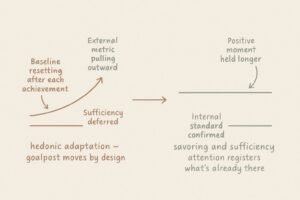
The first is that achievement continuously resets the baseline. The satisfaction that accompanies completing something tends to be absorbed quickly — what was difficult yesterday becomes ordinary today, and what was exceptional last month becomes the minimum expected this week. This is not a moral failure or a sign that the goals were the wrong ones. It is a feature of how the nervous system responds to change: it is designed to register differences from baseline, not stable states. Achievement produces a difference; the system registers it briefly; the baseline updates; the difference disappears. The pursuit of the next achievement begins immediately, because the system is now calibrated to the new level.
The second layer is that pursuing productivity as an external metric moves in the opposite direction from what generates lasting wellbeing. The drive to produce more, accomplish more, and be assessed as more effective draws attention toward outputs that can be measured and evaluated by others. What those outputs cannot provide is what research consistently shows to be the primary source of sustained wellbeing: the intrinsic satisfactions of autonomy, connection, growth, and meaning. The more heavily external metrics are weighted, the more distant the internal sources of satisfaction become. Not because they disappear — but because the orientation that external goals require is systematically incompatible with the orientation that intrinsic ones need.
Where these two layers compound each other, the belief that more achievement will eventually produce sufficiency becomes structurally self-defeating. The way out is not more achievement. It is a different dimension of the same hours.
Session 2: Changing the Quality of the Experience
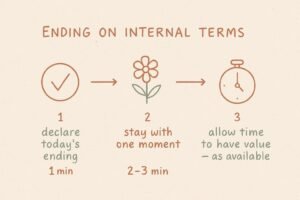
STEP 1: Declare today’s ending (1 minute)
Before closing out the day, confirm one thing that was done.
Today, this happened. That is enough for today.
This is not a denial of what remains unfinished. It is a deliberate step outside the external standard of evaluation — a single moment of registering completion on internal terms rather than against the baseline that tomorrow will already have moved. The declaration does not need to be large. Its function is to create a moment in which sufficiency is confirmed rather than deferred.
STEP 2: Stay with one moment (2–3 minutes)
Bring to mind one moment from today that was, in some small way, good — something that registered, even briefly, as worth noticing.
Rather than moving past it immediately, stay with it a little longer.
Remaining here with this, now.
The coffee’s warmth, a brief exchange, the quality of light through a window — anything. Direct attention to the specific details within that experience. This deliberate dwelling is the operation that counteracts hedonic adaptation before it completes its reset.
STEP 3: Allow unproductive time to have value (as available)
At some point in the day, hold a period of time that produces nothing.
No phone, no processing, no input — simply being present without generating output.
This time is not for anything. It is enough on its own.
This reframing moves the valuation of time from an external metric — what was produced per hour — toward the intrinsic quality of the experience itself. The shift does not require a long time. It requires a different relationship to whatever time is available.
Session 3: Four Findings That Explain Why the Path Ends There
Why satisfaction keeps resetting
Philip Brickman and Donald Campbell’s adaptation-level theory (1971), developed by Shane Frederick and George Loewenstein in Well-Being: The Foundations of Hedonic Psychology (1999), establishes the structural mechanism. The nervous system registers deviations from baseline rather than stable conditions — meaning stable achievement produces no ongoing positive signal. Each accomplishment updates the standard from which the next is assessed. The belief that the next goal will finally produce lasting sufficiency is the experience of hedonic adaptation in progress — the goalpost moves because the system is designed to move it.
Why external metrics pull in the wrong direction
Tim Kasser and Richard Ryan’s research — from Journal of Personality and Social Psychology (1993) and Personality and Social Psychology Bulletin (1996) — identifies the motivational mechanism through which pursuing productivity as an external metric works against sustained wellbeing. Kasser and Ryan showed that extrinsic aspirations — financial success, social recognition, appearance — predicted lower vitality and more physical symptoms, while intrinsic aspirations — self-acceptance, affiliation, community contribution — predicted higher wellbeing. Extrinsic goal pursuit does not satisfy the basic psychological needs that intrinsic goals address. External metrics pull orientation toward evaluation by others and away from the internal sources of satisfaction those metrics were meant to serve.
What actually shifts when the productivity orientation is set aside
Cassie Mogilner’s time affluence findings, from Psychological Science (2010), identify what becomes available when attention moves away from output. Participants primed to think about time — rather than money — reported higher happiness and chose more socially connecting activities. The subjective sense of having enough time is determined not by objective time available but by how time is used and what attention is directed toward. Felt time richness is generated by depth of present engagement rather than volume of output.
The mechanism that keeps attention long enough to register
Fred Bryant and Joseph Veroff’s account of savoring, from Savoring (2007), identifies the practical operation that counteracts adaptation. Deliberately attending to a positive experience — directing attention to its specific details and staying with it rather than moving past — increases subjective wellbeing and engages attention before the hedonic adaptation reset completes. What Theravāda Buddhism described as contentment (Santutthi) — the active recognition of sufficiency in what is already present — arrived at the same operational conclusion: not the passive acceptance of less, but the deliberate engagement with what is already available, before the system moves on to what isn’t. Savoring is what keeps attention there long enough to register it.
Conclusion: Enough Was Never at the End of the List

Hedonic adaptation had been resetting the baseline faster than achievement could satisfy it. Extrinsic goal pursuit had been pulling orientation away from the sources of wellbeing that external metrics cannot provide. Time affluence and savoring locate sufficiency in a different dimension: not in how much was produced, but in how fully what was present was met.
Productivity optimizes the hours. It doesn’t touch what makes them feel like enough.
KEY TERMS
Hedonic Adaptation
Philip Brickman and Donald Campbell’s adaptation-level theory (1971), developed by Shane Frederick and George Loewenstein in Well-Being: The Foundations of Hedonic Psychology (1999), showing that positive affect from desirable events is rapidly absorbed into a new baseline, returning emotional states to prior levels. The nervous system registers deviations from baseline rather than stable conditions — making sustained achievement produce no ongoing positive signal. Explains why the productivity path structurally cannot deliver lasting sufficiency: each accomplishment updates the standard against which the next is measured.
Extrinsic Goals and Wellbeing
Tim Kasser and Richard Ryan’s findings, from Journal of Personality and Social Psychology (1993) and Personality and Social Psychology Bulletin (1996), that the centrality of extrinsic aspirations — financial success, social recognition — predicts lower vitality and wellbeing, while intrinsic aspirations predict higher wellbeing. Extrinsic goals fail to satisfy the basic psychological needs that generate sustained wellbeing. Provides the motivational basis for understanding why weighting productivity metrics heavily moves in the opposite direction from internal sources of satisfaction.
Time Affluence
Cassie Mogilner’s finding, from Psychological Science (2010), that the subjective sense of having enough time is determined by how time is used and what attention is directed toward — not by objective time available. Participants primed to think about time reported higher happiness and more socially connecting behavior than those primed to think about money. Felt time richness is generated by depth of present engagement rather than volume of output.
Savoring
Fred Bryant and Joseph Veroff’s account, from Savoring (2007), of deliberately attending to a positive experience — directing attention to its specific details and dwelling rather than moving past — which increases subjective wellbeing and engages attention before the hedonic adaptation reset completes. Provides the operational basis for the Theravāda Buddhist practice of contentment (Santutthi) — the active recognition of sufficiency in what is already present.