
Introduction: Why Trying to Shop Ethically Makes Shopping Feel Like a Burden

You research the production conditions of an organic cotton t-shirt down to the country of origin and labor practices — and end up buying nothing, exhausted. In the supermarket, you stand between the local vegetables and the cheaper imports and sigh. You balk at the price of the ethical brand, buy the fast fashion instead, and carry a vague guilt home with it.
This is not laziness. Between the intention and the action lies an overwhelming amount of information, a significant gap in cost, and a complexity that grows the more seriously you take it. The impossible ideal of the 100% correct choice is what prevents even the smallest step from being taken.
Session 1: The Perfectionism Trap — When Good Intentions Become Exhausting

The thinking that surrounds ethical consumption tends to lock itself into binary moral categories and demands for completeness — and in doing so, turns the act of buying things into a psychological burden.
At the center is the paralysis of all-or-nothing thinking. If it’s not completely ethical, it means nothing. This pattern erases the fact that almost everything in the real world occupies a gray zone. The possibility of compromise or incremental improvement gets foreclosed, and action freezes.
Onto this layers the cognitive load of navigating overwhelming information. Supply chains, environmental impact, labor conditions — the sense of obligation to investigate everything imposes enormous cognitive costs on what is, at its core, a routine daily activity. Shopping stops being satisfying and becomes a test with no passing grade.
Then there is the over-identification of consumer choice with personal ethics. If I don’t choose this product, I’m not an ethical person. The attributes of a product become fused with the worth of the self. A purchasing failure registers as a moral failure.
A genuinely good intention converting, paradoxically, into a system of self-surveillance and self-punishment.
Session 2: Practice — Toward a Sustainable “Good Enough”
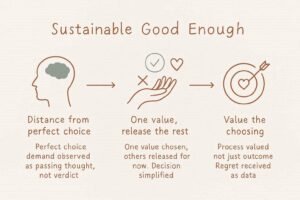
This practice is about shifting from exhausting perfectionism toward a way of choosing that can actually be maintained.
STEP 1: Create distance from the “perfect choice” demand
When the thought arrives — this isn’t fair trade so it doesn’t count or at this price point I can’t call this ethical — pause before accepting it as fact.
“My mind is running the ‘perfect choice’ story right now.”
Observe that thought as a stream of words passing through rather than a verdict to act on. This reframes the purchase decision from a moral examination of the self into what it actually is: a series of judgments made under real constraints.
STEP 2: Choose one value and release the others — for now
Environment, animal welfare, labor rights, local economy — it is not possible to honor all of these perfectly at once. Instead, identify the one value you most want to prioritize right now.
If this month’s focus is reducing plastic, make packaging the primary criterion and allow yourself to be less strict about other factors. If the current priority is supporting local economies, choose local products even when the price is higher, and extend more flexibility on certification. Concentrating on one axis simplifies the decision, and the experience of following through on it builds the foundation from which other values can naturally expand over time.
STEP 3: Value the process of choosing, not just the outcome
Loosen the grip on finding the perfect product and purchasing it as the only valid result. Find value in the process of seeking and deciding consciously.
Setting an intention before shopping — today I’ll try to notice the packaging — is itself a form of practice. When you make a choice you later regret, receiving it as a data point rather than a verdict keeps the process moving. This shift transforms consumption from a test to pass into an ongoing conversation with your own values.
Session 3: The Exhaustion Was Structural
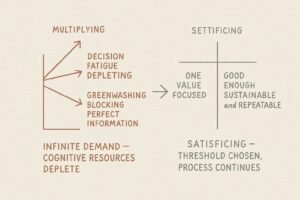
Why good intentions produce exhaustion
Psychologist Barry Schwartz’s research on the paradox of choice showed that as the number of options increases, satisfaction decreases and regret increases. With fewer choices, people tend to feel more settled about what they selected; with more, the question of whether something better existed keeps surfacing. Ethical consumption worsens this paradox to an extreme degree — by multiplying the axes of evaluation indefinitely. Environmental impact, labor conditions, transportation distance, packaging materials: every additional criterion means that no choice can be fully free of something to regret.
The good intention is genuine. But the cost of searching for the perfect choice is what makes choosing impossible.
Why ethical consumption is particularly depleting
Decision research documents a phenomenon called decision fatigue: the more decisions a person makes, the more their cognitive resources deplete, and the lower the quality of subsequent judgments. Studies of judges, physicians, and hiring managers all show that decisions made later in the day trend toward default outcomes — refusal, the status quo, the path of least resistance. Ethical consumption accelerates this depletion by requiring multi-axis evaluation and ongoing information processing for what would otherwise be routine choices.
And perfectionism adds a further layer: the tendency to ruminate after a decision — was there something better? — retroactively undermines the meaning of the action already taken. The exhaustion is not weakness. It is the result of applying finite cognitive resources to an infinite set of demands.
The structural reason perfect information was never available
There is also a structural explanation for why perfect choices remain out of reach regardless of effort. Corporate greenwashing — the practice of exaggerating or misrepresenting environmental credentials in marketing — systematically prevents consumers from making accurate judgments. The proliferation of certification labels with inconsistent standards, the opacity of supply chains beyond a certain depth, the commercial absorption of the word “ethical” itself: these are features of the market, not failures of individual research.
The impossibility of the perfect choice is, in part, a market design problem. The asymmetry between what companies know about their products and what consumers can access is not closeable through more effort.
“Good enough” is the scientifically correct strategy
Economist Herbert Simon described two distinct approaches to decision-making: maximizing — pursuing the optimal solution — and satisficing — setting a threshold of “good enough” and selecting the first option that meets it. Applying satisficing to ethical consumption means choosing one priority value and releasing the demand on the others — which is what Session 2 STEP 2 does in practice. Schwartz’s subsequent work found that people who habitually pursue the best available option report more regret, lower wellbeing, and more difficulty making decisions than those who work with a good-enough standard.
Not pursuing the best possible choice. Pursuing a choice that is good enough to act on, and sustainable enough to repeat.
Conclusion: “Good Enough” Is Not Settling

The perfect choice does not exist — and continuing to demand it is what turns good intentions into fuel that burns out.
Choosing one value, today, and making a decision that reflects it — that is sufficient. The process continues. Nothing needs to be resolved all at once.
“Good enough” isn’t settling. It’s the only design that lasts.
KEY TERMS
Paradox of Choice
Barry Schwartz’s finding that increasing the number of options decreases satisfaction and increases regret. Ethical consumption intensifies this paradox by multiplying the axes of evaluation — environmental, labor, logistical, packaging — until no available choice is free of something to regret. The cost of searching for the perfect option is itself what makes choosing feel impossible.
Decision Fatigue
The documented depletion of cognitive resources through repeated decision-making, leading to lower-quality judgments over time. Ethical consumption accelerates this depletion through multi-axis evaluation and ongoing information demands applied to otherwise routine purchases. The exhaustion is not a failure of will — it is the predictable result of finite capacity meeting infinite criteria.
Greenwashing
The practice of exaggerating or misrepresenting environmental or ethical credentials in corporate marketing. Combined with inconsistent certification standards and supply chain opacity, greenwashing ensures that perfect consumer information is structurally unavailable — not a problem that more research can solve. The impossibility of the perfect ethical choice is, in part, a market design problem.
Satisficing
Herbert Simon’s term for the decision-making strategy of setting a “good enough” threshold and selecting the first option that meets it, rather than pursuing the optimal solution. Research consistently shows satisficing produces less cognitive depletion and higher long-term wellbeing than maximizing. The scientific basis for Session 2 STEP 2: choosing one priority value and releasing the demand on everything else.
Moral Fatigue
The depletion of moral judgment capacity through repeated ethical decision-making — the specific form of decision fatigue that applies to value-laden choices. Setting values-based criteria in advance, rather than evaluating each decision from scratch, is the primary strategy for preventing it. The practical foundation underlying all three steps of Session 2.