
Introduction: The Gap You Didn’t Know Was Occupied

Phone already open before the elevator doors have a chance to close. The brief pause between tasks filled before it can be felt. A day full of activity, and at the end of it — a particular kind of exhaustion that has nothing to do with what was accomplished.
The small gaps in the day are not empty. They are already occupied — by the next task, the unread message, the unresolved tension running on a loop. The mind that never rests is not lazy. It is running a circuit it was never asked to pause.
One breath is enough to interrupt it.
Session 1: Why the Return Is the Training

“What could one breath possibly change?” — the question is fair.
Attention drifts from the breath. The drift is noticed. Attention returns. This sequence is not a failure corrected. It is the training itself.
The brain runs a network that activates automatically whenever attention isn’t anchored to a specific task — processing past regrets, future worries, unresolved tensions, without pause. This circuit is a major source of stress and fatigue, and the elevator wait is no exception: before the phone even comes out, the brain has already moved on to the next concern.
This is precisely why the return matters. The moment attention drifts and comes back — that specific operation — directly loads the circuits that regulate where attention goes. What determines the quality of a session is not how long the focus held. It is how many times the return happened. A brief return, repeated many times across a day — the elevator wait is exactly the right training ground for that.
Session 2: The Practice — Three Steps While You Wait
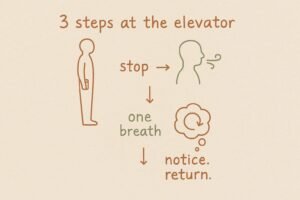
No experience needed. The moment the button is pressed, try this:
STEP 1: Stop (5 seconds)
Phone away. Feel the floor beneath both feet — the simple, physical fact of standing here.
Just this: the weight of the body, the contact with the ground.
STEP 2: One conscious breath (10–15 seconds)
Bring full attention to a single inhale and exhale. The sensation at the nostrils, the slight rise and fall of the chest or belly.
Not trying to breathe correctly — simply noticing that breathing is happening.
STEP 3: When the mind wanders, return
Why is this taking so long? Did that email get sent? — thoughts will arrive. That is not failure. The moment the drift is noticed, acknowledge it lightly:
There’s a thought — returning now.
That return is the practice. Everything else is the condition that makes it possible.
Session 3: What the Gap Is Already Doing
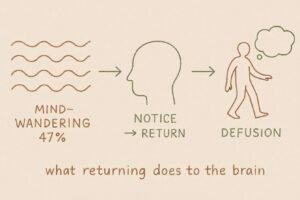
The elevator wait looks like dead time. Psychologists Matthew Killingsworth and Daniel Gilbert’s large-scale experience-sampling study found that people’s minds were away from what they were doing roughly 47 percent of waking hours — and that this wandering state was consistently associated with lower wellbeing, regardless of what the activity was. The mechanism is the brain’s default mode network: a circuit that activates automatically in the absence of a focused task, redirecting attention toward past regrets, future scenarios, and unresolved social tensions. The elevator wait doesn’t generate fatigue because of its length. It generates fatigue because the circuit is already running before the phone comes out.
What, then, does the return actually do? Neuroscientist Wendy Hasenkamp and colleagues, using real-time fMRI during meditation, mapped the precise neural events in the cycle: mind wandering, the moment of noticing the drift, the act of redirecting, and sustained focus. Each phase showed a distinct neural signature. The noticing-and-returning operation directly activated the anterior cingulate cortex and the dorsolateral prefrontal cortex — the circuits responsible for attention control. The training unit is not the period of sustained focus. It is the moment of return. A single elevator ride produces only a few of these operations. Ten rides a week, across months, is a different matter.
When Step 3 catches the thought why isn’t this elevator coming and steps back from it, a second change is taking place. Steven Hayes and colleagues identified this as defusion — the shift from being fused with a thought, in which the thought and the thinker feel identical, to observing it as a passing mental event. The content of the thought doesn’t change. Its claim on the next action loosens. This is the operation that keeps a minor irritation from setting the emotional baseline for the next hour. What Theravāda Buddhism called Sati — the quality of attention that notices what is arising without being carried away — describes the same operation from a different point of origin. The noticing, the return, the light touch on the thought: three moments in one continuous cycle.
Conclusion

The day is full of gaps — elevator waits, the two minutes before a meeting starts, the pause at a traffic light. Most of them are already occupied before they’ve begun.
One breath doesn’t ask for a free afternoon. It asks for thirty seconds and the decision to put the phone away. That is enough.
The brain had already left before the doors opened. The return was the only moment that moved anything.
KEY TERMS
Default Mode Network (DMN)
The brain circuit that activates automatically during rest and in the absence of a focused task — redirecting attention toward past events, future scenarios, and self-referential processing. Killingsworth and Gilbert’s research established that time spent in this wandering state occupies roughly 47 percent of waking hours and is consistently associated with lower wellbeing, making the small gaps in daily life cognitively costly when left uninterrupted.
Attention Control Training
The neural mechanism identified by Hasenkamp and colleagues in which the noticing-and-returning operation during breath-focused practice directly activates the anterior cingulate cortex and dorsolateral prefrontal cortex. The training unit is not the period of sustained focus but the moment of return — each return loads the attention control circuit, and the effect accumulates across repetitions.
Defusion
A core concept in Acceptance and Commitment Therapy (ACT), developed by Steven Hayes and colleagues. The shift from being fused with a thought — experiencing it as reality — to observing it as a passing mental event. The instruction in Step 3 to note there’s a thought rather than following its content is defusion in its simplest form: it reduces the behavioral pull of the thought without requiring suppression.
Sati
Pāli for “awareness.” The quality of attention that notices what is arising — a thought, a drift, a distraction — without being carried away by it. In Theravāda practice, Sati is not a technique reserved for formal meditation but a trainable quality of mind available in any moment, including the thirty seconds before the elevator arrives. Its structure maps precisely onto what Hasenkamp measured and what Hayes formalized: the noticing that precedes the return.
Mind Wandering
The state in which attention moves away from a present activity and into self-referential processing — past events, future plans, unresolved social concerns. Killingsworth and Gilbert’s experience-sampling research established that this state occupies nearly half of waking life and is associated with consistent decreases in reported wellbeing, independent of the activity being interrupted.