
Introduction: Why We’re Drawn to What Feels True Rather Than What Is

A shocking headline in the social media feed. A health claim forwarded by a friend. Political accounts that are irreconcilably opposed depending on who is telling the story. The intention is to find the truth, but what keeps getting selected is what produces the stronger emotional response, or what confirms what was already believed.
Being misled by misinformation is not an intelligence problem. It is a brain design problem.
Session 1: The Brain Prefers Information That Feels Good

Vulnerability to misinformation has almost nothing to do with education level or critical thinking capacity. When information arrives that confirms existing beliefs, the brain registers something that functions like reward. This is a neural event, not a character trait.
When content aligns with what is already believed — news that supports a political position, data that validates a health choice, a story that confirms a suspicion about a person or group — the brain’s reward circuitry activates. This happens independently of whether the content is accurate. The feeling of this is right and the feeling of this is satisfying run through overlapping neural pathways, which means the search for truth and the search for confirmation produce the same internal experience. The person who consumes misinformation is not looking for falsehood. They are following a reward signal.
Strong emotions accelerate this process. When content produces anger, fear, or surprise, the emotional response arrives before the evaluative one. The question is this true comes after the question do I want this to be true has already been implicitly answered. Misinformation exploits a sequence, not a weakness.
Session 2: Practice — Check the Reaction Before the Content
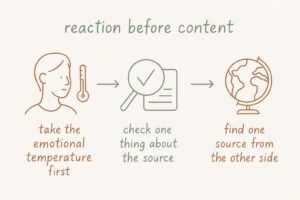
This practice is not about becoming a more rigorous fact-checker. It is about introducing a brief interval between the arrival of information and the response to it — enough to let something other than the immediate emotional reaction participate in the judgment.
STEP 1: Take the Emotional Temperature First
When a piece of information arrives, pause for a single breath before evaluating its content.
What am I feeling right now in response to this — anger, anxiety, satisfaction, relief?
The stronger the emotional response, the harder critical evaluation becomes. Simply noticing that a strong reaction is present creates a small gap between the automatic response and the decision about what to do with the information.
STEP 2: Check One Thing About the Source
Rather than attempting a thorough investigation, identify one thing about where the information came from.
What is the original source of this? Who produced it, and what was the context it came from?
This is not a demand for complete verification. It is a single question that shifts the information from an isolated fact to a situated claim — which is what every piece of information actually is. The shift in framing is enough to introduce a different quality of attention.
STEP 3: Find One Source From the Other Side
For information that feels clearly correct, find one reliable source representing a different perspective and check what it says.
What does someone who sees this differently actually argue?
This is not about changing positions. It is about making the boundary of the current information environment briefly visible. When the other side is audible, even briefly, the bubble becomes detectable — which is the minimum condition for deciding whether to stay inside it.
Session 3: The Brain Was Rewarded for Agreeing
Confirmation Felt Like Pleasure
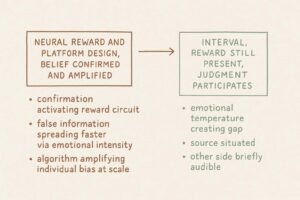
Cognitive neuroscience research has established that receiving information that aligns with existing beliefs activates reward-related neural circuitry. This activation occurs independently of the information’s accuracy. Content that supports a political position, validates a health belief, or confirms a suspicion about a group provides not only the possibility of being correct but the immediate experience of satisfaction. The tendency to seek out belief-confirming information has a neural substrate: confirmation is rewarding, and the brain pursues reward. What this means is that the search for truth and the search for pleasure are, in practice, running on the same system. The person drawn to misinformation is not making a deliberate choice to believe something false. They are following a signal that the brain uses to navigate toward what it has been built to find: confirmation, pattern-recognition, and the resolution of uncertainty. Susceptibility to misinformation is a feature of the reward system doing its job.
The Lie Outran the Truth
A large-scale analysis of Twitter data published in 2018 by Soroush Vosoughi and colleagues at MIT examined the spread of true and false information across the platform over more than a decade. The finding was stark: false information spread approximately six times faster than true information, reached more people, and penetrated deeper into networks. What made this result particularly significant was where the difference came from. The asymmetry came overwhelmingly from human sharing, not from bots. The researchers identified the emotional character of the content as the primary driver: false information was more likely to contain novel, surprising, and emotionally charged material — particularly content producing fear, disgust, and surprise — and those qualities accelerated sharing. The neural reward of confirmation provides the motivation to accept belief-confirming content. The emotional intensity of false information provides the motivation to spread it. These two mechanisms operate in sequence: the brain accepts what feels confirming and amplifies what feels emotionally significant. The misinformation travels faster not because it is false but because of what it produces in the people who encounter it.
The Algorithm Reinforced What the Brain Already Preferred
Internet researcher Eli Pariser’s concept of the filter bubble describes the structural consequence of platforms learning individual user preferences and optimizing the information environment accordingly. Every click, every moment of sustained attention, every emotional reaction that keeps a user on a platform becomes data that the algorithm uses to predict what that user will engage with next. The result is an information environment progressively shaped to match the user’s existing preferences, beliefs, and emotional responses. This is the neural reward of confirmation operating at industrial scale: the brain’s preference for belief-confirming information is met by a system designed to supply it. Alternative perspectives, uncomfortable facts, and content that challenges existing frameworks are not removed — they are simply deprioritized until they are effectively invisible. The individual susceptibility that cognitive neuroscience describes is amplified by a technological infrastructure that has every incentive to keep delivering exactly what the reward system is looking for. The filter bubble didn’t create the bias. It built a machine to feed it.
Conclusion: Knowing the Design Is the First Gap

The neural reward of confirmation will keep making belief-aligned information feel satisfying tomorrow. The asymmetry of emotional propagation will keep carrying false information faster and further than true. Filter bubbles will keep narrowing the information environment to match what the reward system prefers. The structure does not change. But the question what am I feeling right now in response to this can be asked before any headline, before any forwarded message, before any piece of content that arrives with the feeling of certainty already attached. That question is the interval between the brain’s design and the judgment that follows it. The gap is small. It is enough.
The lie traveled faster not because people were foolish. It traveled faster because it felt like something.
Key Terms
Neural Reward of Confirmation Bias
The cognitive neuroscience finding that receiving belief-confirming information activates reward-related neural circuitry independently of the information’s accuracy. Confirmation feels like pleasure, which means the search for truth and the search for satisfaction run on the same system. The mechanism through which susceptibility to misinformation is a feature of the reward system rather than a failure of intelligence.
Asymmetry of Emotional Propagation
The finding from Vosoughi and colleagues’ MIT analysis that false information spreads approximately six times faster than true information across social networks — driven overwhelmingly by human sharing of emotionally novel content. False information is more likely to produce fear, disgust, and surprise, and those emotions accelerate sharing. The neural reward of confirmation explains why people accept misinformation; the asymmetry of propagation explains why it travels further. Together they describe how individual susceptibility becomes a social-scale phenomenon.
Filter Bubble
Eli Pariser’s term for the information environment produced when platform algorithms optimize content delivery based on individual user behavior — click patterns, dwell time, emotional reactions — progressively narrowing the information environment to match existing preferences and beliefs. Not a conspiracy but the structural consequence of platforms built to maximize engagement: the brain’s preference for confirming content is met by a system designed to keep supplying it. Alternative perspectives are not removed — they are deprioritized until they are functionally invisible.
Emotional Hijacking
The state in which strong emotional responses — anger, fear, surprise — arrive before evaluative processing, making the question do I want this to be true precede the question is this true. In combination with the neural reward of confirmation, emotional content accelerates the acceptance and spread of misinformation. Noticing the emotional temperature before engaging with the content is the minimum intervention that introduces a gap between the emotional response and the judgment.
Defusion
The capacity to notice that the immediate judgment — this is obviously true / obviously false — has fused with the emotional response to the information, and to create a brief observational interval before acting on it. Checking the emotional temperature before evaluating content is the practice of keeping that interval open — small enough to be sustainable, large enough to allow something other than the reward signal to participate in the decision.