
Introduction: Why the World Keeps Dividing into “Right” and “Wrong”

Take a close look at your social media feed.
What you find there is probably a collection of views you already find convincing, narratives that resonate emotionally, opinions that make you nod. And somewhere along the way, the people on the other side of the screen — the ones who think differently — have become increasingly difficult to understand.
This is not simply a difference in values. We are now living inside what algorithms have built for each of us individually: a personalized version of reality, in which the world itself has been reorganized to fit your interests, beliefs, and emotional patterns.
And here is the thing about a bubble: the moment you notice you’re inside one, you are already partly outside it.
Session 1: The Comfortable, Curated World

The optimized reality enters our worldview through three layers that function as a single process.
The first is the quiet alliance between confirmation bias and algorithmic design. Human beings naturally prefer information that confirms existing beliefs and unconsciously avoid what contradicts them. Algorithms learn this tendency and supply an increasingly efficient stream of reality you are likely to accept. Beliefs stop being tested by outside friction. The world begins to feel like it is simply confirming what you already know — while the process of verifying whether those beliefs are actually correct quietly disappears.
The second layer is the emotional echo chamber. When information that triggers anger, anxiety, or moral outrage is served continuously, the space for examining complex problems from multiple angles collapses. What forms instead is an environment where positions are determined by emotional allegiance. Discussion stops being a tool for understanding and becomes a ritual of confirming which side you belong to.
The third is the slow retreat of intellectual agency. As the choice of what to look at next is handed over to the algorithm, the capacity to navigate the world using your own curiosity and discomfort gradually dulls.
What disappears, quietly and without announcement, is not your ability to think — it is the felt sense that another angle exists at all.
Session 2: Practice — Becoming Aware of the Personalized Reality, and Expanding It
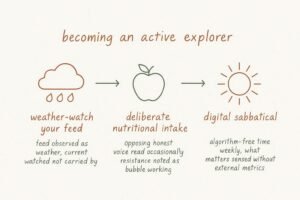
This practice is about shifting from passive consumer to active explorer — building habits that make the filter visible.
STEP 1: Weather-watch your feed
Before or after scrolling through social media or a news app, pause and ask yourself:
“What kind of emotional and ideological weather is my feed running today — a calm, uniform clear sky, or a strong wind pulling steadily in one direction?”
That single question creates a step back from being carried by the current to observing it. The feed stops being a window onto truth and becomes an environment with its own particular weather conditions.
STEP 2: Deliberate nutritional intake
Just as physical health requires nutritional balance, information intake benefits from deliberate variety.
Find one person whose position is opposite to yours, but whose reasoning strikes you as honest and coherent, and read them occasionally. This step will probably feel pointless or even irritating the first time — that resistance is the bubble doing its job. The goal is not agreement. It is the understanding that the world contains perspectives that hold together differently from your own. Occasionally seeking out primary sources — statistical reports, summaries from international bodies, original texts before interpretation layers accumulate — is a practice in the same direction.
STEP 3: The digital sabbatical
Set aside a few hours each week free from all algorithm-driven feeds. Watch a long documentary, read deeply in a single book, have a conversation with someone in person — experiences that are not optimized by any system.
This distance resets the dependency and sharpens the ability to sense what actually matters to you, without external metrics telling you what should. What you notice in that quiet is often more yours than anything the feed delivers.
Session 3: The Architecture of the Bubble
Why the brain gets pulled in
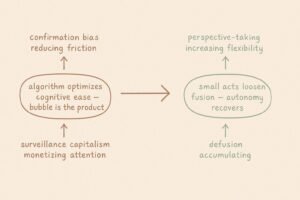
Confirmation bias is not a weakness of character. From a neuroscientific standpoint, processing information that aligns with existing beliefs requires less cognitive effort. The prefrontal cortex — which handles critical thinking — carries a lighter load, while the amygdala — which governs emotional response — more easily takes the lead. Information that matches your beliefs flows through without friction; information that contradicts them registers as resistance. This asymmetry is a feature of a brain designed for efficiency. Algorithms learn this design and optimize their delivery accordingly — serving you the content you will process most smoothly.
Why it becomes so powerful
Economist Shoshana Zuboff describes what she calls surveillance capitalism: a business model in which human attention and behavioral data become raw material, used to build products that predict and influence future behavior, sold in advertising markets. In this structure, keeping you inside a filter bubble maximizes the platform’s revenue. Research consistently shows that anger and anxiety are the emotions that drive the highest engagement. The prioritization of emotionally provocative content is not accidental.
The filter bubble is not a flaw in the algorithm. It is the condition in which your cognitive design has been most efficiently turned into a product.
What exposure to difference actually does
Psychologists studying perspective-taking — the capacity to imaginatively inhabit another person’s point of view — have found that this ability increases cognitive flexibility and builds resistance to fusion with a single narrative. Crucially, it strengthens with use. Regular exposure to the coherent reasoning of someone who sees things differently is a direct exercise of this capacity.
Psychologist Arie Kruglanski’s research on the need for cognitive closure — the discomfort with uncertainty that generates a craving for simple, definitive answers — identifies another source of the bubble’s gravitational pull. Time away from algorithm-driven feeds works to quietly reduce that discomfort, building a greater tolerance for staying with complexity rather than resolving it too quickly.
What small acts of defusion accumulate into
Reclaiming cognitive autonomy does not mean changing what the algorithm shows you. It means recovering the capacity to choose, consciously, where your attention goes and how it orients itself. What the three steps in Session 2 share is a momentary loosening of the fusion between incoming information and your existing worldview — observing the feed, encountering the opposing view, stepping away from the system entirely. The accumulation of these small acts of defusion builds the capacity to hold an outside perspective even while remaining inside the bubble.
Conclusion: The Moment You Notice the Bubble, You Are Already Partly Outside It

The filter bubble will not disappear. The algorithm will keep learning, keep optimizing, keep using the design of your cognition against your awareness of it.
But noticing the bubble — observing the weather of the feed, catching the moment when incoming information and your own worldview begin to merge — that moment of noticing is itself a defusion. Small, repeatable, available at any point in the scroll.
The algorithm decides what you see. How you see it is still yours.
KEY TERMS
Confirmation Bias
The tendency to favor information that confirms existing beliefs and unconsciously avoid what contradicts them. Not a character weakness — a feature of a brain designed to conserve cognitive resources. Algorithms learn and amplify this tendency, delivering an increasingly efficient stream of reality you are already inclined to accept.
Surveillance Capitalism
A business model described by economist Shoshana Zuboff in which human attention and behavioral data become raw material for products designed to predict and influence behavior. The filter bubble is not a byproduct of this model — it is one of its optimal conditions. Keeping users inside their bubble maximizes engagement and, by extension, revenue.
Perspective-Taking
The cognitive capacity to imaginatively inhabit another person’s point of view. Research shows it increases in strength with practice, building flexibility and resistance to fusion with a single narrative. The scientific grounding for Session 2 STEP 2 — the deliberate exposure to coherent reasoning from the opposing view.
Need for Cognitive Closure
A concept from psychologist Arie Kruglanski. The discomfort with uncertainty that generates a craving for simple, definitive answers. One of the psychological forces that makes filter bubbles feel comfortable rather than constraining. The digital sabbatical in Session 2 STEP 3 works to reduce this discomfort and build tolerance for complexity.
Defusion
The act of noticing — and momentarily stepping back from — the fusion between incoming information and one’s existing worldview. The common thread running through all three steps in Session 2: observe the feed, encounter the opposing view, step away from the system. Each is a small act of defusion. Their accumulation is what builds cognitive autonomy.