
Introduction: Why the Fight on Your Screen Starts Damaging the Relationship in Front of You

Late at night, an argument on your phone — heated, escalating, your pulse rising as you type. The next morning, you’re face to face with someone who might hold the opposite view. And something has changed. There’s a wariness that wasn’t there before. The conversation stays surface-level. The ease is gone.
This is not a simple disagreement about ideas. The framework that formed online — us versus them, right versus wrong — has filtered into the way you’re reading the person in front of you. The division doesn’t stay on the screen.
Session 1: How the Toxicity Transfers — When Online Patterns Overwrite Offline Reality

Online interaction quietly instills particular ways of feeling and thinking. And those patterns don’t stop when the screen goes dark.
The first layer is the persistence of emotional state. The anger and anxiety activated in a late-night social media argument are still present in the nervous system the next morning. Walking into a conversation in that state, you’re more likely to read an ordinary remark as a provocation. The emotional residue precedes the other person. It shapes what you hear before they’ve finished speaking.
Onto this layers the transfer of a cognitive style. Online, most arguments move within a framework of winning and losing. That script — disagreement as combat — gets carried into face-to-face conversation without announcement. Differences of opinion register as threats. Defensive communication activates automatically, in contexts where it was never needed.
Then there is the objectification of the other person. On social platforms, people are routinely reduced to their positions — extremist, ignorant, enemy — and processed as a type rather than as an individual. When that habit of perception travels offline, the complex human being in front of you gets compressed into a label.
The curiosity about what brought them to their views, about the experience underneath the opinion, quietly switches off.
Session 2: Practice — Breaking the Toxic Loop
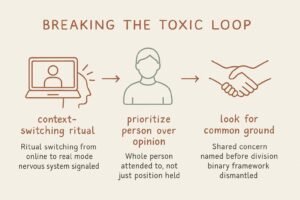
This practice is about intercepting the flow of toxicity from digital to physical space — building small, conscious acts of separation between the two.
STEP 1: Create a context-switching ritual
After any significant online engagement — an argument, a distressing thread, a stretch of heated scrolling — build a deliberate pause before entering face-to-face interaction.
Wash your hands and focus on the sensation of cold water. Open a window and breathe three times. It doesn’t need to be elaborate. What matters is the declaration, internal or spoken:
“I’m switching from online argument mode to real conversation mode.”
This small ritual signals a transition to the nervous system — beginning to lower the activation that the screen produced, and creating the conditions for a more neutral and open state before the next human encounter begins.
STEP 2: Prioritize the person over the opinion
Before meeting someone whose views might differ from yours — or in the middle of such a conversation — set an intention:
“In this time, I’ll direct my attention to the whole person, not just the position they hold.”
During the conversation, bring interest to expression, tone of voice, the feeling beneath the words, the experience that may have shaped the view — rather than tracking the content of what is being said for points of disagreement. Even when you can’t agree with the opinion, the posture remains: this person arrived here through a path I haven’t fully seen. It is the act of returning a human being from category back to individual.
STEP 3: Look deliberately for common ground
In both online and offline interactions, practice the small act of finding what is shared before engaging with what divides.
In a face-to-face conversation with someone whose views differ, consciously look for a concern or value you both hold — and say it aloud before continuing. Online, before responding to a position you disagree with, look for one element you can genuinely acknowledge. Not as a rhetorical tactic, but as a sincere attempt to locate the human concern beneath the position. This practice works to dismantle the binary framework — replacing you’re wrong and I’m right with we’re both responding to something real, differently.
Session 3: What Travels When the Screen Closes
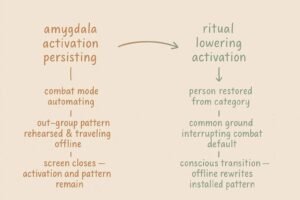
The feeling doesn’t end when the screen does
Neuroscience shows that strong emotional activation — anger, anxiety, humiliation — triggers the amygdala, and that this state persists in the nervous system after the triggering stimulus is gone. Research on mirror neurons adds a further dimension: our emotional states transfer automatically to the people we’re physically present with. Someone who carries the residue of a late-night online argument into a morning conversation brings that activation into the room. The other person — who has no context for any of it — registers a tension they can’t account for. The emotional state lands in a relationship that had nothing to do with producing it.
The screen closes. The feeling does not.
The emotion is not the only thing that transfers
Beyond emotional state, the cognitive style formed online travels with it. Social psychology research on out-group homogeneity — the tendency to perceive members of other groups as uniform and interchangeable — intensifies through repeated online exposure. That type of person. Obviously on that side. When this pattern automates, the individual standing in front of you gets processed as a representative of a category rather than as a person. This is not a conscious choice. It is a recognition pattern that has been rehearsed thousands of times in the online environment, and that activates offline without invitation.
Why this is happening so broadly
Philosopher Jürgen Habermas described the public sphere as a space where citizens engage in reasoned discussion to form shared understanding — a space defined by the quality of argument rather than the status of participants. The digital transformation of that sphere has inverted many of its original conditions. What drives engagement in contemporary social platforms is not the quality of reasoning but the intensity of emotional response. The goal shifts from reaching understanding to confirming that you are on the right side.
Spending hours each day in an environment structured around that goal — where combat is the default, and identity is confirmed through opposition — doesn’t stay contained to the platform. Combat mode gradually becomes the cognitive default that people carry into their other interactions. This is not a personal failure of discipline. It is the predictable output of a designed environment, and conscious offline choice is the only thing that begins to overwrite what it has installed.
Conclusion: Online Shows You Opinions

The emotional residue persists. The cognitive patterns transfer. Without awareness, the toxicity that forms online lands quietly in the relationships that matter most.
But the moment of awareness is the moment of choice. The pause between closing the screen and entering the room. The decision to look at the person rather than the position. These small acts of defusion work against the automatic transfer — not by building a wall between the two worlds, but by choosing, each time, which version of yourself walks through the door.
Online shows you opinions. Offline shows you people.
KEY TERMS
Emotional Contagion
The neurological process by which strong emotional activation — anger, anxiety, humiliation — persists in the nervous system after the triggering stimulus ends, and transfers automatically to people in physical proximity via mirror neuron mechanisms. Online emotional states do not stop at the screen. They travel into face-to-face relationships that had no part in producing them.
Out-group Homogeneity
The tendency, documented in social psychology research, to perceive members of groups different from one’s own as uniform and interchangeable. Intensified through repeated online exposure, this pattern automates the compression of complex individuals into categorical labels. Not a fixed feature of human perception — a habit reinforced by the structure of online environments.
Transformation of the Digital Public Sphere
The shift, analyzed through Jürgen Habermas’s public sphere framework, from a space defined by reasoned discussion toward one structured around emotional engagement and identity confirmation. The effect of spending extended time in this transformed environment is not contained to the platform — combat mode gradually becomes the cognitive default that people carry into other contexts.
Context Switching
The deliberate act of creating a transition between online engagement and face-to-face interaction — using physical sensation or brief ritual to begin lowering nervous system activation before the next human encounter. Activates the parasympathetic system, reduces amygdala overactivation, and partially restores prefrontal function. The neurological and psychological basis for Session 2 STEP 1.
Defusion
The capacity to notice an automated pattern — this person equals that category — and introduce a moment of conscious choice before it completes. The common thread across all three steps in Session 2: switching contexts, prioritizing the person, finding common ground. Each is an act of defusion — using deliberate offline behavior to begin overwriting what the online environment has installed.