
Introduction: The Loop Has a Structure

The same thought comes back. That comment was a mistake. Tomorrow might go wrong. Why am I always like this. The harder the attempt to push it away, the more reliably it returns.
And there is something stranger still: the thought does not feel like a thought. It feels more like reality — weighted, present, insisting on a response.
These two features — the sense that a thought is real, and the fact that it will not stop — are not separate problems. They are two stages of the same circuit. The brain registers the thought as real; real things require resolution; the resolution circuit engages and finds nothing to solve; the loop continues.
This article traces that structure, and describes a practice that interrupts it.
Session 1: Why Thoughts Feel Real

When thinking loops, the most common response is self-criticism. I’m overthinking. I should be able to stop this. But what is happening is not a failure of will.
The brain has a default state. When no external task is demanding attention, a specific network activates automatically — generating self-referential thought. What happened yesterday. What might happen tomorrow. How one appears to others. This is not a sign that something has gone wrong. It is the brain’s resting activity, running in the background whenever the foreground is clear.
The second layer is less obvious. The brain does not passively receive reality — it constructs it, using predictive models built from prior experience. Within this system, thoughts that repeat frequently are processed with increasing similarity to actual perception. A thought that returns often enough begins to carry the weight of something real. This might go badly does not feel like a hypothesis. It feels like a signal.
And signals require a response. The problem-solving circuit engages. But some thoughts — why am I this way, what will become of this — are not problems the circuit can resolve. So it keeps running. The same question, the same loop, no exit found.
One intervention shifts the relationship to the thought at this junction. Rather than responding to its content, the move is to notice that the thought is occurring — a step back from the thought’s insistence on being treated as real. That shift is where the loop finds its first opening.
Session 2: Placing the Label
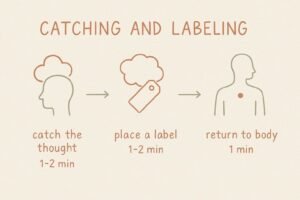
STEP 1: Catch the thought (1–2 minutes)
Notice what is moving through the mind right now. Without trying to stop it, without judging its content, simply confirm that it is there.
Right now, the thought “what if tomorrow goes wrong” is present.
Right now, the thought “I should have said something different” is present.
Catching is not stopping. It is confirmation — the thought has been registered as a thought, not yet as a verdict.
STEP 2: Place a label (1–2 minutes)
Give the thought a short label. Not an analysis — a category. The operation is moving from the content of the thought to the type of thought it is.
A label might be as simple as: this is anticipatory anxiety. This is retrospective rehearsal.
It does not need to be precise — a rough category is sufficient. The function is to create a small distance between the thought’s arrival and the automatic handoff to the problem-solving circuit.
STEP 3: Return to one point in the body (1 minute)
After placing the label, bring attention to a single physical sensation. The pressure of feet against the floor. The weight of hands resting somewhere. The temperature of breath moving through the throat.
One deliberate movement from the thought-world back to the sensory world. Once is enough.
Session 3: The Default Mode Network, Predictive Coding, the Rumination Circuit, and How Labeling Opens the Exit
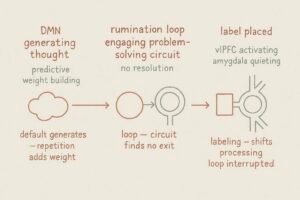
Why thoughts feel real, and why they loop once they do, is a question neuroscience, computational neuroscience, and clinical psychology have each answered at a different stage of the same causal chain — one accounting for the generation, one for the weight, and one for the exit.
The starting point is Marcus Raichle and colleagues’ identification of the default mode network, reported in Proceedings of the National Academy of Sciences (2001). What Raichle’s team found was that a specific network — encompassing the medial prefrontal cortex, posterior cingulate cortex, and angular gyrus — becomes more active, not less, when the brain is released from external tasks. The content this network processes is self-referential: reviewing past events, simulating future scenarios, modeling how one is perceived by others. The absence of external demands does not produce a quiet mind. It produces a mind occupied with itself. Thought generation is not initiated by intention — it is the brain’s default operation whenever external demands release their claim on attention.
Why those automatically generated thoughts feel real is where Karl Friston’s predictive coding framework provides the mechanism. Friston developed the account of the brain as a prediction machine — one that constructs the experience of reality not by passively receiving input but by continuously generating predictive models based on prior experience and minimizing the error between prediction and incoming signal. Within this system, thought patterns that activate repeatedly become incorporated into the predictive model. A thought that has returned many times is processed with increasing similarity to actual perception. The feeling that this might go badly carries real weight is not evidence that the thought is accurate. It is evidence that the predictive system has given it the texture of reality through repetition. The sense of urgency attached to a recurring thought is a product of frequency, not truth.
Once a thought carries the weight of reality, the problem-solving circuit engages. Susan Nolen-Hoeksema’s response styles theory, introduced in Journal of Abnormal Psychology (1991), describes what happens next. Rumination is a pattern of sustained, repetitive, analytical attention directed at negative mood states — functioning as a misdirected effort at problem resolution. The problem-solving circuit is effective when the problem is solvable. Questions like *why am I this way* or *what will happen to me* are not problems the circuit can close. But the circuit does not recognize this. It reengages with the same question, finds no resolution, and returns again. Raichle’s account of automatic thought generation and Friston’s account of how repetition produces the sense of reality together explain why the rumination circuit Nolen-Hoeksema describes becomes chronic rather than episodic in contemporary conditions — the default network continuously supplies material, and the predictive system continuously upgrades its urgency.
The neural basis for interrupting this chain was documented by Matthew Lieberman and colleagues in Psychological Science (2007). Lieberman’s research showed that applying a verbal label to an emotional state — naming it as anxiety, frustration, or sadness — reduces amygdala activation and increases activity in the right ventrolateral prefrontal cortex. Responding to the content of a thought and identifying the category of thought it belongs to are neurally distinct operations. Labeling does not suppress or deny the emotional state. It shifts the level of processing — from automatic affective response to a more regulated form of engagement — and in doing so interrupts the automatic transfer to the problem-solving circuit. The defusion practice in ACT, which moves from I am failing to a failure-thought is present, operates along this same pathway. The label is not a reframe. It is an instruction to the circuit: this does not require resolution.
Conclusion: The Circuit Has an Exit

The thought felt real because the predictive system built it that way. The loop kept running because real things are supposed to be solved, and the problem-solving circuit does not self-terminate on unsolvable questions.
Placing a label does not remove the thought. It changes the instruction the circuit receives — from resolve this to this has been noted. The loop does not need to be forced open. It needs a different signal at the entry point.
The loop wasn’t a thinking problem. It was a reality-processing problem — and the label is what tells the circuit: this one doesn’t need solving.
KEY TERMS
Defusion
The process, central to Acceptance and Commitment Therapy as developed by Steven Hayes and colleagues, of shifting from responding to the content of a thought to observing that the thought is occurring. Where cognitive fusion treats a thought as a direct representation of reality — I am failing — defusion repositions the relationship to the thought itself: a failure-thought is present. The operation does not change the thought’s content; it changes its functional grip. Defusion is a core process within the psychological flexibility model and has generated a substantial body of research in contextual behavioral science examining its mechanisms and clinical applications.
Default Mode Network (DMN)
The network identified by Marcus Raichle and colleagues in Proceedings of the National Academy of Sciences (2001), comprising the medial prefrontal cortex, posterior cingulate cortex, and angular gyrus, which activates during the brain’s resting state rather than during externally directed tasks. The DMN processes self-referential content — autobiographical memory, future simulation, social cognition — making automatic thought generation the brain’s default activity rather than a sign of dysfunction. The relationship between DMN activity and mind-wandering, rumination, and the effects of contemplative practice has become a central area of inquiry in subsequent neuroimaging research.
Predictive Coding and the Reality of Thought
Karl Friston’s computational framework, which describes the brain as constructing the experience of reality through continuous prediction and error minimization rather than passive perception. Within this framework, frequently activated thought patterns are incorporated into predictive models and processed with increasing similarity to actual sensory input — providing the theoretical basis for understanding why recurring thoughts carry the phenomenological weight of reality. The sense of urgency attached to a thought reflects its position in the predictive model, not its accuracy.
Rumination
Susan Nolen-Hoeksema’s response styles theory, introduced in Journal of Abnormal Psychology (1991), describing the tendency to direct sustained, repetitive, analytical attention toward negative mood states as a misdirected form of problem-solving. The rumination circuit engages with questions that the problem-resolution system cannot close, producing loops that persist precisely because they find no exit. Nolen-Hoeksema’s research program continues to inform transdiagnostic treatment frameworks, with rumination identified as a shared maintenance mechanism across depressive, anxiety, and trauma-related presentations.
Affect Labeling
Matthew Lieberman and colleagues’ finding, from Psychological Science (2007), that applying a verbal label to an emotional state reduces amygdala activation and increases activity in the right ventrolateral prefrontal cortex. The operation shifts processing from automatic affective response toward a more regulated engagement with the emotional state — without suppressing or reappraising it. Affect labeling provides the neural basis for understanding why defusion and observational practices in contemplative and clinical traditions produce measurable changes in emotional reactivity, and why the instruction to name what is happening functions as more than a cognitive reframe.