
Introduction: How We Learned to Live Next to Someone We Don’t Know

When passing someone in the hallway of the same building, you look down at your phone. In an elevator with just one other person, your eyes go to the ceiling. After years in the same place, you still don’t know the neighbor’s name.
And yet on social media, you follow the daily life of a stranger in another country, leave comments, feel something. Physically closer than ever, psychologically separated by a boundary that has quietly become the default. This reversal is not a personal failing. It is what the city produces.
Session 1: The Automation of Indifference — When the Armor Becomes Habit
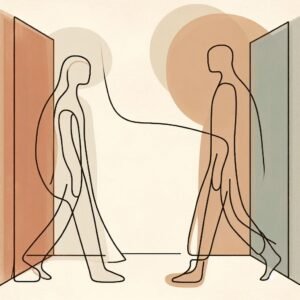
Urban life instills particular habits of perception in us, automating the processing of neighbors as strangers.
At the center is the anxiety of a relationship without a role. In cities, most human interactions are structured around function — landlord and tenant, shopkeeper and customer, colleague. Neighborly relations carry none of this. The absence of a clear social script generates a low-grade unease, and the path of least resistance is avoidance. Without knowing how to engage, the brain defaults to not engaging.
Onto this layers the mutual defense of privacy. Living as an individual within density, you guard your psychological space carefully — and begin to perceive a neighbor’s attention as a potential intrusion before it has even occurred. The fear of intruding on others’ privacy produces the same result from the other direction. Indifference becomes the equilibrium point of a mutual protection agreement.
Then there is the optimization of chosen relationships. With finite time and emotional resources, urban life tends toward relationships with people you selected — shared values, shared interests, shared choice. The neighbor was assigned by geographical accident. The brain, operating on conservation principles, processes this unchosen relationship as background rather than as a priority for attention. The neighbor becomes part of the scenery.
The individual faces and stories on the other side of the wall become invisible.
Session 2: Practice — Shifting from Indifference to Quiet Presence
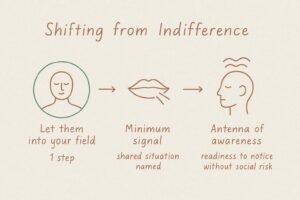
This practice is not about becoming close. It is about introducing the smallest possible interruptions into the automation of not-noticing.
STEP 1: Let them into your field of vision
When passing someone, pause the automatic response of looking away and let the other person’s presence register — briefly, without pressure. Feet, a bag, the edge of your peripheral vision. Simply acknowledge, internally:
“There is a person here, living in the same place I live.”
That is all. No conversation, no smile required. The shift from treating another person as invisible background to treating them as a perceivable presence is the most fundamental step — and it is available in every corridor encounter.
STEP 2: The smallest verbal signal
In the moments that naturally arise — both arriving at the mailbox, meeting at the garbage area — try the minimum: a comment on the shared situation.
“Warm today.” “The elevator’s taking forever.”
The goal is not to start a conversation. It is to send the smallest possible social signal: I see you, and I mean no harm. This is urban civic courtesy — the territory between indifference and intrusion, which turns out to be wider than it appears.
STEP 3: The antenna of passive awareness
Active engagement is not the only option. Passive attention — a background readiness to notice — is available without any social risk.
Is an elderly neighbor moving slowly with a heavy bag? Is someone struggling to get a stroller through a door? Has there been no sound from the apartment next door for an unusual stretch of time?
Maintaining this awareness costs almost nothing. Whether it leads to action or not, the simple state of not-being-indifferent is itself the foundation of the most basic communal safety. It is what makes it possible to act — rather than look away — when something actually matters.
Session 3: What the Indifference Is Actually Made Of
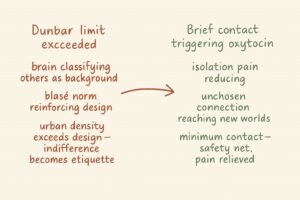
Indifference is the brain’s energy-saving design
Evolutionary psychologist Robin Dunbar’s research established that the human brain can maintain stable social relationships with approximately 150 people — a figure derived from the processing capacity of the neocortex, now known as Dunbar’s Number. A single apartment building, a single subway line, a single commercial block in a contemporary city can expose you to multiples of this number in a single day. Faced with social information at a density it was not built to process, the brain enters an energy-conservation mode, automatically classifying unfamiliar others as background.
The indifference toward your neighbor is not evidence of your coldness. It is evidence that the human brain was not designed for urban density.
Social structure turned indifference into etiquette
The brain’s conservation design was then reinforced and normalized by social structure. Sociologist Ferdinand Tönnies described the shift from Gemeinschaft — the emotionally bound, fate-shared community of traditional village life — to Gesellschaft, the role-based, contractual social organization of modern cities. Emotional bonds dissolve; relationships are defined by function. Sociologist Georg Simmel took this further with his analysis of the blasé attitude — the emotional flattening that urban dwellers develop as a defense against overwhelming stimulation.
What began as a psychological response to overstimulation gradually became a social norm: not speaking to neighbors is not rudeness, it is simply how things are done. Indifference as inherited expectation, rather than personal choice.
The loneliness of proximity is a real pain
The cost of this arrangement is not abstract. Neuroscientist Matthew Lieberman’s research showed that social isolation activates the anterior cingulate cortex — the same neural circuit involved in processing physical pain. Being surrounded by people while remaining psychologically alone is not a mild inconvenience. For the brain, it registers as genuine pain.
At the same time, research on oxytocin and social contact shows that brief interactions — a greeting, a moment of eye contact — trigger oxytocin release, partially restoring the sense of social trust and safety. No depth of relationship is required. The contact itself produces the neurobiological effect.
The value of what you didn’t choose
The connections that neighbor relations represent have a particular quality that deliberate selection cannot replicate. You didn’t choose this person. They arose from the accident of shared geography. And it is precisely this unchosen quality that gives them a social value beyond what friendship networks provide — because what you didn’t select can connect you to worlds that your selections would never have reached.
Research consistently shows that these loose, incidental connections function as emergency safety nets, sources of diverse information, and daily buffers against isolation. The neighbor you avoided in the hallway is part of that web. Small contacts, accumulated over time, quietly transform the experience of living in density from isolated proximity into something more than shared walls.
Conclusion: The Neighbor You Didn’t Choose

The indifference is structural. The brain wasn’t built for this density, and the city turned the resulting numbness into a norm. This is not a personal failing.
But the automation can be interrupted — briefly, with almost no cost. Each small interruption releases something in the nervous system, and slowly weaves a thread into a web that no deliberate effort could have constructed in quite the same way.
The neighbor you didn’t choose may be the connection you can’t manufacture.
KEY TERMS
Dunbar’s Number
A figure derived from evolutionary psychologist Robin Dunbar’s research on the relationship between neocortex size and social group capacity. The human brain can maintain stable social relationships with approximately 150 people. Urban density structurally exceeds this limit, causing the brain to process unfamiliar others as background through an energy-conservation mechanism. The evolutionary and neurological basis for the automation of urban indifference.
Blasé Attitude
A concept from sociologist Georg Simmel describing the emotional flattening that urban dwellers develop in response to overstimulation. Originally a psychological defense, it gradually normalized into a social expectation — the unspoken rule that not engaging with neighbors is appropriate urban behavior. Indifference as inherited norm rather than personal choice.
Social Pain
A finding from neuroscientist Matthew Lieberman’s research showing that social isolation activates the anterior cingulate cortex — the same neural circuit involved in physical pain. The condition of being surrounded by people while remaining psychologically alone is not merely uncomfortable. For the brain, it registers as genuine pain. The neurobiological cost of urban indifference.
Oxytocin and Social Contact
The neurobiological finding that brief social interactions — a greeting, a moment of eye contact — trigger oxytocin release, partially restoring social trust and a sense of safety. Deep relationship is not required; contact itself produces the effect. The scientific basis for Session 2 STEP 1 and STEP 2, and the reason why small acts of noticing carry more weight than they appear to.
The Unchosen Connection
The social value specific to neighbor relations and other geographically assigned contacts. Unlike deliberately selected relationships — which tend to connect similar people to similar worlds — unchosen connections bridge to different social networks, information flows, and forms of mutual support. Their value is precisely what deliberate selection cannot produce. Drawing on research traditions from Dunbar to Granovetter, this is the theoretical foundation for why the neighbor you didn’t choose may matter more than you think.