
Introduction: Why Wanting to Change the World Can Feel Completely Pointless

Climate change. Poverty. War. The scale of what the news describes is overwhelming, and daily life starts to feel negligible by comparison. A donation is a drop in the ocean. A lifestyle change is a new arrangement of furniture in a house that keeps changing around you.
And yet doing nothing produces its own weight — the guilt of knowing and not acting. The space between powerlessness and guilt is where most people who care about the world end up living. But the gap between the scale of the problem and the size of your influence does not mean your influence is zero.
Session 1: The Root of Powerlessness — The Trap of Seeing Yourself as Separate

The feeling of individual powerlessness is rooted in a way of thinking that cuts the self off from the world — treating the individual as an isolated actor, either a lone hero or an irrelevant bystander.
At the center is the linearization of cause and effect. Global problems are generated by the interaction of countless factors across complex systems. But the mind tends to represent them as simple chains — A causes B — and to imagine their solutions as single, massive interventions. The moment you compare that imagined scale of intervention to the size of your own life, powerlessness arrives.
Onto this layers a results-based conception of responsibility. The idea that an action only counts if it produces measurable, directly attributable outcomes — X tons of carbon reduced, Y people helped — applies a logic borrowed from performance metrics to problems whose effects are distributed, delayed, and indirect. In complex systems, this framework produces one conclusion almost immediately: nothing I do makes a difference.
Then there is the internalization of structural responsibility. As sociologists have observed, the responsibility for structural problems increasingly gets transferred onto individual ethics and behavior. What begins as a social problem becomes a personal moral failure — I’m not doing enough, I don’t care enough — and the external reality of systems and institutions fuses with the internal story of personal inadequacy.
A frame that positions the individual as separate from and smaller than the world.
Session 2: Practice — Redefining Responsibility as a Connected Actor
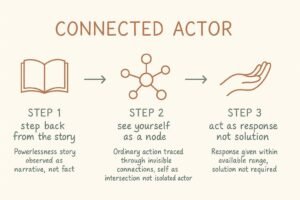
This practice is about stepping out of the separation frame and deepening the sense of oneself as someone acting within, rather than against, a web of connections.
STEP 1: Step back from the powerlessness story
When the thought arrives — *nothing I do alone will change anything* — pause before accepting it as fact.
“My mind is running the ‘isolated, powerless individual’ story right now.”
Observe that thought as a picture floating through — not the truth of your situation, but a narrative the mind is producing. The shift is from being the protagonist of the powerlessness story to being the awareness that is watching it. That is the first step back toward agency.
STEP 2: See your daily life as a node in a network
Choose an ordinary action — drinking a coffee, riding a train — and trace the connections it depends on, as far as the imagination can reach.
The cup: a maker, a shipper, a seller, a designer. The coffee: a farmer, a trading company, a climate, an ecosystem. This moment of quiet: a morning that arrived, a city that kept functioning, a chain of ordinary continuity that held.
“What I am is an intersection of connections that are mostly invisible to me.”
This reframe does not make the individual larger. It makes the separation story less accurate. You are not an isolated actor. You are an expression of connection.
STEP 3: Act as response, not as solution
Release the grip on producing a measurable result, and instead respond — within your available range — to the connections you notice.
A sense of wanting to feel connected to nature becomes, occasionally, a few minutes outside. A curiosity about who made something becomes, once, a brief look into where it came from. A reluctance to completely ignore the future becomes, when it’s possible, a different choice. What matters here is not whether the world changed. It is that you did not ignore the connection. The response can be small, intermittent, incomplete. It does not need to be a solution.
Session 3: How Influence Actually Travels
Why individual action feels meaningless
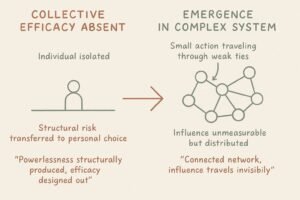
Psychologist Albert Bandura’s research distinguished between individual self-efficacy — the sense that I can do something — and what he called collective efficacy: the sense that we can bring about change together. Research on social movements consistently shows that collective efficacy is the more powerful predictor of sustained engagement. The contemporary information environment tends to address us as individual consumers and voters, systematically making the experience of collective efficacy harder to access. The feeling that you alone can’t change anything is not evidence of personal weakness. It is what the absence of felt collective efficacy produces.
How small actions move through complex systems
Complex systems science describes a phenomenon called emergence — the appearance of new patterns from the interaction of individual elements, patterns that could not have been predicted from any single element in isolation. The elaborate architecture of an ant colony doesn’t exist in any individual ant; it arises from the accumulation of simple interactions. Meteorologist Edward Lorenz described what became known as the butterfly effect: in complex systems, small changes in initial conditions can amplify nonlinearly into large-scale effects.
These are not metaphors for wishful thinking. They are descriptions of how change actually propagates through interconnected systems. The influence of your action is not negated by the fact that it cannot be measured. In a complex system, unmeasurable effects are often the most widely distributed.
The invisible reach of connection
The most striking finding about influence in social networks is not how far it reaches — it is how invisibly it travels. Stanley Milgram’s research on six degrees of separation showed that any two people in the world are connected through an average of six intermediaries. Mark Granovetter’s work adds a crucial detail: it is the loose, incidental connections between acquaintances — not the strong bonds of close relationships — that carry information and influence most broadly across a network. Strong ties tend to reach the same people; weak ties bridge between different clusters.
Together, these findings mean that an individual’s influence travels through networks in ways that are largely invisible from the starting point — reaching people and places that the original actor could not have mapped or predicted.
The powerlessness was structurally produced
Sociologist Ulrich Beck’s concept of the risk society describes a contemporary condition in which the structural risks generated by global industrial and political systems — climate change, ecological degradation — are systematically transferred onto individual ethics and lifestyle. The message that your choices will save the planet distributes the responsibility for collective, structural problems onto individual behavior, which has the effect of weakening the demand for structural change at the level of corporations and political systems.
When individuals experience themselves as isolated actors with no collective power, the kind of change that actually requires collective organization becomes harder to imagine. The powerlessness you feel is not produced by the actual limits of your influence. It is produced by a structural arrangement that benefits from you feeling that way.
Conclusion: Your Actions Don’t End Where You Can See Them

The powerlessness is not yours. It is structurally produced — by the isolation frame, by a results-based logic that makes distributed influence invisible, by the transfer of collective responsibility onto personal behavior.
The sense of collective efficacy — the experience of acting as part of something larger — is recoverable, not through grand interventions, but through the accumulation of responses to the connections that are already present.
Your actions don’t end where you can see them. In a connected system, they never do.
KEY TERMS
Collective Efficacy
A concept from Albert Bandura’s research distinguishing the sense that we can bring about change together from individual self-efficacy. The more powerful predictor of sustained social engagement. The contemporary information environment systematically makes collective efficacy harder to experience by addressing people as isolated individuals. The feeling that one person alone can’t change anything is what the absence of collective efficacy produces — not evidence of personal limitation.
Emergence
A phenomenon from complex systems science in which new patterns arise from the interaction of individual elements — patterns that could not have been predicted from any single element in isolation. The scientific basis for understanding how individual actions contribute to collective change in ways that resist direct measurement. The influence of a small action in a complex system is not negated by being unmeasurable.
Strength of Weak Ties
Mark Granovetter’s finding that loose, incidental connections between acquaintances carry information and influence more broadly across a network than the strong bonds of close relationships. Combined with Milgram’s six degrees of separation research, this establishes that an individual’s influence travels through social networks in ways largely invisible from the starting point — reaching people and contexts the original actor could not have anticipated.
Risk Society
Ulrich Beck’s concept describing the contemporary condition in which structural risks generated by global systems are transferred onto individual ethics and lifestyle. The message that personal consumer choices will solve planetary problems distributes collective responsibility onto individual behavior, weakening the demand for structural change and producing a sense of individual powerlessness that serves the interests of systems that benefit from inaction.
Defusion
The capacity to notice the fusion between a thought — I am a powerless, isolated individual — and one’s sense of what is real, and to create a moment of distance from it. Session 2 STEP 1 works through this mechanism: shifting from being the protagonist of the powerlessness story to being the awareness observing it. The first step toward recovering a sense of agency within a connected system.