
Introduction: The Contacts Are There. The Connection Isn’t

It’s late on a Tuesday night, and the phone is full of names that don’t feel reachable. Hundreds of names in the phone. Followers online. People at work seen every day. And still, late at night, no one comes to mind as someone to call right now. A heaviness somewhere in the chest. Something closing slightly in the throat.
I’m just not very social, the thought arrives. But this feeling is not a verdict on who you are. It is a signal that the structures which make connection possible have been quietly taken away.
Session 1: What the Loneliness Actually Is

When connection seems available but loneliness persists, what is operating is not a personal failing. It is a structure.
The human brain is built to require safe contact with others. When that contact is insufficient, a warning signal is generated. But in the contemporary city, the problem is less often outright isolation than a qualitative one: the number of interactions may be adequate, while the kind of contact the brain actually needs — accidental, purposeless, low-pressure — has been structurally reduced.
What makes this harder still is what happens when loneliness persists over time. The brain adapts. Chronic loneliness changes how social information is processed: contact that might otherwise register as neutral begins to be read as potentially threatening. The experience of wanting to reach out but finding it difficult to do so is not weakness. It is the result of a nervous system that loneliness has been training — quietly, incrementally — to treat approach with caution.
The interpretation I’m not social enough asks the wrong question. The more accurate description is a double structural problem: being inside conditions that generate loneliness, and having a nervous system that those conditions have already begun to reshape.
Session 2: Practice — Beginning With Small Contact
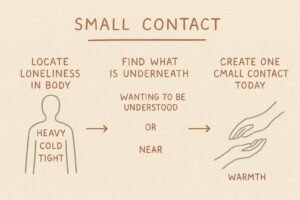
This practice is not about building deep friendships. It is about accumulating small, safe contacts — enough to begin introducing new data into a nervous system that loneliness has trained toward caution.
STEP 1: Locate the loneliness in the body
When the feeling arrives, before naming it or analyzing it, find where it is in the body.
Is it in the center of the chest, the throat, the stomach. Is it heavy, cold, tight.
Confirming the feeling as a physical sensation — before reaching for the word lonely — creates a small distance between the feeling and the self. That distance is the first gap before being taken over by it.
STEP 2: Find one thing underneath the loneliness
Underneath the surface feeling, look for one more specific thing it might be pointing toward.
Is it wanting to be understood. Wanting someone nearby. Wanting to share something with someone.
Loneliness is frequently a surface emotion, with a more specific need underneath. When the need becomes visible, there is somewhere more concrete to move toward.
STEP 3: Create one small contact today
Identify one small, safe social contact to make today — and when it happens, give it a moment of attention.
Make eye contact with the person at the register and mean the thank you. Nod to the neighbor in the elevator. Exchange a few words when ordering coffee.
When the small warmth of that moment arrives, notice it. The goal is not to form a connection. It is to give the nervous system one data point that says: contact happened, and it was safe.
Session 3: Loneliness Makes More of Itself — and the Circuit Loosens Where Contact Begins
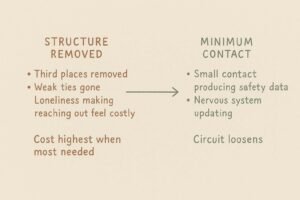
The infrastructure for accidental contact had been removed by design
Urban sociologist Ray Oldenburg’s concept of the third place described how the spaces that are neither home nor work — the coffee shop, the bookstore, the square, the neighborhood bar — form the social foundation of community life. Their defining features are accessibility without purpose, the absence of pressure to perform or produce, and the possibility of staying simply because the space is pleasant. Contemporary urban redevelopment and the commercialization of public space have progressively replaced these environments with efficient, goal-directed ones. Research on social networks establishes that it is not close friendships but the looser network of acquaintances — the person recognized from the café, the neighbor known by name — that buffers against loneliness and provides the low-stakes social contact the nervous system needs. When third places disappear, the conditions under which these ties naturally form disappear with them. The problem is not a shortage of friends. It is the removal, from the built environment, of the places where the kind of contact that doesn’t require effort or intention could simply happen.
Chronic loneliness had changed what contact felt like
Neuroscientist John Cacioppo’s research on loneliness established that its effects extend well beyond the subjective experience of isolation. When loneliness becomes chronic, the brain’s threat detection system becomes hyperactivated in social contexts: neutral social information — an expression, a silence, an ambiguous tone — is more likely to be processed as potentially threatening rather than safe. This hypervigilance is an adaptation. In the evolutionary context from which the loneliness signal emerged, social exclusion carried genuine survival risk, and heightened alertness to social threat was a reasonable response. In the contemporary city, where the loneliness is produced by structural conditions rather than social rejection, the same adaptation works against recovery. The person who most needs to reach out finds that reaching out feels most costly. Loneliness reduces the likelihood of the contact that would relieve it — and this is not a character trait. It is a feature of how a nervous system responds to prolonged social deprivation. Identifying it as a social failing locates the problem in entirely the wrong place.
Small contacts had been introducing new data into the circuit
Social psychologist Nicholas Epley’s research on minimal social contact produced a finding that consistently surprises: brief conversations with strangers — on a commute, in a waiting room, while ordering — generate levels of connection and well-being that participants reliably underestimate in advance. The relevance to chronic loneliness is specific. What a hypervigilant nervous system needs is not a meaningful relationship but repeated evidence that contact is safe — that approach does not produce the threat the adapted system has learned to anticipate. A moment of genuine eye contact with a cashier, a brief exchange in an elevator, a few words with someone at a counter: these are not shallow substitutes for real connection. They are the minimum unit of evidence that the prediction contact is dangerous is not always confirmed.
Conclusion: The Structure Removed the Contact. The Contact Can Begin to Loosen What That Left Behind

The urban design that removed third places and the conditions for weak ties continues. The hypervigilance that chronic loneliness installed in the nervous system remains active. The structural shortage of low-pressure, purposeless social space does not resolve on its own.
But the choice to create one small contact today — and to give the moment of warmth that follows a second of attention — is available in any ordinary interaction. That second of attention is the new data. And the new data is where the circuit begins to change.
The loneliness was never a verdict on who you were. It was a signal that the infrastructure for connection had been quietly removed.
KEY TERMS
Third Place
Ray Oldenburg’s concept describing how spaces that are neither home nor work — coffee shops, bookstores, squares, neighborhood gathering points — form the social foundation of community life through their accessibility, purposelessness, and low pressure. Contemporary urban redevelopment has progressively replaced these environments with efficient, goal-directed spaces. Their disappearance removes the structural conditions under which accidental contact and weak ties naturally form — producing loneliness not through personal failure but through environmental design.
Weak Ties
Mark Granovetter’s social network concept establishing that loose acquaintances — people recognized but not close — function as a critical buffer against loneliness and a primary channel for low-stakes social contact. Applied here specifically to the role of third places as the environments where weak ties naturally develop: when those environments disappear, the formation of weak ties is structurally prevented. Distinct from its use in earlier guides, which focused on information flow and behavioral diffusion.
Chronic Loneliness and Hypervigilance
John Cacioppo’s neuroscientific finding that prolonged loneliness activates the brain’s threat detection system in social contexts, causing neutral social information to be processed as potentially threatening. An evolutionary adaptation — social exclusion once carried survival risk — that in the contemporary city works against recovery by making the contact that would relieve loneliness feel most costly. The neurological basis for understanding wanting to reach out but finding it difficult as a nervous system response rather than a social failing.
Minimal Social Contact Effect
Nicholas Epley’s social psychology research demonstrating that brief interactions with strangers generate levels of well-being and connection that people consistently underestimate in advance. In the context of chronic loneliness, functions as the minimum unit of evidence that contact is safe — introducing new data into a hypervigilant system one small interaction at a time. Not a substitute for structural conditions but the condition under which the circuit that chronic loneliness tightened can begin to loosen.
Self-Reinforcing Loop of Loneliness
The compound structure in which the disappearance of third places reduces weak ties and accidental contact (urban sociology), which produces chronic loneliness, which generates hypervigilance (neuroscience), which makes contact feel more threatening, which deepens the loneliness. The basis for understanding why locating the problem in individual social capacity misidentifies both the cause and the point of intervention. Small safe contacts introduce data that loosens the loop at its neurological link — the place where it is most accessible to change.