
Introduction: “It Won’t Change Anything If It’s Just Me”

You decline a plastic straw after reading about the oceans. You open a donation page, chest tight from footage of a conflict zone. And then, almost immediately, a thought moves through: does any of this actually change anything?
Standing before a problem that dwarfs you, your action shrinks to the size of a grain of sand. This is not a failure of care. It is what happens when the belief that change requires visible, large-scale results turns acting and feeling helpless into the only two options available.
Session 1: Does “Invisible Change” Mean Nothing Changed?

When helplessness arrives, what is operating is not laziness. It is a specific pattern of thought.
Measuring the value of action by direct, measurable outcomes is something most people have been trained to do without noticing. How much did the time invested return? How clearly can the result be traced back to the effort? This framework functions at work, in learning, in daily choices — and quietly extends itself to social engagement. Refusing plastic doesn’t move the numbers on ocean pollution. A single vote doesn’t shift policy. At that point, “no visible change” becomes equivalent to “no change.”
But this is not how change actually travels. A comment shifts someone’s thinking slightly. That person makes a different choice in a different setting. That choice is seen by someone else. When something moves through a social system, it rarely moves in a straight line from cause to effect — it moves through invisible chains of connection. “Unseen” and “undelivered” are not the same thing.
The problem is not the smallness of the action. It is that the pathways through which change moves are invisible. And that invisibility comes from a structure outside of you, not a limitation inside you.
Session 2: Practice — From “Result” to “Condition”
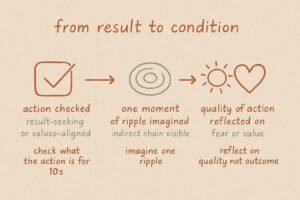
This practice is about shifting the endpoint of action from visible outcome to adding a good condition.
STEP 1: Before Acting, Check Once What the Action Is For
Before acting, pause for ten seconds.
Is this action about producing a particular result — or about acting in alignment with who I want to be right now?
Expecting results is natural. But when the value of an action rests entirely on outcome, action stops the moment no change is visible. Shifting the center of gravity toward adding the best condition I can right now makes action less dependent on what can be seen afterward.
STEP 2: Imagine One Moment of Ripple
Picture one moment where your action might be seen by someone else.
Someone may notice the choice I just made. They may, in a different situation later, make a similar one.
Most change travels indirect routes. Your action may not have “caused” anything directly — but it may have become a condition for the next change. That chain is invisible. But invisible is not the same as absent.
STEP 3: After Acting, Reflect on Quality, Not Outcome
After the action, ask once:
Did that come from fear or avoidance — or from something I actually value?
“Did I add a good condition?” is a question that can be answered. “Did I change the world?” cannot. Moving the axis of reflection from the second question to the first gives action roots inside rather than outside.
Session 3: Where Helplessness Comes From and Where It Can Go
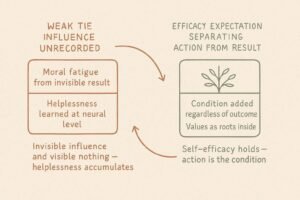
How Society Made Invisible Influence Invisible
Sociologist Mark Granovetter’s research showed that much of how change actually travels through society runs through weak ties — connections that are neither frequent nor deeply intimate, the peripheral relationships at the edges of social life. When information spreads, when values shift, when patterns of behavior update across a population, the pathway is more often weak ties than strong bonds. Modern society, however, is organized around attributing outcomes to individuals. Who achieved what. How much result did a given effort produce. Inside this framework, influence that is indirect, delayed, or wave-like cannot be entered into any ledger. If your small action reached someone through a weak tie and nudged something forward, that transfer is recorded nowhere. The sense of helplessness is not evidence that the action failed to arrive. It is the accurate perception of a social design that has no column for the kind of influence that actually drives most change.
When the Brain Learns Helplessness
Repeated ethical judgment carries a cognitive cost. Engaging with social problems, making considered consumption choices, extending care and attention to others — these are functions of the prefrontal cortex, and when the load becomes sustained, the brain moves automatically toward decision suspension, avoidance, and disengagement. Research consistently suggests that this is not a failure of will. It is a protective response. Moral fatigue is not evidence that good intentions have evaporated. It is an honest signal that the accumulated weight of judgment has reached a threshold. And this fatigue deepens specifically when action produces no visible change — because the experience of acting without visible result teaches, at a neural level, that action is not worth the cost. When helplessness accumulates not as a feeling but as a learned state, attempting to override it through willpower is roughly equivalent to demanding more from a muscle that is already exhausted.
Not “Can I Produce the Result” but “Can I Choose the Action”
The core of what psychologist Albert Bandura called self-efficacy is frequently misread. It is not confidence in producing outcomes. It is trust in the capacity to choose and execute an action. Bandura drew a careful distinction between efficacy expectation — the sense that one can perform a given action — and outcome expectation — the belief that the action will lead to a specific result. These are separate. When results are invisible, outcome expectation is damaged. Efficacy expectation is not. The sense that I can choose an action grounded in my own values right now holds regardless of what follows. Shifting the weight of action’s meaning from result to the quality of the act itself is the only structural exit from the fatigue loop. Every phenomenon arises through the convergence of countless conditions — and an action does not need to be the cause of change to matter. It only needs to be one of its conditions.
Conclusion: The Action Was Always a Condition

The pathways of change remain invisible. Influence through weak ties goes unrecorded. Moral fatigue accumulates. The sense that effort is wasted gets reinforced at a neural level. The structure does not change. But the question is this action coming from my own values? can be answered regardless of what follows. An action that begins there is not waiting to be validated by visible change. It is already doing what conditions do — preparing the ground for what comes next.
The action didn’t need to be the cause. It only needed to be the condition.
Key Terms
Learned Helplessness in Social Contexts
The state in which repeated experiences of acting without visible change erode the motivation to act at all. Not a weakness of will, but an adaptive response to an environment in which the pathways between action and effect are structurally invisible. The experience accumulates as a learned pattern rather than a passing emotion.
Weak Ties
Sociologist Mark Granovetter’s finding that peripheral, low-frequency connections — rather than close relationships — serve as the primary channels through which information, behavioral change, and social shifts actually travel. The influence most likely to carry an action forward is often the one least visible to the person who initiated it.
Moral Fatigue
The neurological state in which sustained ethical judgment places sufficient load on the prefrontal cortex to trigger automatic decision suspension, avoidance, and disengagement. Not the disappearance of care, but a protective signal that the accumulated weight of repeated judgment has reached a threshold the brain is designed to manage.
Efficacy Expectation / Outcome Expectation
Albert Bandura’s distinction between the sense that one can perform an action — efficacy expectation — and the belief that the action will produce a specific result — outcome expectation. The two are separable. When results are invisible, outcome expectation is damaged. The capacity to choose an action grounded in one’s values remains intact.
Action as Condition
The reframe of individual action from direct cause of change to one condition among many through which change becomes possible. Shifts the center of gravity from controlling outcomes to the quality of the act itself — and in doing so, provides a foundation for action that does not depend on visible results to remain meaningful.