
Introduction: Why Scrolling Makes You Feel Smaller

You open your phone to unwind. A friend’s elaborate wedding. A colleague’s promotion announcement. A stranger’s flawless travel photos. The first response is something like admiration — and then, quietly, something else. Why doesn’t my life look like that. The screen’s light catches the ordinary shape of your days and makes them look like a deficit.
This is not envy in the petty sense. And it is not evidence of a weak character or a small heart.
Session 1: The Comparison That Runs Itself

The comparisons that activate when you open a social media feed are not conscious choices. The moment information about another person’s success or abundance enters your visual field, the brain begins cross-referencing it against your current self-assessment automatically. This is not a flaw in the system. It is the system — a survival mechanism refined over thousands of years of living in groups where knowing your position relative to others had direct consequences.
The problem is not the mechanism. It is the environment the mechanism has been handed.
The range of people available for comparison was once limited to the dozens you actually knew. Now it extends to hundreds of millions, delivering their most curated moments directly to your palm, multiple times a day. The comparison circuit was not designed to process that volume, or that kind of input.
What the feed delivers is not other people’s lives. It is the specific version of their lives they chose to make visible — selected, edited, and posted at the moment that best represented them. You are comparing your interior in full — the anxiety, the fatigue, the failed attempts, the unremarkable Tuesdays — against the exterior highlights of people you may never have met. The brain does not register this asymmetry. It processes the incoming information as representative rather than curated, and the resulting sense of falling short is structurally guaranteed.
The comparison runs because the brain was built this way, and the feed was built to use it.
Session 2: Practice — Creating a Gap in the Automatic Response
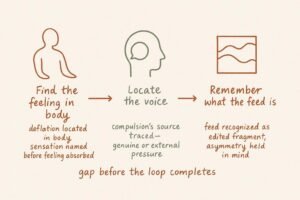
This practice is not about stopping the comparison. It is about noticing that it has started — and finding a small interval before being carried along by it.
STEP 1: Find the Feeling in the Body
When you notice a vague deflation while scrolling — a shift in mood you can’t immediately account for — pause before labeling it abstractly as envy. Look for where it is in the body instead.
There’s a tightening across the chest. Something slightly heated in the stomach.
Putting sensation into words creates a small shift: from being inside the feeling to observing it from just outside. My brain is currently generating a social pain signal. That recognition alone — quiet, without self-judgment — opens the first gap in the automatic chain.
STEP 2: Locate the Voice
When the compulsion that follows comparison surfaces — I need to earn more, move faster, be further along — pause to trace where it is actually coming from.
It can be difficult to tell the difference, especially mid-scroll when the signal arrives fast. But underneath: Is this coming from something I genuinely care about? Or am I trying to prove something to someone?
What you want for your own reasons and what you feel you should want because of external pressure can appear identical on the surface. Inside, they feel different. One has a direction that feels like yours. The other has a pressure behind it that has never quite named itself. Noticing the difference — even briefly, even imprecisely — begins to move the frame of reference from the feed back toward something internal.
STEP 3: Remember What the Feed Actually Is
When a post produces that familiar sting, recall what you are actually looking at: a single selected fragment, posted at the moment it looked best.
You don’t know what came before that travel photo, or after it. You don’t know what that promotion cost. The feed carries the version of a person’s life they wanted to make visible — not the life itself. You were comparing your whole story to someone else’s edited highlight. Holding that asymmetry in mind doesn’t eliminate the sting, but it changes what the sting means.
Session 3: The Pain Had a Name All Along
The Signal Was Always Real
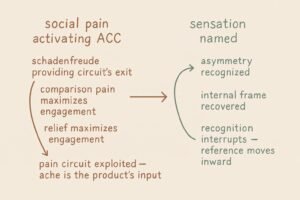
When you see evidence of someone else’s success and feel that tightening in the chest — that is not a figure of speech. Neuroscientist Naomi Eisenberger’s research demonstrated that social pain activates the anterior cingulate cortex, the same region that processes physical pain. The brain does not maintain a clean separation between being cut and being left behind. Both register in the same circuit, generating the same category of signal. The ache of comparison is not an emotional overreaction. It is a neurological event. This matters, because it explains why telling yourself to simply not care runs into a structural wall. You cannot decide your way out of a pain signal any more than you can decide your way out of a burn. The mechanism has to be worked with, not overridden.
The Exit the Circuit Finds
There is a further irony embedded in the circuit. When information arrives that someone you had been comparing yourself to has failed — lost the job, ended the relationship, made a visible mistake — a different region activates: the striatum, associated with reward processing. The momentary relief of learning that someone else has slipped back is a well-documented phenomenon called schadenfreude. The pain circuit, seeking exit, finds one in another’s misfortune. The comparison stops hurting for a moment because the gap has narrowed from the other direction. Social media algorithms are built around the knowledge that this response exists. Content involving collapse, exposure, and failure spreads not despite the discomfort it produces but because of the relief it offers. Pain and relief both keep you engaged. Engagement is the product.
What the Design Always Knew
Social psychologist Leon Festinger proposed in 1954 that humans naturally evaluate themselves through comparison with others — a lateral process, oriented toward people in roughly similar circumstances. What he described was a navigational tool, not a source of chronic distress. The environment social media created is something different: comparison extended to hundreds of millions, calibrated permanently upward, delivered continuously. Sociologist Shoshana Zuboff’s analysis of surveillance capitalism identifies the economic logic underneath this design. Your attention is the commodity being sold to advertisers. Anxiety generated by comparison — the anterior cingulate cortex doing exactly what it was built to do — is among the most reliable mechanisms for holding that attention in place. The pain the feed produces is not a side effect of the business model. It is one of its primary inputs. The ache you feel while scrolling is not a mark of your sensitivity. It is the circuit performing precisely as the architecture intended.
Conclusion: The Feed Was Never a Mirror

The feed will deliver other people’s highlights tomorrow. The anterior cingulate cortex will keep generating its signals. The algorithm will keep using them. The structure does not change.
But the question how do I actually feel right now does not arrive through a feed. When the ache surfaces mid-scroll — when you notice the tightening and can locate it somewhere in the chest — that moment of noticing is the gap. Not a solution. An opening back toward your own reference point, rather than the market’s.
The feed was never a mirror. It was a market.
KEY TERMS
Social Pain
Neuroscientist Naomi Eisenberger’s research finding that social exclusion and comparison-based inferiority activate the anterior cingulate cortex — the same region that processes physical pain. The brain does not distinguish between being physically hurt and being socially diminished; both generate the same category of neural signal. The ache produced by social media comparison is not a metaphor or an overreaction. It is a neurological event, which is why willpower alone cannot resolve it.
Schadenfreude
The momentary relief or satisfaction produced when another person’s failure or misfortune reaches the reward circuit — the striatum. When social pain seeks an exit, another’s misfortune provides one: the gap narrows from the other direction, and the comparison temporarily resolves. Social media algorithms are built with awareness of this response; content involving collapse and exposure spreads reliably because it delivers relief as well as discomfort. Both keep attention in place.
Social Comparison Theory
Leon Festinger’s 1954 framework proposing that humans naturally evaluate themselves through comparison with others. The original model assumed lateral comparison — with people in roughly similar circumstances. Social media transformed this into a system of permanent upward comparison against a global pool of curated highlights. The impulse to compare is not a character trait. It is a basic feature of human cognition, now operating in an environment it was never designed to navigate.
Surveillance Capitalism
Shoshana Zuboff’s term for the business model in which user behavioral data is collected, analyzed, and used to predict and influence action — with attention sold to advertisers as the core commodity. Within this model, the anxiety and social pain generated by comparison are not unfortunate side effects. They are reliable mechanisms for holding attention in place, making the feed’s capacity to produce discomfort a feature rather than a flaw. The self-worth erosion produced by social media comparison is a designed output of an economic system, not a personal failing.
Defusion
The capacity to notice that the comparison narrative — present me measured against their highlight and found lacking — has fused with one’s experience of reality, and to create observational distance from it. Locating the feeling in the body, questioning the source of the compulsion, and recalling the curated nature of the feed are all forms of defusion: small interruptions in the automatic chain that open a gap between stimulus and response.