
Introduction: Before “I Did It Again”

Five minutes late. That’s all it takes for the chest to tighten. A message left on read with no reply. That’s all it takes for the thought they must be avoiding me to start running. And then the emotion carries the response — a sharper tone than intended, a choice regretted an hour later.
This loop is not a problem with patience or temperament. It is a structural problem: the brain is built to output emotion before thinking catches up, and certain social environments are built to keep that output running constantly.
Session 1: What the Irritation Actually Is

When strong irritation or anxiety surges, what is happening inside is a process of fusion — thought and emotion collapsing into a single experience.
A thought arrives: they’re probably dismissing me. Before it can be examined, the body responds — heart rate climbs, shoulders tighten. That physical response feeds back into the thought, confirming it: yes, this is a threat. By the time any of this is noticed, the original thought and the current feeling have merged completely, and it is no longer clear which came first.
Psychologist Steven Hayes, in developing the concept of cognitive defusion, described this state — in which thoughts are experienced not as observable events but as absolute reality — as fusion. When fusion is happening, the emotional weight of a thought arrives in full before its content has been checked against anything.
Whether fusion happens easily also depends on the environment. Instant replies, visible reaction speeds, quantified social feedback — the daily texture of urban life is structured in ways that raise sensitivity to social signals. The sensitivity is not excessive. The environment keeps the threshold low.
Session 2: Practice — Three Steps Out of Fusion
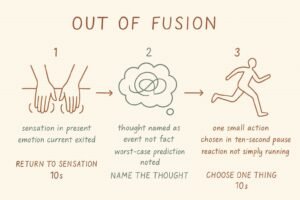
This practice is not about feeling less. It is about creating a small gap between the automatic response and what actually happens next.
STEP 1: Return to sensation
When irritation or anxiety surges, stop everything and spend ten seconds with the sensation of the hands resting against something — a surface, a lap, a table. Temperature. Pressure. Texture.
What is the palm touching right now. Just that.
Strong emotion pulls attention toward the past or the future. Returning to a present physical sensation creates a temporary place to stand outside the emotional current.
STEP 2: Name the thought
When a thought like I’m probably not good enough arrives, don’t agree with it and don’t argue with it. Just name it.
There’s the worst-case prediction again.
Treating a thought as an event happening in the mind — rather than as a fact about the world — creates a small distance between the thought and the self. That distance is where the automatic response loses its grip.
STEP 3: Choose one thing
When the pull toward an automatic response is strong, pause for ten seconds. In that ten seconds, identify the smallest available action that is actually within reach.
A sip of water. Open the window. Reply in five minutes instead of now.
There is no requirement to respond correctly. The only thing that matters is that one thing was chosen rather than the reaction simply running.
Session 3: The Irritation Arrived Before the Thinking Did
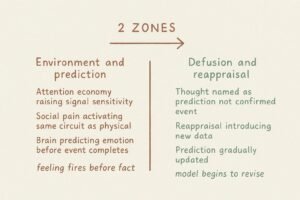
Why social signals in the modern environment hit so fast
Media scholar Tim Wu’s concept of the attention economy describes how contemporary communication environments are designed around human attention as a resource to be captured. When immediate replies become a social norm and response time becomes a proxy for relationship quality, sensitivity to social signals rises structurally — not as a personal failing but as an adaptation to environmental design. Neuroscientist Naomi Eisenberger’s research adds a further layer: social exclusion and being ignored activate the same neural circuitry — the anterior cingulate cortex — as physical pain. The ache of an unanswered message is not metaphorical. At the level of neural processing, it registers as pain. The attention economy raises the sensitivity of the circuit, and Eisenberger’s findings explain why every signal that passes through it lands with such weight. The environment was built to keep the threshold low, and the brain was built to treat what crosses that threshold as real.
The brain outputs emotion before the event arrives
Neuroscientist Karl Friston’s predictive processing framework describes the brain as a system that is constantly generating predictions about what will happen next, updating those predictions against incoming data. Emotion is part of this predictive system — the brain does not wait for an event to complete before producing a feeling. It generates an emotional response in advance, based on patterns from previous experience. Five minutes of waiting produces irritation not because the lateness contains actual malice, but because the brain has predicted threat based on earlier data and output the emotion accordingly. This is where Hayes’s concept of defusion becomes precise: fusion is the state of receiving that advance output as verified reality — taking the prediction as the fact. Naming a thought does not change what the brain predicted. It creates the first moment of noticing that a prediction is what arrived, not a confirmed event.
Reappraisal was always updating the model
Psychologist James Gross’s research on emotion regulation demonstrated that reappraisal — offering a different interpretive frame to the same event — produces real changes in emotional intensity, distinct from suppression, which leaves the underlying response intact. In the language of predictive processing, reappraisal is the act of revising the prediction model itself. Reading the late arrival as a transit problem rather than a slight is not a mood adjustment. It is the introduction of new data into the system that generated the original prediction — data that, repeated over time, gradually shifts how the same signal gets processed in the future. The intervention does not require willpower. It requires only a moment of noticing — introduced at the point where the prediction has already begun to move.
Conclusion: The Irritation Was Running on Old Data

The attention economy continues to be designed in ways that raise social sensitivity. The brain’s predictive system will keep outputting emotion before thinking catches up. Fusion will keep happening.
But the moment of noticing this is a prediction can be brought into any point where the automatic response begins to move. That noticing is the first shift — from the old data running its course to a small, present-tense response to what is actually here.
The irritation was never a malfunction. It was the system running its best prediction — on data that was no longer current.
KEY TERMS
Predictive Processing
Karl Friston’s framework describing the brain as a prediction-generating system that processes the world by continuously modeling what will happen next. Emotion is part of this system: the brain outputs emotional responses in advance, based on patterns from prior experience, before the event that triggered them has been fully processed. Irritation is not a reaction to what happened. It is a prediction that arrived first.
Cognitive Defusion
Steven Hayes’s core concept from ACT. The practice of relating to thoughts as observable events in the mind rather than as facts about the world. In fusion, a thought’s emotional weight is received in full before its content is examined. Defusion creates a small distance — not by changing the thought, but by changing the relationship to it.
Social Pain
Naomi Eisenberger’s finding that social exclusion and being ignored activate the same neural circuitry — the anterior cingulate cortex — as physical pain. The discomfort of an unanswered message is not a metaphor. Combined with the structural sensitivity-raising of the attention economy, this explains why social signals produce such immediate and intense emotional responses.
Cognitive Reappraisal
James Gross’s concept from emotion regulation research. Offering a different interpretive frame to the same event produces real reductions in emotional intensity — unlike suppression, which leaves the underlying response intact. In predictive processing terms, reappraisal introduces new data into the model that generated the original prediction, gradually shifting how the same signal is processed over time.
Attention Economy
Tim Wu’s concept describing contemporary media and communication environments as systems designed to capture and hold human attention. The normalization of instant replies and visible response metrics raises the sensitivity threshold for social signals structurally. Not a personal failure of sensitivity — a designed feature of the environment.