
Introduction: Monday Morning, and the Weekend Weight Is Still There

Saturday night, the phone went away. Sunday had nothing scheduled. And yet Monday morning arrives with a body that feels heavy and a mind already running through the week ahead.
The feeling of not having rested properly is not a failure of rest. The inability to switch off over the weekend is not a weakness of will or a mistake in how rest was approached. The structure that prevents switching off is embedded in workplace design and digital environments — and it was never yours to overcome alone.
Session 1: Why Switching Off Takes So Long

When work ends, the body doesn’t end with it.
The workplace asks for emotional management. Not showing irritation. Performing energy when exhausted. Appearing prepared in every meeting. This is what research on emotional labor describes: work that consumes enormous resources without being recognized as work. And it doesn’t stop at the door.
The problem is that emotional labor leaves a residue in the body that continues after clocking out. The shoulders that won’t release. The low-level alertness that persists through the evening. The thought of tomorrow’s meeting that surfaces uninvited during dinner. These are not signs of poor stress management. They are the body still running a pattern it was asked to run all day.
What recovery actually requires is not physical distance from the workplace. It is psychological separation from it — what researcher Sabine Sonnentag calls psychological detachment. Without this separation, the body remains in the workplace’s extension regardless of where it physically is. The weekend doesn’t fail to restore. The conditions for restoration were never established.
Session 2: Practice — Creating One Condition for Detachment
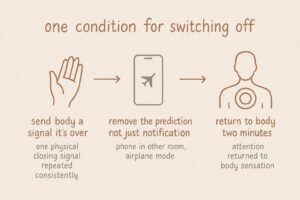
This practice is not about forgetting work. It is about giving the brain one environmental reason to leave standby mode.
STEP 1: Send the body a signal that it’s over
When the workday ends, or when the weekend begins, choose one physical act as a closing signal. Getting changed. A shower. One specific song played through once. Opening a window and standing in the outside air. The content doesn’t matter.
Today ends here. What comes next belongs to Monday.
Repeated consistently, the body learns to read this act as a boundary. Psychological detachment is not produced by intention — it is produced by conditions. This is one condition.
STEP 2: Remove the prediction, not just the notification
Turning off notifications is often not enough. Even in silence, the prediction that something might arrive keeps the brain in standby mode.
Put the phone in a different room. Set it to airplane mode during specific hours. Remove the mail application from the home screen.
Nothing is coming into this time. And if it does, this time is not available to receive it.
Creating an environment where arrival is impossible is more reliable than deciding to ignore what might arrive. The brain responds to conditions, not to resolutions.
STEP 3: Return to the body for two minutes
When detachment is happening, attention moves away from work-related thought and back to immediate sensation.
For two minutes, place attention on what the body is currently doing. The contact between feet and floor. The depth of the breath. Where the shoulders are sitting.
The body is here. Work is not here.
This is not meditation practice. It is the minimum intervention that gives the brain a present-moment anchor — briefly interrupting the prediction loop that standby mode runs on.
Session 3: The Structure That Prevented Switching Off Was Never Inside You
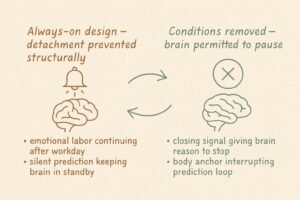
Emotional labor was designed to continue after the workday ended
When Arlie Hochschild described emotional labor in 1983, she was documenting the demands placed on service workers to manage their feelings as part of the job. What subsequent research revealed is that these demands don’t stay at work. A body that has spent the day managing its emotional presentation doesn’t automatically know how to stop. The tension patterns remain. The alertness persists. The anticipatory posture — something might still come — carries into the evening and through the weekend. Contemporary workplaces have deepened this problem by expanding the surfaces on which emotional labor is required. Not just face-to-face contact but email, chat platforms, video calls — every point of contact now carries its own emotional management requirement. As the boundary of the workday has become harder to locate, so has the boundary of emotional labor’s demands.
Digital design structurally prevents the detachment that recovery requires
Sonnentag’s recovery research has consistently demonstrated that psychological detachment — the state of not thinking about work — is the single most important factor in whether rest actually restores. More than physical distance. More than sleep duration. More than the length of a holiday. The quality of this mental separation determines whether recovery happens at all. The arrival of smartphones and always-on workplace culture has made this detachment structurally difficult in ways that have nothing to do with individual willpower. When notifications are active, detachment is interrupted directly. When notifications are silenced, the prediction that they might arrive keeps the brain in a low-level waiting state. The difficulty of switching off is not a personal failing. It is the predictable consequence of a system designed around continuous availability.
Standby mode cannot be stopped by intention — only by the removal of its conditions
The predictive processing framework describes the brain as a system continuously generating predictions about what will happen next. From this perspective, carrying a smartphone is a continuous prediction task — something might arrive, something might need a response, something might be missed. This prediction loop is what standby mode runs on, and it cannot be terminated by deciding to stop thinking about work. The brain is functioning exactly as it should given the environment it is in. What changes the state is changing the conditions: a physical act that marks an ending, a device placed where it cannot be checked, two minutes of attention returned to the body. These work not because they require discipline but because they give the brain an environmental reason to stop predicting. The tiredness that accumulates across the weekend is the cost of a prediction system that was never given permission to pause.
Conclusion: It Wasn’t That You Failed to Rest. The Conditions for Rest Were Never in Place

The residue of emotional labor continues. The design of digital environments hasn’t changed. The workplace’s resistance to clear endings is structural and unlikely to shift quickly.
But the choice to create one closing signal — today, this week — is always available. That choice is the minimum condition. It gives the brain one environmental reason to stop waiting.
The tiredness on Sunday evening was never about the weekend. It was about a system that had never learned how to end the workday.
KEY TERMS
Emotional Labor
Arlie Hochschild’s concept describing the management of feeling as a form of work — suppressing irritation, performing energy, maintaining a composed presentation across every point of contact. Consumes significant cognitive and emotional resources without recognition. Research following Hochschild’s original work demonstrated that these demands leave a residue that persists after the workday ends, contributing to the failure of evenings and weekends to restore.
Psychological Detachment
Sabine Sonnentag’s term for the state of mentally disengaging from work — not thinking about work-related problems, obligations, or situations. Consistently identified in recovery research as the single most important factor in whether rest actually restores. Distinguished from physical distance: being at home does not produce detachment if the mind remains in workplace mode. Always-on digital culture has made this state structurally harder to achieve.
Predictive Processing
The framework describing the brain as a system that continuously generates predictions about what will happen next and updates those predictions based on incoming information. Applied to digital life: carrying a device generates a continuous low-level prediction task regardless of whether notifications are active. The standby state this produces cannot be resolved by intention — only by removing the environmental conditions that sustain the prediction loop.
Standby Mode
The low-level state of anticipatory alertness produced when the brain is running a continuous prediction task around potential incoming demands. Persists even when notifications are turned off, because the prediction is about possibility rather than actual signals. Cannot be terminated by deciding to stop — requires environmental conditions that remove the basis for the prediction.
Conditions for Recovery
The environmental factors that allow psychological detachment to occur, as identified in Sonnentag’s research. A physical act marking an ending, removal of devices from accessible space, return of attention to immediate sensation — these function not as exercises in willpower but as environmental interventions that give the brain a structural reason to exit standby mode.