
Introduction: Why the Morning Commute Slowly Erases You

Bodies pressing against each other, breath mingling in the same air. And yet no eye contact, no conversation, faces arranged in uniform blankness at regular intervals.
You are cargo. A unit being transported to its destination. The irritation, the helplessness, the strange sensation of becoming something less than human — this is not simply a matter of physical crowding. It is what happens when a space systematically strips away individuality and forces anonymity. The stress is not from the density. It is from the dehumanization.
Session 1: The Pressure of Anonymity — When Dehumanization Sets In

The environment of a packed train enters self-perception and other-perception in three layers that function together.
First, the inability to move physically removes the sense of self-determination. The experience shifts from acting to being carried — from subject to object. The mind follows, settling into a passive mode in which agency quietly contracts. Without noticing it, you begin treating yourself the way the space treats you.
Onto this layers the objectification of others. People at close range are registered not as individuals but as sources of heat, pressure, and smell. The awareness that you are surrounded by human beings — each with an interior life — gets switched off. And since the dynamic is mutual, you become equally anonymous to everyone around you. The dehumanization runs in both directions.
Then the sensory overload — touch, sound, smell — triggers a defensive shutdown. Earphones in, eyes fixed on a screen: a natural response to the overwhelm, but one that also disconnects you from your own body.
The stress of a packed train is less about the crowding itself than about this unconscious merger with the dehumanization — the quiet acceptance of being a thing.
Session 2: Practice — Small Acts of Staying Human
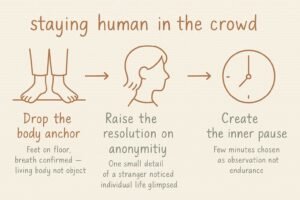
This practice is about stepping out of the automatic mode of endurance and remaining a conscious presence inside the space — small internal shifts, not dramatic ones.
STEP 1: Drop the body anchor
In the middle of the press of bodies, bring attention to the soles of your feet making contact with the floor. Hold that for a few seconds. Then notice, without trying to change it, the breath moving in and out.
“Breathing in. Breathing out.”
Not a technique for relaxation — a return to the most basic fact available: you are a living body, in contact with the ground, not an object being transported. That contact is the first and most reliable point of resistance to the dehumanizing current.
STEP 2: Raise the resolution on anonymity
With eyes down or closed, use peripheral sound and vision to find one individual inside the anonymous mass.
A faint sigh. The sound of a page turning. The texture of someone’s bag, the title of a book, the lines on a pair of hands. Let one small detail suggest the edge of a life.
“This person is also going somewhere.”
Not an attempt at connection. A quiet act of restoring, internally, the awareness that everyone in this car is living a story as complex as yours.
STEP 3: Create the inner pause
Until the next stop, say to yourself:
“For these few minutes, I choose to simply be here. Not consuming, not enduring — just observing.”
Watch the train’s movement, the sensations arising in the body, the thoughts passing through — as if watching clouds. This deliberate pause interrupts the automatic chain from stimulus to reaction, and returns a small measure of agency to the space.
Session 3: Why the Crowding Isn’t the Problem
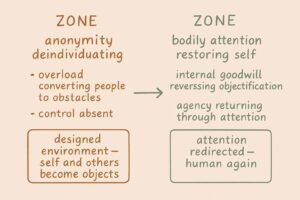
The stress is not from the crowding
Psychologist Jonathan Freedman’s research on density showed that physical crowding does not directly cause psychological stress — what causes it is the loss of a sense of control. The same density produces very different stress responses depending on whether it was chosen or imposed. A packed concert and a packed rush-hour train contain similar numbers of bodies per square meter; the experience is almost incomparable.
Sociologist Georg Simmel’s observation that urban dwellers develop what he called the blasé attitude — a deliberate emotional flatness in the face of overwhelming stimulation — can be understood in the same terms: not indifference, but a defensive response to having no control over one’s exposure. The exhaustion of the commute is not about how many people are in the car. It is about the fact that you did not choose any of them.
Why other people start to look like objects
Social psychologist Philip Zimbardo’s research on deindividuation showed that high-anonymity environments reduce self-awareness and cause people to perceive and be perceived not as individuals but as undifferentiated parts of a crowd. Layered onto this, neuroscientist Matthew Lieberman’s work on the social brain shows that when the volume of incoming social information exceeds what the brain can process, it activates a cognitive economy measure: it stops processing others as people and begins processing them as obstacles.
Two mechanisms compounding each other — the anonymity stripping self-awareness, the overload converting humans to objects. Neither is a personal failing. Both are structural responses to a designed environment.
What attention actually does
Research in embodied cognition shows that directing attention to physical sensation — the breath, the contact of feet with floor — directly restores the sense of self. The feeling of being an object in transit partially dissolves the moment bodily awareness returns.
A consistent finding in social psychology adds a further dimension: brief, quiet attention directed toward a stranger — a moment of imaginative recognition, a small internal gesture of goodwill — measurably increases subjective wellbeing in the person offering it. It temporarily reverses the objectification process from the inside, without requiring any outward act at all.
Control comes back through attention
A further implication of Freedman’s research: the recovery of a sense of control does not require physical freedom. The internal choice of where to direct attention — what to notice, what to let pass — partially restores the sense of agency that the environment removes.
The space cannot be changed. The attention can be redirected. And that redirection, practiced consistently, gradually transforms the experience of the same packed car from something to be endured into something that can be inhabited — consciously, and on your own terms.
Conclusion: The Train Moves You
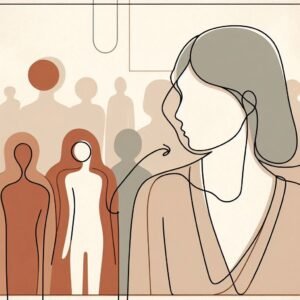
The train will be packed tomorrow. The dehumanizing current will run its automatic course — the anonymity, the overload, the slow drift toward being cargo.
But the attention is not the train’s to direct. Feeling the ground underfoot, finding one human being in the crowd, holding a moment of quiet presence — these small acts work against the current. Quietly, from the inside, without announcement.
The train moves you. Where your attention goes is still your choice.
KEY TERMS
Loss of Control
The mechanism at the center of crowding stress, identified in psychologist Jonathan Freedman’s density research. Physical density alone does not generate psychological stress — the loss of a sense of control over one’s situation does. The same number of bodies in a chosen versus an imposed space produces entirely different stress responses. Commuting stress is not about how many people are present. It is about the absence of choice.
Deindividuation
A phenomenon documented by psychologist Philip Zimbardo. In high-anonymity environments, self-awareness decreases and people are perceived — and perceive others — not as individuals but as undifferentiated parts of a crowd. The mutual invisibility of the packed train is not a collection of personal failures. It is the predictable output of an environment designed around anonymity.
Social Brain Overload
Based on neuroscientist Matthew Lieberman’s research on the social brain. When the volume of incoming social information exceeds processing capacity, the brain shifts to a cognitive economy mode — treating others as obstacles rather than as people. Combined with deindividuation, this is the mechanism by which passengers in a packed train begin to register each other as physical objects rather than human beings.
Embodied Cognition
The finding from cognitive science that directing attention to physical sensation directly influences self-perception and cognitive state. Attention to the breath or the contact of feet with the floor partially dissolves the sense of being an object in transit. The scientific basis for Session 2 STEP 1.
Micro-kindness Effect
The social psychology finding that brief, quiet attention directed toward a stranger — a small act of imaginative recognition or internal goodwill — measurably increases subjective wellbeing in the person offering it. Temporarily reverses the objectification process from the inside. The scientific basis for Session 2 STEP 2.