
Introduction: What Are You Blocking Out?
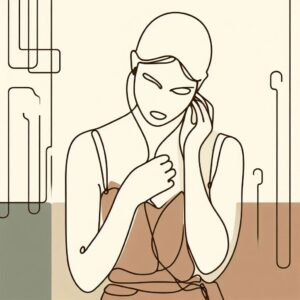
Earphones in before the front door closes. Music on for the walk, the train, the gap between here and there. It’s become so automatic that the decision to listen has effectively disappeared — replaced by the habit of never not listening.
There’s nothing wrong with music or podcasts. But something happens when the ears are never left open: the world outside the feed stops registering. Not dramatically — just gradually, the way any capacity quietly atrophies when it goes unused. Today’s practice is simple. Take the earphones out. Leave them out for a few minutes. See what’s actually there.
Session 1: Why “Sonic Fasting”? Because the Ears Were Designed for This

The auditory system wasn’t built for curated input. It evolved to process an acoustic environment — layered, unpredictable, spatially complex — and to extract meaning, danger, and presence from that complexity.
When we route sound through earphones continuously, we fix the auditory system in what researchers call focused attention mode: a state optimized for tracking a single, chosen source while filtering everything else. This is useful. It’s also narrow. The broader capacity of the auditory system — the ability to process space, distance, movement, and the simultaneous layering of multiple sound sources — goes largely unused.
Taking the earphones out isn’t a deprivation. It’s a reactivation. What comes back online isn’t just hearing — it’s a way of being present in a space that curated listening quietly displaces.
Session 2: Walking the City as a Sound Map
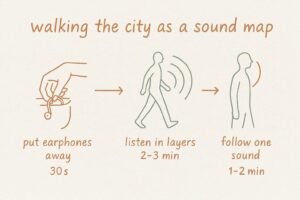
STEP 1: Put the earphones away — deliberately (30 seconds)
Not just paused. Put them in your pocket or bag. Make it a small, conscious act. Inwardly, note: for the next few minutes, I’m listening to what’s actually here.
The first few seconds without sound may feel slightly uncomfortable — a low-level restlessness, the sense that something is missing. That feeling is information. It’s a measure of how thoroughly the silence has been filled, and how unfamiliar its absence has become.
STEP 2: Listen in layers (2–3 minutes)
Let your gaze soften — not focused on anything specific — and begin to separate what you’re hearing by distance.
The far layer: traffic from a block or two away, wind, birds, a distant siren.
The middle layer: footsteps of people nearby, a conversation passing, a bicycle bell, music from a shop doorway.
The near layer: your own footsteps, your breathing, the sound of your clothing moving.
All of it is happening simultaneously. The layers don’t need to be perfectly distinct — the practice is simply to hear the soundscape as a landscape rather than as noise: three-dimensional, layered, alive. If the separation feels difficult at first, start with just near and far. The middle will come.
STEP 3: Follow one sound (1–2 minutes)
Choose a single sound and track it with curiosity rather than analysis. Where is it coming from? Is it moving? What would you need to know to understand it fully? A rhythmic sound from a construction site — does it have a tempo? A laugh from somewhere nearby — what does it suggest about what’s happening?
No conclusions required. Just attention, moving with the sound.
Session 3: What the Auditory System Does When Nothing Is Curating It
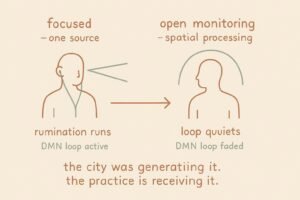
The shift from earphones to open listening isn’t just experiential. It engages a meaningfully different neural mode.
Auditory attention operates along a spectrum. At one end is focused auditory attention — the mode engaged when tracking a podcast, a piece of music, or a specific voice. This mode involves selective suppression of non-target sounds and sustained engagement with a chosen source. It’s cognitively efficient and familiar. At the other end is open monitoring — a mode in which attention is distributed broadly across the acoustic environment, without a fixed target. Neither mode is superior; they serve different purposes. The problem with chronic earphone use is not that focused attention is bad. It’s that the open monitoring circuit gets almost no use.
The auditory cortex is plastic — it changes in response to how it’s used. Consistent patterns of focused, single-source listening reinforce the neural pathways associated with that mode. The pathways associated with spatial auditory processing — the brain’s capacity to simultaneously locate, distinguish, and integrate multiple sound sources across three-dimensional space — are used less frequently and with less facility. This isn’t hearing loss. It’s a narrowing of auditory range that most people don’t notice because they’ve stopped encountering situations that require it.
The layered listening practice directly reactivates spatial auditory processing. Tracking near, middle, and far sound sources simultaneously recruits the dorsal auditory stream — the pathway responsible for sound localization and spatial integration — alongside the primary auditory cortex. This is a different neural demand than single-source listening, and it draws on processing resources that earphone use doesn’t reach.
There is a further effect worth noting. Open auditory attention — genuinely receiving the acoustic environment rather than filtering it — distributes cognitive resources outward. This outward distribution competes with inward rumination in a way that focused listening doesn’t. A curated feed occupies one channel of processing while leaving the default mode network free to run its background narrative. The unfiltered acoustic environment, received openly, occupies something broader — and leaves less room for the loop. The same principle holds across sensory modalities: when the perceptual field opens outward, what had been running inward tends to quiet. The city was generating the input the whole time. The practice is simply allowing the auditory system to receive it.
Conclusion: It Was Never Just Noise

This practice doesn’t require a quiet street or a particularly interesting soundscape. A busy intersection works as well as a residential side street. The content of what’s heard is secondary to the quality of attention brought to it — open, curious, unfiltered. Three to five minutes is enough. Once today is enough.
The acoustic environment was always this layered. The ears just hadn’t been given anything to do with it.
KEY TERMS
Open Monitoring
A mode of attentional processing in which awareness is distributed broadly across the perceptual field without a fixed target. Contrasts with focused attention, which tracks a single chosen source while suppressing others. Chronic earphone use reinforces focused attention pathways while the open monitoring circuit receives little activation — narrowing the auditory system’s functional range without affecting basic hearing acuity.
Spatial Auditory Processing
The auditory system’s capacity to simultaneously locate, distinguish, and integrate multiple sound sources across three-dimensional space. Handled primarily by the dorsal auditory stream — the neural pathway responsible for sound localization and spatial integration. Underused during single-source listening; directly recruited by the layered listening practice.
Auditory Cortex Plasticity
The auditory cortex reorganizes in response to consistent patterns of use. Sustained focused listening reinforces those pathways while spatial processing circuits receive progressively less activation. The result is a functional narrowing of auditory range — not a reduction in hearing sensitivity, but a reduced capacity for the kind of broad, simultaneous sound-field processing the open environment requires.
Soundscape
A term developed by composer and acoustic ecologist R. Murray Schafer to describe the total acoustic environment of a place — not noise to be filtered, but a landscape with its own texture, depth, and meaning. The foundation of acoustic ecology as a field, and the conceptual frame behind treating urban sound as something to be received rather than blocked.
Sensory Gating
The brain’s mechanism for filtering incoming sensory information before it reaches conscious awareness — allowing relevant signals through while suppressing background input. Chronic acoustic filtering through earphone use can effectively lock this gate in the closed position, making it harder to receive the unfiltered environment even when the earphones are removed. Open auditory attention is a deliberate practice of loosening that default — allowing the full acoustic field to register before the filtering reflex engages.