
Introduction: Attention, by Default, Belongs to Something Else

You walk the same route every day. You work in the same office. You wake up in the same room.
How many blue things were in that environment today — you probably can’t say.
Attention feels like a choice, but mostly it isn’t. Things that move, things that are bright, things that are unexpected, things that carry emotional charge — attention is pulled toward these automatically. The outside world holds the wheel.
Deciding I’ll look for blue things today is a small declaration. But in that moment, the wheel comes back to your hands.
Session 1: Why Blue

Attention operates in two modes.
One is triggered by external stimuli — a sudden sound, a flashing screen, an emotionally loaded word. This is bottom-up processing: it activates without intention. The other is directed by internal intention — I’m looking for this, I’m focusing here. This is top-down processing: it requires a conscious choice to start.
Most of daily life runs on bottom-up processing. Smartphone notifications, news headlines, fragments of conversation — these are all designed to pull attention from the outside. Opportunities to deliberately use top-down processing are rare unless you create them.
Deciding to look for blue is a simple device for activating top-down processing intentionally. Blue isn’t special. Any target works. What matters is the act of choosing the target yourself.
Session 2: Three Steps
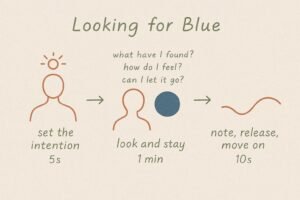
Works anywhere in the day — commute, break, a walk between meetings.
STEP 1: Set the intention (5 seconds)
Before leaving, or before the walk begins, decide quietly: I’m looking for blue. No reminder needed, no record to keep. The intention is the whole of this step.
STEP 2: Look and observe (1 minute or more)
The instinct is to keep moving — to log the blue thing and look for the next one. That instinct is what this step is working against. When something blue appears, stay with it for a moment.
Is this the same blue as the sky, or a different blue?
Natural blue or manufactured blue?
Was it where you expected it, or somewhere surprising?
The goal isn’t to find more. It’s to see one thing more carefully.
STEP 3: Note it, release it, move on (10 seconds)
Acknowledge the find quietly: *blue, one.* Then let it go and continue. Not collecting — encountering, acknowledging, releasing. That rhythm keeps attention fluid rather than grasping.
Session 3: Why the Blue Was Always There — and Why You Couldn’t See It
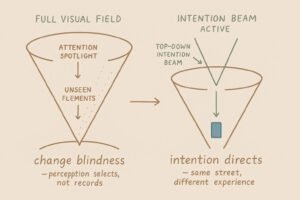
Cognitive psychology has a name for what happens when something changes in your visual field and you don’t see it: change blindness. Simons and colleagues have spent decades documenting the phenomenon — the finding, consistently replicated, that human perception does not process everything in view. It processes what attention has selected. The now-famous “invisible gorilla” experiment — in which participants counting basketball passes fail to notice a person in a gorilla suit walking through the scene — is the extreme version of something that happens continuously in ordinary life. The blue things on your daily commute were always there. Attention simply hadn’t selected them.
The philosophical frame for this was laid down long before the experiments. William James argued in 1890 that experience is what we agree to attend to — that the substance of a person’s life is not everything that happened, but everything attention chose to register. What cognitive science would spend the following century confirming through controlled experiments, James described through introspection and philosophical analysis. The blue hunt is a way of testing this claim in your own nervous system: same street, different intention, different experience.
Bounded rationality — Herbert Simon’s framework establishing that cognitive resources are finite — treats attention as a scarce resource with hard limits. Allocating attention to one thing is always a trade-off against attention to everything else. The modern information environment is built around this scarcity: notifications, algorithmic feeds, and headline design are all optimized to claim attentional resources before a conscious choice is made. Deciding to look for blue is a small intervention in that structure. Not a rejection of the environment, but a reclamation of one small allocation — attention directed by your own intention rather than by external design.
The neuroscience connects here without dominating. Top-down attention — the kind activated by a prior intention — involves the prefrontal cortex in directing the focus of perception. Bottom-up attention — reactive, stimulus-driven — involves subcortical structures including the superior colliculus and amygdala. These systems compete and interact continuously. When a top-down intention is active, the relative influence of bottom-up pulls decreases. Posner’s attention network research mapped these systems in detail.
Conclusion: What Attention Touches Becomes the Day

Attention, left to its defaults, flows toward whatever the environment has optimized to receive it. Notifications, movement, emotional charge — the architecture of modern life is built to claim it before a choice is made. This is not a failure of willpower. It is the system working as designed.
The environment didn’t change. The intention did. That was enough.
KEY TERMS
Change Blindness
The failure to detect changes in a visual scene when attention is directed elsewhere — documented extensively by Simons and colleagues. The “invisible gorilla” experiment is the most widely known demonstration. The practical implication: perception is not a complete record of the environment. It is a selective record of what attention chose.
Top-Down / Bottom-Up Attention
Bottom-up attention is triggered automatically by external stimuli — movement, brightness, emotional salience. Top-down attention is directed by internal intention — a prior decision about what to look for. Modern information environments are optimized to engage bottom-up attention continuously. Deliberately setting a perceptual target — looking for blue — is a practical activation of top-down processing. Posner’s attention network research provides the neural architecture behind this distinction.
Bounded Rationality
Herbert Simon’s framework establishing that cognitive resources, including attention, are finite. Attending to one thing is always a trade-off. In the context of the modern information environment, the implication is that attention allocation is either chosen or defaulted — and the default is increasingly shaped by external systems rather than internal intention.
William James on Attention
James argued in 1890 that experience is what we agree to attend to — that a person’s lived reality is constructed from what attention selects, not from everything present. The observation preceded the experimental confirmation of this principle by nearly a century. Still the most direct philosophical entry point into the relationship between attention and experience.
Defusion
A core skill in Acceptance and Commitment Therapy (ACT): the capacity to observe thoughts as passing mental events rather than facts requiring immediate response. When *this is pointless* or *I keep forgetting to look* arrives during the practice, recognizing it as a thought rather than a verdict — and returning attention to whatever blue thing is actually in front of you — is defusion applied to the mild resistance this kind of practice tends to generate.