
Introduction: You Were Somewhere Else Just Now

The meeting ended twenty minutes ago. You’re back at your desk. And somewhere between there and here, without deciding to, you’ve been running a full internal review of something you said — or replaying a conversation that hasn’t happened yet.
When did that start?
Most of the time, there’s no answer. The thinking was already underway before anything registered. And then, at some point, something shifts: oh. I was thinking.
That moment — the noticing — is what this practice is about.
Session 1: Why Noticing Is Enough

That oh — that small shift of recognition — doesn’t feel like much. Neurologically, it’s one of the more precise things the mind can do.
Being inside a stream of thought and noticing that you’re inside a stream of thought are different states. When the mind is running on autopilot — reviewing the past, simulating the future, processing relationships — the default mode network is active. This self-referential processing is automatic, energy-efficient, and has no built-in endpoint. It continues until something interrupts it.
The interruption comes from the salience network — centered on the anterior insula and anterior cingulate cortex — which continuously monitors both external and internal states for signals that warrant a shift in attention. When it detects that the DMN has been running a particular pattern for long enough, the noticing occurs: a brief activation of prefrontal self-referential processing that makes the automatic thinking visible.
The circuit that observes thinking is separate from the circuit doing the thinking. That observing circuit just turned on for a moment. Nothing needs to be done with it. The noticing itself is the shift.
Session 2: Three Steps
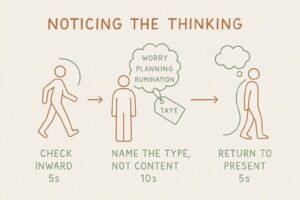
No special time or location needed. This can start right now, in the middle of whatever is already happening.
STEP 1: Check inward (5 seconds)
In the middle of any activity, briefly redirect attention: what’s happening in here right now? Not to change anything — just to look. The quality of attention is light, like glancing at a reflection rather than staring into a mirror.
STEP 2: Note the type, not the content (10 seconds)
Instead of following what the thought is about, notice what kind of thinking is running.
Worry-type thinking, looping through a scenario
Planning-type thinking, organizing and sequencing
Rumination-type thinking, returning to the same moment again
This is the step that feels unnatural at first — we’re trained to follow the content, not observe the pattern. Don’t evaluate the content. Just place a loose label on it. Not I am worried — but worry-type thinking is active right now. The difference in phrasing is small. The difference in position is significant.
STEP 3: Return to something present (5 seconds)
Once the pattern has been noticed and named, let the thinking continue without following it. Bring attention back to something immediate — the physical contact of feet on floor, the current breath, the texture of whatever the hands are touching. If the thinking resumes and carries attention with it again, that’s fine. When the next noticing arrives, do the same thing.
Session 3: Why Observation Changes the Observed

The moment of I was thinking looks, from the inside, like a small thing. From a cognitive neuroscience perspective, it’s one of the more sophisticated operations the brain performs.
Cognitive scientist John Flavell’s framework for metacognition distinguishes between object-level processing — the thinking itself — and meta-level processing — thinking about thinking. Most of the time, these two levels don’t run simultaneously. We are in the thought, not observing it. The shift into metacognitive monitoring — I notice that I am currently running worry-type thinking* — requires the prefrontal cortex to take the ongoing mental activity as an object of observation rather than simply being the subject of it. This is not a skill that develops automatically. It requires repeated activation to become more readily available.
The neural architecture behind this involves the relationship between two large-scale networks. The default mode network generates the self-referential processing that constitutes most of what we call “mind-wandering” — not random noise, but structured, meaningful processing of past events, future possibilities, and social relationships. Running alongside it, the salience network monitors the overall state of the system, flagging patterns that warrant a shift in attention. Research using fMRI suggests that transitions from mind-wandering to self-awareness involve the salience network interrupting DMN activity and facilitating the engagement of prefrontal monitoring circuits. The oh, I was thinking moment corresponds to this transition. It isn’t willed into existence — the salience network produces it. The practice is creating conditions where that transition is more likely to occur, and where it’s received consciously rather than immediately lost again.
The instruction in STEP 2 — labeling thought-type rather than thought-content — engages a mechanism related to what has been called affect labeling: the finding that naming an emotional state reduces its automatic processing intensity by routing it through prefrontal language circuits. Applied here to thought patterns rather than emotions, naming worry-type thinking rather than engaging with what if the project goes wrong routes the processing through a different circuit, creating a small but functional distance between the observer and the observed. The thought doesn’t disappear. The relationship to it shifts.
There’s a quiet paradox at the center of this practice. Observing a thought changes it — not its content, but its status. Before it’s noticed, it’s the medium the mind is moving through. After it’s noticed, it’s an object the mind is looking at. The same pattern of neural firing, experienced differently. This is sometimes described through the metaphor of the observer effect in physics — the act of measurement influencing what is measured. The metaphor is imprecise scientifically, but it points at something real: observation and the thing observed are not fully separable. The medium became an object. The relationship changed before anything else did.
Conclusion: The Noticing Is Already Different

The thinking won’t stop. That isn’t the goal, and it isn’t a failure when it doesn’t. The default mode network will resume — probably within seconds. The same patterns will run. What changes is not the frequency of the thinking but what happens at the moment of noticing: whether that moment is received, or passes unregistered.
The thinking was always happening. The capacity to notice it is a different circuit entirely — and it just turned on.
KEY TERMS
Metacognitive Monitoring
John Flavell’s term for the real-time observation of one’s own thought processes — distinct from the thinking itself. The shift from being inside a thought to noticing that thought as an object of observation. The neurological basis involves prefrontal circuits taking ongoing mental activity as their object rather than simply generating it. The capacity that I was thinking activates.
Salience Network
The brain network centered on the anterior insula and anterior cingulate cortex that monitors both external and internal states for signals warranting a shift in attention. Operates continuously alongside the DMN, detecting when automatic processing patterns warrant interruption. The network whose activity corresponds to the moment of noticing.
Thought Labeling
The practice of naming the type of thinking running — worry-type, planning-type, rumination-type — rather than engaging with its content. Routes processing through prefrontal language circuits, creating functional distance between the observer and the thought pattern. Related to affect labeling research on emotional states, applied here to cognitive patterns.
The Observer Paradox
The observation that noticing a thought changes the relationship to it, even without changing its content. Before noticing, the thought is the medium the mind moves through. After noticing, it is an object the mind is looking at. Not a technique for stopping thought — a description of what observation itself does.
Sati — The Dynamic Layer
Earlier guides in this series worked with Sati as awareness directed toward specific sensory objects, and later as objectless awareness prior to any chosen anchor. This guide engages its most active form: awareness of thinking as it moves, mid-stream. The same capacity, in its most dynamic application — not resting on an object, but tracking the movement of mind itself.
Defusion
A core skill in Acceptance and Commitment Therapy (ACT): the capacity to observe thoughts as passing mental events rather than facts requiring immediate response. The instruction in STEP 2 — not I am worried, but worry-type thinking is running — is defusion in its most direct form: a shift in grammatical position that reflects a shift in psychological position. The practice of this guide and the ACT framework approach this from different directions. The territory is the same.