
Introduction: That Feeling Right After You Post

A perfectly edited photo uploaded. A thoughtful comment written. A good moment shared. And then — almost immediately — a flicker: Is this actually me?
Meanwhile, scrolling through someone else’s highlights makes you feel somehow smaller. On social media, you perform a version of yourself while simultaneously measuring that version against someone else’s performance.
That unsettled feeling isn’t about using your phone too much. It has a structure. And understanding that structure is the first step toward something more useful than guilt.
Session 1: A Stage You Didn’t Audition For

When you open a social media app, two forces activate simultaneously — neither of them chosen.
The moment you see someone’s post, the brain automatically begins measuring: Am I enough? This isn’t a personal failing. It’s a social species doing what social species do — reading the room, assessing position, recalibrating. The problem is that this ancient mechanism is now running continuously against a curated feed of other people’s best moments.
And then your own experiences start to become material — things to be captured, shaped, and presented rather than simply lived. A good meal, a meaningful conversation, a quiet afternoon: all potentially subject to the question how would this look? Two streams of consciousness run in parallel — experiencing and observing — and the split is quietly exhausting.
That low-grade, can’t-quite-name-it sense that something is slightly off? It has a shape. And it’s not yours alone.
Session 2: Stepping Back from the Stage
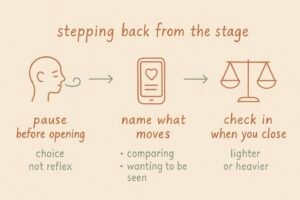
STEP 1: Pause before opening (every time)
Before opening any social media app, stop for one breath.
Ask yourself: Why am I opening this right now?
To connect with someone. To find information. To fill a quiet moment. Any answer is fine. The point isn’t to judge the reason — it’s to make the opening a choice rather than a reflex. One breath of intention changes the quality of what follows.
STEP 2: Name what moves (when you notice it)
While scrolling, or just after posting, if something shifts — envy, urgency, the desire to be seen, a vague deflation — quietly name it.
Comparing right now. Wanting to be noticed. Waiting for a response.
No evaluation. No fixing. Just naming. The moment you name a feeling, you create a small distance between it and you. That distance is where choice lives.
STEP 3: Check in when you close (every time)
Thirty seconds after closing the app, notice your state.
Did that leave me lighter or heavier? More connected or more hollow?
If lighter — that use worked for you. If heavier — something happened. Over time, this thirty-second check builds something no algorithm can give you. A felt sense of what actually works — for your particular nervous system, on your particular kind of day.
Session 3: The Architecture of Exhaustion
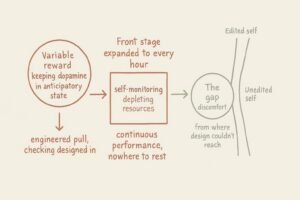
The particular exhaustion that social media produces is neither accidental nor a sign of personal weakness. Three layers connect.
The engineered pull
Social media platforms are deliberately built around variable reward schedules — the same behavioral mechanism that makes slot machines difficult to walk away from. Because the reward (a like, a comment, a response) arrives unpredictably, the dopamine system stays in a state of anticipatory activation, generating repeated checking behavior. Behavioral researcher B.F. Skinner identified this as the most powerful pattern for sustaining compulsive behavior. The urge to check one more time isn’t weak willpower. It’s the system responding exactly as designed.
The cost of continuous performance
Once inside that engineered pull, a second layer activates. Sociologist Erving Goffman described social life as a constant negotiation between the front stage — the self we present to others — and the back stage — the self we are when no one is watching. Social media has expanded the front stage to cover every waking hour, at global scale, with no guaranteed exit. Research on self-monitoring consistently shows that sustained high-self-monitoring depletes cognitive resources over time. The hollowness after a long session isn’t imaginary. It’s the accumulated cost of continuous impression management with nowhere to rest.
The gap that generates the feeling — and what it means
Drawing on Pierre Bourdieu’s analysis of social capital, social media functions as an economy where approval — likes, shares, follower counts — operates as a primary currency. Under this system, self-presentation gradually shifts from expression toward optimization: shaping how you appear to maximize return in the approval economy. The self that gets posted is real, but it’s also edited — selected for what travels well in this particular market. The gap between that edited self and the unedited one is where the discomfort lives.
But here the chain reverses
That quiet, persistent is this actually me? is a signal from the part of you that noticed the editing. It means your self-awareness is functioning. To feel the gap is to still have something that hasn’t been fully optimized away. The discomfort isn’t a problem to fix. It’s arriving from the one place the design couldn’t reach.
Conclusion

The exhaustion is structural. The comparison is automatic. The performance has a measurable cost. None of this is your fault — but all of it is yours to work with.
The discomfort wasn’t a flaw. It was the only part of you they couldn’t design.
KEY TERMS
Variable Reward Schedule
A reinforcement pattern in which rewards arrive at unpredictable intervals, identified by B.F. Skinner as the most powerful driver of compulsive behavior. Social media notifications operate on this principle — which is why you check your phone before you’ve even decided to.
Impression Management
Erving Goffman’s term for the ongoing work of controlling how we appear to others. Social media extends this work to a permanent, global stage — raising the cognitive cost of self-presentation far beyond what most social environments have ever required. There’s no backstage anymore. That’s not nothing.
Cognitive Fusion
A concept from Acceptance and Commitment Therapy (ACT): the state of becoming so identified with a thought or image that it feels like reality rather than a mental event. Fusing the edited social media self with the actual self is a common form. The naming practice in STEP 2 works directly against it — not by rejecting the thought, but by creating just enough distance to see it as a thought.
Economy of Recognition
Drawing on Pierre Bourdieu’s framework of social capital: the way approval metrics on social media function as a currency, gradually shifting self-expression toward self-optimization. Once you see it as an economy, the pressure to perform stops feeling personal. It becomes legible. And legible things can be worked with.