
Introduction: The Weight of “You Are Our Pride”

A parent’s expectations, spoken in the language of the homeland. The warm but sometimes suffocating gaze at community gatherings. And on the other side, the society you grew up in — speaking constantly of individual freedom, self-actualization, the importance of being true to yourself.
To live as the next generation of a diaspora community is to have two sets of “of course” arriving at you simultaneously. To be someone who honors tradition while also being someone who chooses their own life — that tension does not come from a personal failing or a lack of love. It comes from somewhere deeper: history, memory, and culture exerting their force directly on one ordinary life.
What follows is not a method for resolving that tension. It is a practice for learning to see it as a place where something is being made.
Session 1: The Psychology of Being Caught

In the presence of family and community, something activates — an impulse to embody the culture correctly, to represent it well, to be a worthy heir. Less a conscious choice than a reflex shaped over generations in which belonging to a group was inseparable from survival. The monitoring is quiet. It doesn’t announce itself. It simply runs.
Then you step back into the life you’ve built in the society you grew up in, and a different pull takes over. Individual freedom. Self-actualization. The value of being true to yourself. These aren’t abstract ideals — they’re the air you’ve been breathing. And they can come into direct conflict with what the community expects.
Step away from the culture of your parents — the feeling of being a traitor arises. Move back toward it — a different discomfort waits, the sense of not having assimilated, of being out of place in both worlds. Either way, something feels sacrificed.
This is the double bind. And it is exhausting in a specific way — not because you love your family too little, not because you’re doing it wrong, but because two legitimate sets of values are making simultaneous demands on the same person. That is not a personal failing. It is a structural condition.
Session 2: Practice — Turning the Conflict into Conversation
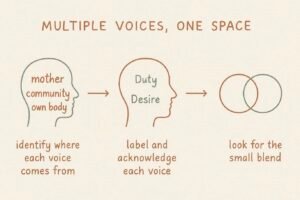
This practice is not about resolving the tension into a single answer. It is about learning to hold multiple voices in the same space — without requiring any of them to disappear.
STEP 1: Identify where each voice comes from
When conflict arises, the voices and demands swirling in your head can feel like one undifferentiated pressure. Try separating them by origin. Quietly identify each one:
“This is my mother’s voice — it is asking for stability.”
“This is the community’s gaze — it is saying, protect the honor.”
“This is my own body’s voice — it is saying, I’m tired.”
Identifying each voice as coming from a specific place — rather than treating the whole tangle as evidence of your own failure — shifts the experience. The conflict becomes less a personal inadequacy and more a set of legitimate claims that need to be heard.
STEP 2: Label each voice as duty or desire
Sort what each voice is asking for into two categories: obligation (should) and longing (want). Then offer a brief, quiet acknowledgment to each.
“The voice that says ‘preserve the tradition’ — I hear you. That concern is real.”
“The voice that says ‘I want to walk my own path’ — I hear you. That wish is real too.”
Not eliminating either, but letting both know they have been heard. The voice that feels heard stops needing to shout.
STEP 3: Look for the small blend
When a situation feels like a forced choice — tradition or freedom, loyalty or autonomy — look deliberately for a third option. A small, concrete action that allows both values to breathe a little.
Attending a family ceremony that matters, and bringing your own partner into it. Speaking love to a parent in their language, while letting your children grow up freely in both. Showing up to the community gathering in your own way, and letting what you find there become material for something you create.
These are not grand compromises. They are small experiments — and it is the accumulation of small experiments, not a single decision, that builds an integrated sense of self over time.
Session 3: The Structures Underneath the Weight
Why the guilt runs so deep
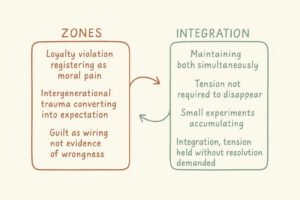
Psychologist Jonathan Haidt’s research shows that violations of group loyalty are not processed as mere awkwardness — they register as moral emotions, moving through the same neural circuits as physical pain. The weight of potentially disappointing your community is not a sign of weakness or oversensitivity. It is the product of a long evolutionary and cultural history in which belonging to a group was a condition of survival — and sensitivity to loyalty violations was shaped accordingly.
Knowing this doesn’t make the guilt disappear. But it changes what the guilt means. It is not evidence that you are doing something wrong. It is evidence of how deeply you are wired to care.
What the parents carried
There is another layer to that emotional weight — a historical one. The displacement, loss, discrimination, and isolation that the parent generation experienced does not simply disappear. It gets converted: into expectations, into the urgency to succeed, into “be strong,” “protect the culture,” “don’t bring shame.” What researchers describe as the intergenerational transmission of trauma shows that the heaviness of parental expectation is rarely pure control. It is something more complicated — fear and love, loss and hope, pressed together and passed forward.
Understanding where the weight comes from does not mean accepting it without question. It means being able to see it whole.
The strategy that actually works
Cultural psychologist John Berry identified four strategies that diaspora individuals use to navigate cultural change. Assimilation — releasing the original culture and merging into the new. Separation — maintaining the original culture and withdrawing from the new. Marginalization — finding belonging in neither. And integration — maintaining meaningful connection to both simultaneously. What research has consistently shown is that integration correlates most strongly with psychological wellbeing. Not because it resolves the tension, but because it stops demanding that the tension disappear.
Conclusion

The next generation of a diaspora community is not simply a bridge between cultures. You receive the materials of two or more worlds — and from those materials, you make something no one has made before.
The voice that says “preserve” and the voice that says “be free” are not enemies. Bringing attention to both — without demanding that either one disappear — is what makes the making possible.
The friction was never the problem. It was always the sound of something forming.
KEY TERMS
Moral Emotions
The category of emotions — guilt, shame, disgust — triggered by violations of group loyalty. Research by psychologist Jonathan Haidt shows these are processed through the same neural circuits as physical pain. The intensity of feeling like a traitor is not a personal weakness. It is the product of a long evolutionary and cultural history in which loyalty to the group was a condition of survival — and the body still remembers.
Intergenerational Trauma Transmission
The mechanism by which experiences of displacement, loss, and discrimination in the parent generation are converted into expectations, values, and fears passed to the next. The weight of parental expectation often carries within it the compressed fear and love of a generation that survived by holding on. Understanding this does not mean accepting the weight without question — it means being able to see it whole.
Integration Strategy
One of four cultural adaptation strategies identified by cultural psychologist John Berry. Rather than assimilating into the new culture or retreating into the original, integration involves maintaining meaningful connection to both simultaneously. Research consistently shows this strategy correlates most strongly with psychological wellbeing — not because it resolves the tension, but because it stops requiring the tension to disappear.
Cultural In-Between Space
The generative zone that emerges when two cultures meet and mix within a single life. Not a compromise between them, and not a diluted version of either — but a space where new meanings and expressions form that belong to neither original. The identity built there is a third thing, made from both. The friction of diaspora life is the friction of this space being created. Not a problem. The sound of something forming.
Sati
Pāli for “awareness” or “mindfulness.” The capacity to bring steady, non-reactive attention to what is present — including conflict, competing voices, and the discomfort of holding more than one truth at once. The orientation underlying all three steps of the practice in Session 2.