
Introduction: The Colorless Landscape at the End of Everything

The goal was reached. The project was finished. And what waited on the other side was not satisfaction — it was a deep emptiness, and the particular exhaustion of someone whose interior has gone to ash.
This is not tiredness. It is the stopping of the engine that made the work feel worth doing. What once carried genuine passion becomes a gray queue of obligations.
When burnout is treated as a temporary malfunction to be repaired, the instinct is to get back on the same road. But what if that road is exactly what led here?
Session 1: The Fusion of Output and Worth

Burnout doesn’t arrive suddenly. It is the end result of a psychological process that has been running for a long time.
At its center is a complete dependence of self-worth on external indicators. What you have accomplished becomes the only answer to who you are. The internal sources of motivation — the quiet drive that doesn’t need an audience — hollow out. Metrics rise and there is a brief exhale of relief, and then the next metric is already pulling at attention.
Layered onto this is the shelving of feeling. Fatigue, stress, the persistent sense that something is wrong — these get classified as non-productive and set aside. The body and the mind raise their signals, and the thinking mind responds with a longer list of things to do.
Eventually, the narrative that sustained all of it — effort leads somewhere, the difficulty has a meaning — collapses under the weight of the exhaustion itself. The bridge between past effort and future hope disappears, and what remains is the specific heaviness of having worked very hard toward nothing that can still be felt.
Burnout is what happens when that rigid fusion is forcibly broken by the body and mind — painful, but in some ways necessary. Not a malfunction. A dissolution.
Session 2: Practice — Growing Something New from the Ash
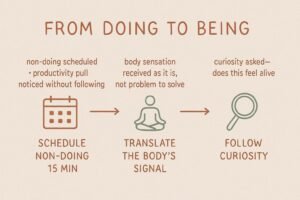
Recovery is not a return to the high-output version of yourself. It is the slow work of loosening the fusion between productivity and worth — and building a wider sense of what it means to be here.
STEP 1: Schedule non-doing
Find fifteen minutes — or less — in your day and dedicate them to producing nothing. Look out the window without a destination in mind. Listen to music without doing anything else alongside it. Walk without tracking steps or time.
When the thought arrives — I should be doing something more useful — notice it rather than follow it.
“This is not a time for doing. This is a time for being.”
That single act of noticing is the first distance between yourself and the automatic pull of productivity thinking.
STEP 2: Translate the body’s signal
Burnout lives in the body before it fully surfaces in the mind. Practice turning attention away from analysis and toward physical sensation.
“What is the quality of this tension in my shoulders — its texture, its weight?”
“Where exactly does this afternoon heaviness sit, and how does it feel from the inside?”
Receiving sensation as it is — not as a problem to be solved, not as evidence of failure — is practice in a form of attention that evaluation and productivity cannot reach.
STEP 3: Follow the compass of curiosity
Set aside the list of what should be done and ask a smaller question:
“Is there anything, however small, that I’m genuinely curious about right now?”
A chapter in a book that has nothing to do with work. A recipe. Something you were absorbed in as a child. The criterion is not is this useful or will this be evaluated — it is simply does this feel alive? That small flicker is the first sign of intrinsic motivation beginning to stir.
Session 3: The Structures Underneath the Feeling
Why we run until we break
Sociologist Max Weber traced the spiritual origins of modern capitalism to what he called the Protestant ethic — the idea that diligence and self-discipline were evidence of divine grace. Secularized, that structure didn’t disappear. It became the ethic of self-optimization: the relentless pursuit of self-actualization, career growth, personal branding. Digital tools made this process available around the clock; social media made everyone else’s optimized success permanently visible for comparison.
The sense of obligation to keep running — to keep producing, to keep improving — is not a character trait. It is a social norm with a long history, one that has been absorbed so thoroughly it feels like a personal conviction. Burnout, in this light, is not individual failure. It is what happens when a biological system meets a set of demands it was never designed to sustain indefinitely.
Why the body stops
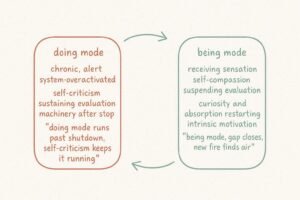
Psychologist Mark Williams and colleagues identified two fundamental modes of mental operation. Doing Mode is the goal-oriented, gap-closing mode — constantly measuring the distance between where things are and where they should be. Being Mode is the mode of present-moment attention, in which experience is received rather than evaluated.
When Doing Mode runs chronically without interruption, the brain’s alert system becomes persistently overactivated, and eventually an automatic shutdown follows. Burnout is the body’s protective response to this overload. Not a malfunction. An honest signal from a system that has been asked to do too much for too long.
What stops the engine from restarting the same way
Psychologist Kristin Neff’s research on self-compassion shows that the self-criticism many people fall into after burnout — why did I let this happen, why wasn’t I stronger — doesn’t aid recovery. It sustains Doing Mode. Self-criticism is goal-pursuit in a different form: the goal of having been better. It keeps the evaluative machinery running even when the work has stopped.
What enables the shift into Being Mode is the capacity to receive one’s own suffering without the need to immediately fix it — and in that receiving, the conditions for something new begin to form.
Csikszentmihalyi’s research on flow shows that intrinsic motivation tends to appear not when searched for directly, but in the middle of absorption, when the gap between self and activity temporarily disappears. Non-doing, sensation, curiosity — these are not rest stops on the way back to performance. They are the conditions under which the next fire finds its air.
Conclusion: The Ash Contains the Next Fire

Burnout is the signal that one particular road has ended. Going back the same way leads to the same place.
The ash is not nothing. Sitting in it — looking at the colorless landscape without rushing to redraw it — is where the shift from Doing Mode to Being Mode begins. That shift doesn’t happen through effort. It happens through the steady, patient practice of turning toward what is already here: sensation, curiosity, the small flicker of something that feels alive.
The ash contains the next fire. But fire doesn’t force itself. It waits for the right conditions — and those conditions are made by attention, not by will.
KEY TERMS
Burnout
The state of physical and psychological depletion resulting from chronic stress and overwork. Characterized by emotional exhaustion, diminished sense of accomplishment, and a loss of felt connection to one’s work. Understood neurologically, burnout is the body’s protective response to the sustained overactivation of Doing Mode — not a personal failing, but a biological signal.
Cognitive Fusion
The state in which the belief my output equals my worth becomes indistinguishable from reality. While this fusion holds, fluctuations in productivity register directly as fluctuations in self-worth. The three steps in Session 2 work progressively to loosen this fusion — creating the distance in which the belief can be observed rather than lived.
Doing Mode / Being Mode
Two modes of mental operation identified by psychologist Mark Williams and colleagues. Doing Mode is goal-oriented and gap-closing, continuously measuring the distance between current and desired states. Being Mode receives present-moment experience without evaluation. Burnout is the product of chronic Doing Mode overload. Recovery depends on intentional movement toward Being Mode.
Self-Compassion
A concept developed by psychologist Kristin Neff. The capacity to receive one’s own suffering with the same quality of attention one might offer a close friend — without judgment, without the immediate impulse to fix. Post-burnout self-criticism sustains Doing Mode; self-compassion enables the transition into Being Mode. The orientation underlying Session 2.
Sati
Pāli for “awareness” or “mindfulness.” The capacity to notice the automatic pull of Doing Mode — and to recognize, in that noticing, a moment of choice. The foundational orientation underlying all three steps of the practice in Session 2.