
Introduction: In the Progress Meeting, It May Not Be the Work That Isn’t Moving

A progress meeting to discuss the ongoing project. A report to organize what was discussed. A guidelines meeting to standardize the report format. Somewhere in this sequence, the original purpose — creating something of value — disappears, and you find yourself inside an endless loop where completing the process has become the goal.
Did we actually need that meeting? Who is going to read this, and when? That flicker of pointlessness is not laziness. It is an honest response to the misuse of a finite resource: your attention.
Session 1: Fusing with the Process — When the Means Becomes the Water You’re Swimming In

The emptiness that surrounds meetings and paperwork takes several recognizable forms.
One is the state in which how something is done completely absorbs the attention that should be on why. Report formatting, presentation fonts, the correct way to take minutes — form displaces purpose, and the content hollows out. The container becomes more important than what it holds.
Another is the unexamined belief that the only reliable path to a decision is to hold a meeting about it. The possibility of individual thinking, or a brief conversation between two people, gets quietly foreclosed. The meeting fills its scheduled hour, and the hour produces another meeting.
Then there is the self-replication of work itself. An unclear report generates an explanatory session; the explanatory session generates minutes; the minutes generate a follow-up. Each task exists partly to justify or cover the inadequacy of the last. The system produces its own fuel, and the people inside it are the engine.
The emptiness that follows is not a character flaw. It is the mind’s accurate report that something finite is being consumed without return.
Session 2: Practice — Lifting Attention Out of the Process
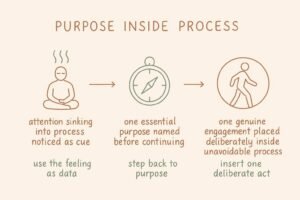
This practice is about building the habit of pausing, briefly and deliberately, inside the current of automatic process — and finding the compass that points toward purpose.
STEP 1: Use the feeling as data
The moment it arrives — what is this meeting even for? or does anyone actually read these? — catch it before dismissing it or pushing through. You know that feeling. It surfaces in the gap between what the calendar says you’re doing and what your attention is actually doing. Receive it as the most useful signal in the room. Quietly note:
“My attention is beginning to sink into the process. This is the cue to check the purpose.”
Redefining the feeling from problem to data is the first act of stepping outside the automatic current.
STEP 2: Take one step back toward the purpose
Once the cue is noticed, ask yourself one question before continuing:
“What is the single most essential purpose of this action?”
For a meeting: is it to make a decision, share information, or build a relationship? For a document: who will act on this, and what will they need in order to act? If possible, write that purpose at the top of your notes, or say it aloud at the start of the meeting. Even when everyone around you is caught in the form, keeping your own attention anchored to that one point is the line back to solid ground.
STEP 3: Insert one deliberate act
Within the unavoidable process, find one small point of genuine engagement and place it there intentionally.
In a meeting: rather than tracking the content of what is being said, try listening for what the speaker actually wants — the need underneath the words. In a document: imagine the person who will read this and organize it around what they will need to do next.
The content of the action may not be changeable. The quality of attention brought to it always is. And that shift — small, invisible to everyone else in the room — is often enough to make the hour feel like it belonged to you.
Session 3: The Structures Underneath the Feeling
The feeling of pointlessness is accurate
Behavioral economist Daniel Kahneman’s research established that human attention is a finite resource. The cognitive capacity available in a given day has a ceiling, and attention spent on tasks that produce no meaningful output directly reduces what remains for creative thinking and substantive problem-solving.
The sense that a meeting was a waste is not cynicism or ingratitude. It is the cognitive system’s accurate report that a limited resource has been spent without return. When that signal is ignored, the depletion continues — quietly, cumulatively, below the level of conscious accounting.
Why the process keeps growing
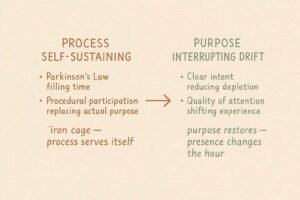
Sociologist Max Weber described what he called the “iron cage” — the condition in which the rational systems humans build to serve particular purposes eventually become self-sustaining structures that constrain the people inside them. The bureaucracy designed to create efficiency begins to treat the maintenance of its own rules as the highest value, and the original purposes the rules were meant to serve recede from view.
Alongside this, economist C. Northcote Parkinson observed what became known as Parkinson’s Law: work expands to fill the time available for its completion. A one-hour meeting slot will find enough agenda to fill an hour. A standardized report format will generate the work required to complete it. The proliferation of process is not a failure of individual discipline. It is the structural gravity of the system itself.
Why redirecting attention changes the experience
Psychologists studying procedural justice have found that people place strong value not only on whether outcomes are correct, but on whether the process that produced them felt fair and inclusive. Inside organizations, this tendency quietly transforms meetings: the goal shifts from reaching a good decision to being present for the process of deciding. Attendance becomes the deliverable.
Asking what is the single most essential purpose of this action? introduces a momentary interruption to this drift — redirecting attention away from the performance of participation and toward the actual function the meeting was called to serve. Research on attentional resources points to a further implication: people who approach a task with a clear sense of its purpose show less cognitive depletion from the same work, and greater capacity for creative engagement within it.
Not a better system. A different quality of presence inside the one that exists.
Conclusion: Attention Is the One Thing the System Doesn’t Control

The process will keep expanding. The meetings will keep filling their slots. The iron cage does not unlock from the inside.
But where the attention goes is not determined by the system. The moment of noticing — my attention has drifted into the process again — is the moment of choice. Returned to, steadily and without drama, that noticing is what keeps something in you oriented toward purpose rather than procedure.
The process doesn’t have to change for your attention to go somewhere real.
KEY TERMS
Attentional Resources
A concept from behavioral economist Daniel Kahneman’s work on cognitive capacity. Human attention is finite — the cognitive fuel available in a given day has a ceiling. Attention consumed by meaningless tasks directly reduces what remains for substantive thinking. The feeling of pointlessness in meetings and paperwork is the cognitive system’s accurate report of this depletion in progress.
Cognitive Fusion
The state in which the actions — attending the meeting, submitting the document — become indistinguishable from the purposes they were meant to serve. The means fuse with the ends, and the original purpose disappears from view. The three steps in Session 2 work progressively to loosen this fusion, returning attention to the purpose beneath the action.
Iron Cage
Max Weber’s term for the condition in which rational systems designed to serve human purposes become self-sustaining structures that constrain the people inside them. Combined with Parkinson’s Law — work expands to fill the time available — the iron cage helps explain why process proliferates structurally, independent of individual effort or intention.
Procedural Justice
The psychological tendency to value the fairness of a process, not only the correctness of its outcomes. Inside organizations, this transforms meetings from decision-making forums into participation rituals — where being present becomes the deliverable. Understanding this mechanism is the foundation for the intervention in Session 2 STEP 2.
Sati
Pāli for “awareness” or “mindfulness.” The capacity to notice when attention has drifted into automatic process — and to choose, in that noticing, where it goes next. The orientation underlying all three steps of the practice in Session 2, and the one form of agency the system cannot reach.