
Introduction: Where Does That Feeling Come From?

The alarm goes off. You ride the packed train. Or you open the laptop and face the screen, same as yesterday. There is plenty to do. The salary arrives. And yet, in an unguarded moment, a question surfaces.
What was any of this for?
This question doesn’t come from being tired or overloaded — not exactly. It sits somewhere deeper than burnout, a quiet tremor that that word doesn’t quite reach.
What follows isn’t a method for answering that question. It’s an exploration of how to hold it differently — and find a slightly different relationship between yourself and the work that’s already in front of you.
Session 1: When Work and Self Become the Same Thing

The vague unease that surrounds work tends to take a few recognizable forms.
One is the feeling that your value has become too tightly bound to external measures. Evaluations, titles, salary — when they rise, there’s a brief exhale of relief, and then the next indicator is already pulling at your attention. When they fall, it’s not just the number that drops. It feels like you do. The measuring stick has moved inside you, and it never rests.
Another is the guilt that comes with stopping. Time that isn’t producing something feels wasted. Just being somewhere — not performing, not contributing — feels like something you haven’t earned. Productivity has become a gatekeeper that won’t grant permission even to rest.
And then there is the feeling of working in isolation. The small tasks in front of you feel disconnected from anything larger — from anyone who might actually be affected by them. The image that comes is a cog in an enormous machine, turning because the mechanism requires it.
That depletion is not a personal failing. It is the structural result of conditions that were in place long before you arrived.
Session 2: Practice — Creating a Little Space Between You and Your Work
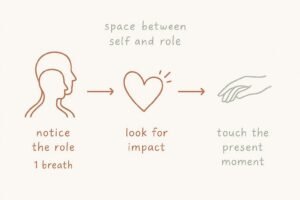
This practice is not about changing the content of your work. It is about shifting the relationship between yourself and the work — from the inside.
STEP 1: Notice that you are playing a role
When stress or emptiness arises at work, take one quiet breath and say to yourself:
“I am taking on this role right now. But this role is not all of me.”
Project lead. Point of contact. The person who trains the new hire. Each role carries a pre-written script — a set of behaviors and expectations that existed before you arrived. Try looking at that script from a slight distance, the way an actor might look at a part. The fusion between the role and the self loosens, just a little. The evaluations that come with the role lose some of their grip.
STEP 2: Look for impact rather than meaning
The large question — what is the meaning of this work? — can loop endlessly without resolution, pulling more energy than it returns. Try a smaller question instead.
“The email I just wrote carefully might make someone’s afternoon slightly easier.”
“The document I organized might save the next person five minutes.”
Even when meaning feels out of reach, impact is often findable. It shifts the frame from work as output — something to be evaluated — to work as a small chain of effects between people.
STEP 3: Touch the present moment
Set aside, temporarily, the awareness of outcomes and evaluation. Look deliberately for the moments when you are absorbed in the process itself.
The stretch of time when a difficult problem has your full attention. A conversation where an idea takes shape between you and someone else. The quiet physical satisfaction of moving through a familiar task smoothly.
“This moment — it isn’t for the reward. The doing itself is what’s interesting.”
Finding even a few minutes like this in a day is enough. That is where the thread of intrinsic motivation begins.
Session 3: The Structures Underneath the Feeling
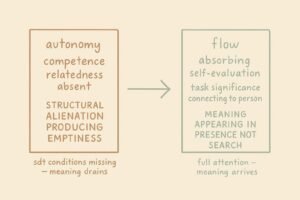
The feeling of being a cog is not your weakness
The sense that your work is disconnected from anything meaningful — that you are a part in a machine too large to see — has a long structural history. Since industrialization, labor has been progressively divided and specialized, and the opportunity for a single person to see the full arc of what their work creates has been systematically reduced. What sociologists have called alienation — the experience of one’s labor becoming separated from oneself, its outcomes invisible and inaccessible — is not a personal failing. It is a structural product of the way work has been organized.
The emptiness you feel is not evidence of weakness. It is evidence of the design you are inside.
Three conditions — and what happens when they’re missing
Psychologists Edward Deci and Richard Ryan spent decades studying why people lose intrinsic motivation — and what they found was structural. Their framework, Self-Determination Theory, identifies three conditions that human beings need in order to move from the inside: autonomy, the sense that you have some choice in how you work; competence, the sense that you are capable; and relatedness, the sense that what you do is connected to others.
Remove any one of the three, and meaning drains from even the most objectively favorable job. Burnout, in this framework, is not a character flaw. It is what happens when these conditions are absent long enough.
Where meaning actually appears
Psychologist Mihaly Csikszentmihalyi described a state he called flow — the experience of being so fully absorbed in a task that awareness of outcomes and self-evaluation temporarily falls away. In that state, people are not searching for meaning. They are, as the research suggests, living it.
Research on task significance adds a complementary finding: when people can see — concretely, specifically — that their work has affected another person, motivation and persistence increase. The mechanism isn’t abstract purpose. It is a felt connection to someone on the other end.
The pattern across this research is consistent: meaning is not located by searching for it directly. It tends to appear when attention is fully present — in the work, in the moment, in the person it reaches.
Conclusion: Meaning Grows

You don’t have to answer the question of whether this work matters. You can hold it, and still write the email carefully. Still make someone’s afternoon a little easier. Still give this task your full attention for the next ten minutes.
Meaning is not something you locate and secure. It accumulates — in the moments when you were actually present for what you were doing.
The question wasn’t asking for an answer. It was the attention it required — and that attention was already the practice.
KEY TERMS
Alienation
The experience of one’s labor becoming separated from oneself — its outcomes invisible, its contribution to a larger whole impossible to feel. A structural product of how work has been organized since industrialization, not a personal failing. The feeling of being a cog in a machine is not evidence of weakness. It is evidence of the design you are inside.
Self-Determination Theory
A framework developed by psychologists Edward Deci and Richard Ryan identifying three conditions necessary for intrinsic motivation: autonomy, competence, and relatedness. Remove any one of the three, and meaning drains from even objectively favorable work. Burnout is not a character flaw — it is what happens when these conditions are absent long enough.
Cognitive Fusion
The state in which thoughts like “my value is determined by output” become indistinguishable from reality. Once fused with these beliefs, contradicting evidence stops registering — moments of ease are discounted, moments of falling short accumulate. The practice in Session 2 works to loosen this fusion.
Flow
A state described by psychologist Mihaly Csikszentmihalyi in which full absorption in a task causes self-evaluation and outcome-awareness to temporarily fall away. In flow, meaning is not being searched for — it is being lived. The direction that Session 2 moves toward.
Sati
Pāli for “awareness” or “mindfulness.” The capacity to notice what is happening — in the work, in the body, in the quality of attention — without being pulled immediately into evaluation or judgment. The orientation underlying all three steps of the practice in Session 2.