
Introduction: The Pendulum Between Full Force and Complete Collapse

Either do it perfectly or don’t do it at all. Either give everything or give up entirely. Either recover completely before starting again, or push through until the system breaks down.
The oscillation between these two poles is itself a source of exhaustion. Full effort followed by sudden collapse, followed by full effort again — each cycle of the pendulum extends the recovery time required before the next one begins.
Burnout is not only caused by working too hard. The thought pattern that insists anything less than full effort is meaningless keeps the brain in a continuous state of processing the present moment as a problem to be solved. The structure of that processing — operating at both a cognitive and a neural level — is what this article traces.
Session 1: The Two Layers Through Which Binary Thinking Produces Exhaustion

The relationship between all-or-nothing thinking and burnout operates through two distinct layers: a cognitive layer and a neural layer.
At the cognitive layer, perfectionist binary thinking functions as a form of cognitive rigidity. When the only visible options are do it perfectly or abandon it entirely, the adaptive range of responses available in any given moment is narrowed to two. The option of working at sixty percent capacity, or finishing something at a standard that is good enough for now, is not chosen against — it is made invisible by the structure of the thinking pattern itself. The range of what is possible is determined before any specific decision is reached.
At the neural layer, the chronic activation of what cognitive science calls Doing Mode generates a second problem. Doing Mode is the brain’s goal-oriented processing state — the mode that engages when working toward an outcome, measuring the current situation against a desired one. In its appropriate context, this mode is adaptive. When it becomes chronic — when it continues running even during rest — the brain processes the current state as a continuously unresolved gap between what is and what should be. The instruction to rest does not reach the circuit that is still running.
Session 2: Interrupting the Doing Mode
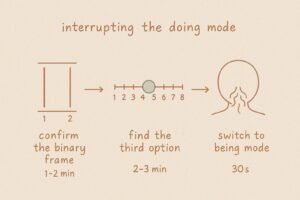
STEP 1: Confirm the binary frame (1–2 minutes)
Is an all-or-nothing frame currently running? The sense that full effort is the only meaningful option, or that stopping entirely is the only alternative?
Confirm that the frame is present — not by engaging its content, but by noticing that the binary structure has activated.
Something in me is insisting that partial effort isn’t worth making.
That recognition — without engaging its logic — is the first step.
STEP 2: Locate the third option (2–3 minutes)
Between the two poles, there is a wide range that the binary frame was not making visible.
Check the current state — energy, concentration, available capacity. If it were on a scale of ten, where would it land right now?
From that position, identify one thing that is accessible without requiring either pole. Not full effort, not complete withdrawal — one action available from the current state.
When the binary frame returns — that isn’t enough — that thought can be confirmed as the frame operating, and the chosen action continued anyway.
STEP 3: Switch to Being Mode for thirty seconds (1–2 minutes)
Before moving into the chosen action, create thirty seconds of not trying to resolve anything.
Bring attention to the breath. Confirm the sensation of inhaling and exhaling — not the goal the breath is serving, not the gap between current and desired state, just the sensation itself.
Thirty seconds of this is enough to interrupt the Doing Mode that was running continuously. The switch does not need to be sustained — the interruption is the operation.
Session 3: Four Findings That Explain the Mechanism
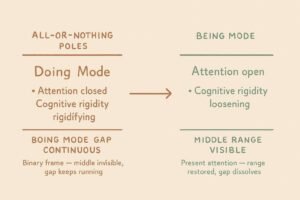
How binary thinking narrows the available options
Aaron Beck’s account of all-or-nothing thinking, from Cognitive Therapy of Depression (1979), establishes the cognitive layer’s foundation. Beck identified the tendency to process events as either complete success or complete failure — with no intermediate gradations — as a form of cognitive rigidity that functions as a primary cognitive antecedent of emotional distress. In the state all-or-nothing thinking produces, the middle range of adaptive options is not weighed and rejected; it is structurally excluded from the field of what appears possible. The available choices are determined by the thinking pattern before any specific situation is evaluated.
How the cognitive layer produces behavioral exhaustion
Gordon Flett and Paul Hewitt’s perfectionism research, published in Journal of Personality and Social Psychology (1991), extends the cognitive account to its behavioral consequences. Flett and Hewitt distinguished self-oriented perfectionism — the imposition of exacting standards on oneself — from socially prescribed perfectionism — the perception that others demand perfection. Their finding was that perfectionistic self-presentation — the behavioral pattern of concealing imperfection and maintaining the appearance of perfect performance — functions as a primary antecedent of chronic stress and burnout. The connection to Beck’s binary thinking is direct: the cognitive frame that defines anything short of full effort as failure generates the behavioral imperative to appear as though full effort is always being delivered, and sustaining that appearance is what depletes the system.
How the neural circuit keeps running after the work stops
Zindel Segal and colleagues’ account of Doing Mode and Being Mode, from Mindfulness-Based Cognitive Therapy for Depression (2002), and Matthew Killingsworth and Daniel Gilbert’s mind-wandering research, published in Science (2010), describe how the cognitive layer descends into the neural one. Segal and colleagues showed that Doing Mode — the brain’s goal-oriented processing state — functions by continuously measuring the current situation against a desired outcome, generating a gap that the system works to close. When this mode becomes chronic, it continues processing the present moment as an unresolved discrepancy even in the absence of active effort. Killingsworth and Gilbert’s experience-sampling study of 2,250 adults found that minds were wandering from present activity approximately 47 percent of the time, and that this state was consistently associated with lower wellbeing. Chronic Doing Mode structurally generates this wandering: the circuit oriented toward the next goal or the current insufficiency continuously redirects attention away from present experience, even when present experience is what recovery requires.
What restores the adaptive range
Kirk Warren Brown and Richard Ryan’s research on mindfulness and cognitive flexibility, published in Journal of Personality and Social Psychology (2003), identifies the intervention point. Brown and Ryan showed that the quality of present-moment attention characteristic of Being Mode — open, non-evaluative engagement with current experience — recovers cognitive flexibility and reduces automatic entrainment to rigid thinking patterns. Beck’s all-or-nothing thinking and Flett and Hewitt’s perfectionistic patterns are both softened by this quality of attention: the cognitive rigidity that was making the middle range invisible begins to loosen when attention is no longer organized around the gap between current state and desired outcome. The middle range was always there — between the two poles the thinking pattern kept insisting were the only options.
Conclusion: The Structure That Kept the Trying Running

Binary thinking had narrowed the available options to two. Chronic Doing Mode had been maintaining the gap-processing circuit even during rest. The burnout was not the result of effort — it was the result of a system that had lost the capacity to register that the effort could stop.
Being Mode attention is the interruption. Not the elimination of effort, but the recovery of the cognitive flexibility that makes the range between full force and complete collapse visible again.
The exhaustion wasn’t from trying too hard. It was from never letting the trying stop.
KEY TERMS
All-or-Nothing Thinking
Aaron Beck’s account, from Cognitive Therapy of Depression (1979), of the tendency to process outcomes as either complete success or complete failure — a form of cognitive rigidity that excludes the adaptive middle range from the field of visible options. The thinking pattern determines the range of available choices before any specific situation is evaluated. In the context of burnout, it functions as the cognitive antecedent that generates perfectionistic self-presentation and the chronic neural conditions Segal and colleagues describe.
Perfectionism and Burnout
Gordon Flett and Paul Hewitt’s finding, from Journal of Personality and Social Psychology (1991), that perfectionistic self-presentation — concealing imperfection while maintaining the appearance of perfect performance — functions as a primary antecedent of chronic stress and burnout. Their distinction between self-oriented and socially prescribed perfectionism identifies the two directions from which the binary frame is reinforced — the behavioral layer through which Beck’s cognitive rigidity produces its exhausting effects.
Being Mode and Doing Mode
Zindel Segal and colleagues’ framework, from Mindfulness-Based Cognitive Therapy for Depression (2002), distinguishing the goal-oriented gap-processing state of Doing Mode from the open present-moment engagement of Being Mode. Doing Mode’s chronic activation structurally generates the mind-wandering Killingsworth and Gilbert documented in Science (2010) — continuously redirecting attention toward unresolved gaps even during rest.
Mindfulness and Cognitive Flexibility
Kirk Warren Brown and Richard Ryan’s finding, from Journal of Personality and Social Psychology (2003), that present-moment attention recovers cognitive flexibility and reduces automatic entrainment to rigid thinking patterns. Being Mode attention softens both Beck’s all-or-nothing thinking and Flett and Hewitt’s perfectionistic patterns by dissolving the cognitive architecture that was excluding the middle range — restoring the adaptive range that binary thinking had eliminated.