
Introduction: The Impulse to Make It Stop Is What Makes It Stay

When anxiety arrives, the impulse is to make it go away. When regret surfaces, the impulse is to stop thinking about it. When anger comes, the impulse is to push it down.
These responses are understandable. They are also, in many cases, what keeps the suffering running. The more a painful experience is treated as a problem requiring a solution, the more the system that monitors it keeps it at the center.
There is a deeper layer. The craving that underlies much suffering — if I could just get this, the discomfort would end; if this situation would change, I could finally rest — is not designed to conclude upon satisfaction. Getting what was wanted generates the next wanting. This circuit is what produces the automatic renewal of suffering even after the immediate cause has passed.
This article traces both structures — why avoidance sustains suffering, and why craving does not terminate on satisfaction — and describes what changes when the structure is observed rather than fought.
Session 1: Two Structures That Keep Suffering Running

When suffering persists, two mechanisms are usually operating simultaneously.
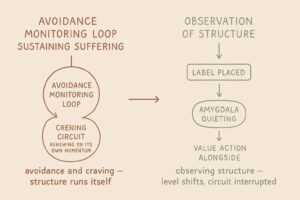
The first is the maintenance function of avoidance. Trying not to feel anxiety, trying not to think about regret — these avoidance attempts require continuous monitoring of the avoided experience. The monitoring sustains the presence of what is being avoided. The more suffering is treated as something to be eliminated, the more the elimination effort keeps it structurally active. Suffering is not resolved by the attempt to resolve it. It is organized, by that attempt, as something that must continue to be resolved.
The second structure is the neural separation between wanting and satisfaction. The belief that obtaining what is craved will end the craving does not match how the relevant circuits operate. Wanting and liking are processed by different systems — craving does not terminate when its object is reached. The approval obtained generates the next need for approval. The problem solved generates vigilance toward the next problem. The circuit that produces craving runs independently of the circuit that registers satisfaction.
The direction of intervention is not the removal of suffering. It is a different relationship to the structure through which suffering operates: observing that it is occurring rather than reacting to its content.
Session 2: Observing the Structure
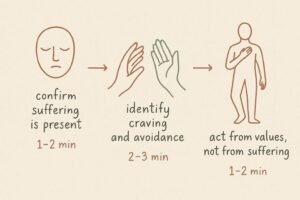
STEP 1: Confirm that suffering is present (1–2 minutes)
Is there suffering present right now — anxiety, regret, frustration, anger, in any form?
Without moving to resolve it, confirm that it is there.
There is difficulty here right now.
That confirmation — without the impulse to resolve it — is the first movement.
STEP 2: Identify the craving and the avoidance (2–3 minutes)
Beneath the suffering, bring two questions inward:
What is being held onto right now?
What is being pushed away?
No answer needs to be decided upon. The operation is confirming that a craving or an avoidance is running — not engaging its content, but observing its structure.
Something in me is reaching toward something. Something else is pushing away from something.
Those two movements — confirmed without engaging their content — are the structure this step is making visible.
STEP 3: Choose one action from values, not from the suffering (1–2 minutes)
From the position of having observed the structure — without waiting for the suffering to be resolved — identify one action that comes from what matters rather than from what is being avoided.
The suffering can remain present. The action does not require it to be gone first. Moving from values while suffering is present is the most direct interruption of the avoidance circuit available.
Session 3: Four Findings That Explain the Structure
Why avoidance keeps suffering running
Steven Hayes and colleagues’ account of experiential avoidance, from Behaviour Research and Therapy (1996), establishes the first layer. Avoidance of unwanted internal experience maintains and intensifies that experience over time rather than resolving it. The mechanism is structural: avoidance requires monitoring the avoided content for its absence, and monitoring sustains presence. Treating suffering as a problem to be solved organizes it as something that must continue to be monitored — and the monitoring is what keeps it central. Hayes’s research showed that the degree of experiential avoidance, rather than the specific content being avoided, is the primary predictor of psychological distress. The attempt to eliminate suffering is frequently what prevents it from passing.
Why craving renews rather than concludes
Kent Berridge and Terry Robinson’s incentive salience theory, published in Brain Research Reviews (1998), provides the neural account of why craving renews rather than concludes upon satisfaction. Berridge and Robinson demonstrated that wanting and liking are processed by distinct neural systems — dopaminergic circuits handle the craving state, while opioid circuits handle the experience of satisfaction. These systems operate independently. Obtaining what was craved does not terminate the wanting circuit; it generates the conditions for the next activation. The approval received produces the next need for approval. The problem resolved produces vigilance toward the next problem. Craving functions as a circuit that runs on its own momentum.
How observing the structure changes what it does
Adrian Wells’s metacognitive monitoring research — from Behaviour Research and Therapy (1995) and Metacognitive Therapy (2009) — and Matthew Lieberman’s affect labeling findings, from Psychological Science (2007), describe the mechanism by which observing the structure changes what it does. Wells showed that directing attention toward the process of suffering — observing that a thought or craving is occurring — rather than toward its content interrupts the maintenance circuit that reactive engagement sustains. Lieberman’s research showed that applying a verbal label to an emotional state reduces amygdala activation: the act of naming what is present — this is anxiety, this is craving — shifts the neural processing from automatic reactive engagement toward regulated observation. The observation is not acceptance or suppression. It is a change in the level at which the suffering is being processed — from inside the content to a position from which the structure can be seen.
What an ancient tradition had already mapped
An ancient contemplative tradition had mapped this structure as a diagnostic sequence — suffering, its origin in craving, the possibility of a different relationship to it, and the practical path toward that shift — two and a half millennia before the experimental record caught up.
Conclusion: The Structure Was Never the Enemy

Experiential avoidance had been maintaining suffering by keeping it under continuous monitoring. The craving circuit had been renewing itself independently of whether its objects were obtained. The attempt to solve suffering was the mechanism sustaining it.
Metacognitive observation changes the relationship to both structures — not by eliminating suffering, but by creating the position from which its structure becomes visible and value-based action becomes available without waiting for the suffering to conclude first.
Suffering wasn’t the problem to be solved. The solving was.
KEY TERMS
Experiential Avoidance
Steven Hayes and colleagues’ finding, from Behaviour Research and Therapy (1996), that attempts to avoid or suppress unwanted internal experience maintain and intensify it over time — because avoidance requires monitoring the avoided content, and monitoring sustains its presence. The degree of experiential avoidance, independent of its specific target, is the primary predictor of psychological distress. The central intervention target of ACT, and the mechanism through which treating suffering as a problem to be solved becomes the condition that keeps it running.
Incentive Salience and the Craving Circuit
Kent Berridge and Terry Robinson’s finding, from Brain Research Reviews (1998), that wanting and liking are processed by distinct neural systems — dopaminergic circuits for craving, opioid circuits for satisfaction — operating independently. Obtaining what is craved does not terminate the wanting circuit; it generates conditions for the next activation. The neural basis for understanding why suffering renews after apparent resolution.
Metacognitive Monitoring
Adrian Wells’s account, from Behaviour Research and Therapy (1995) and Metacognitive Therapy (2009), of directing attention toward the process of suffering rather than reacting to its content. Combined with Lieberman’s affect labeling finding in Psychological Science (2007) that naming an emotional state reduces amygdala activation, the framework describes how observing the structure of suffering shifts its neural processing from reactive engagement to regulated observation.
The Diagnostic Sequence
The four-stage observational framework mapped by an ancient contemplative tradition — suffering, its origin in craving, the possibility of cessation, and the practical path — which anticipates structurally what Hayes, Berridge, Wells, and Lieberman describe through experimental means. Not a doctrinal claim, but a diagnostic map of the conditions under which suffering is generated, sustained, and related to differently.