
Introduction: When the Searching Becomes the Suffering

You read the books, rethink the career, sometimes even change the city. And still the question remains: Is this really me?
If anything, the more you search, the further away the answer moves.
There is a name for this feeling. The mode of endlessly seeking an “authentic self” has become its own kind of compulsion — a search that deepens the question rather than answering it.
What follows is not another method for finding yourself. It is a practice for stepping out of that loop entirely: setting aside the effort to locate a fixed self, and instead learning to observe the living flow of experience that is already here.
Session 1: The Self in Pursuit

Something pulls toward a picture. The unshakeable person, the authentic career, the self that finally fits — and from the moment that image forms, every experience gets measured against it. The moments that close the gap pass without registering. Only the moments that widen it accumulate.
Something else pulls toward a story. I am this kind of person — until a failure, a change of heart, or a contradiction makes the story feel unstable. What should be a normal part of living registers as a fracture in the self. The story becomes a cage: honest experiences that don’t fit get quietly excluded rather than integrated.
Underneath both is a thought that has stopped feeling like a thought: I must be something definite. When that belief becomes indistinguishable from reality, the question stops being who do I want to become? and turns into why am I still not enough?
The searching becomes self-sustaining. This is not a failure of will — it is the structural pull of a thought that has been mistaken for the truth.
Session 2: Practice — From Searching to Seeing
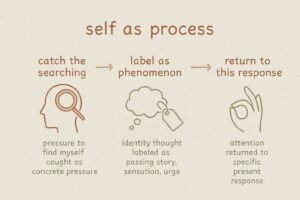
This practice trains a shift in perspective: from treating the self as something to be discovered, to observing it as a process already unfolding.
STEP 1: Catch the searching
The moment a thought arises — Who am I really? What is my purpose? — catch it before entering its content. Instead of following the question, observe it. Quietly note to yourself:
“The pressure to find myself has started.”
The problem shifts from the abstract — the nature of the self — to the concrete: a specific pressure, happening right now, in this moment.
STEP 2: Label the thought as phenomenon
When a thought or feeling about identity arises, treat it not as a revelation about your essence, but as a passing mental event.
“The story ‘I am a failure’ is moving through.”
“There is a tightening in the chest — the wanting to be seen as capable.”
“There is an urge to hold onto the label ‘this is who I am.'”
Naming the elements one by one — what you thought made up a fixed self, each treated as a phenomenon — something begins to shift. What felt like a solid thing reveals itself as a collection of smaller, moving processes.
STEP 3: Return to this response
Step away from the large question and bring attention back to the specific response happening right now.
“Right now, I am listening in this conversation.”
“Right now, my mind is moving in an analytical mode.”
“Right now, something in me is quietly opening to this view.”
Rather than reaching for the self as a fixed noun, experience it as a series of changing responses to what is present. There, in that series, is something that no label fully captures — the actual movement of being alive.
Session 3: The Machinery Underneath
The social contract nobody signed
Sociologist Anthony Giddens observed that in modern societies, as traditional communities dissolved, the self became what he called a “reflexive project” — something to be continuously monitored, revised, and narrated. What family, community, and religion once provided — a framework for knowing who you are — the modern individual must now produce and update alone.
Self-actualization became an obligation. In the social media era, this accelerates further: the self shifts from something lived to something optimized, curated for value in a marketplace of attention.
The exhaustion of self-searching is not a personal failure. It is the inevitable result of being asked to complete a task that has no finish line.
Why the search becomes a maze
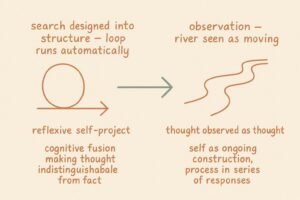
Within this pressure, the belief I must be a certain kind of person stops functioning as one thought among many. Psychologists describe a state called cognitive fusion — when a thought becomes indistinguishable from reality itself. Once fused, contradicting evidence stops registering. The moments that don’t match the ideal get processed as confirmation: still not enough. The moment a thought is observed as a thought — rather than lived as a fact — it shifts from absolute truth to one possible interpretation.
What the brain is actually doing
The default mode network — a circuit that activates in the absence of external tasks — automatically generates self-referential thought: how you should be, how you used to be, how you compare. The loop of self-searching is, in part, this network doing what it was built to do.
What neuroscientists have found is that the sense of self is itself an ongoing act of construction, generated fresh by the brain in each moment. Not a stable entity waiting to be uncovered, but a process — continuously reconstructed in response to context.
Searching for a completed self is like looking for the permanent shape of a river.
Conclusion: What Becomes Visible When You Stop

The authentic self is not a destination that, once found, stays found. It is the thinking, feeling, sensing, responding — the living stream of what is already happening.
Seeing is not resignation. It is bringing attention, simply and directly, to the experience of this moment. When it is turbulent, observe the turbulence. When it is quiet, feel the quiet. The capacity to do this — to rest in awareness rather than reach for a conclusion — is what the Buddhist tradition has long called sati.
The moment you stop searching, what was always there becomes, for the first time, felt.
KEY TERMS
Cognitive Fusion
The state in which a thought becomes indistinguishable from reality itself. The belief “I must be a certain kind of person” feels like absolute truth, and experiences that contradict it stop registering. The labeling practice in Session 2 works to loosen this fusion — developing the capacity to observe thoughts as interpretations rather than facts.
Reflexive Self
Sociologist Giddens’ description of selfhood in modern society. As traditional frameworks dissolved, individuals became responsible for continuously constructing, monitoring, and updating their own identity. The social origin of the exhaustion that comes with self-searching — not a personal weakness, but a structural demand that arrived without being chosen.
Default Mode Network
A brain circuit that activates during rest and generates self-referential thought — rumination about the past, anticipation of the future, self-evaluation. The loop of searching for an authentic self is partly this network running on autopilot. The observation practice in Session 2 offers a momentary exit from that loop — not by silencing the network, but by changing your relationship to what it produces.
Narrative Identity
A concept developed by psychologist Dan McAdams. The self is formed and maintained as a story — coherent, continuous, authored. When the story is disrupted — by failure, contradiction, or change — it registers as a crisis of self. Understanding this structure makes the disruption easier to hold: the story cracked, not you.
Sati
Pāli for “awareness” or “mindfulness.” The inner capacity to observe thoughts, feelings, and sensations as phenomena — without grasping or pushing away. The foundational orientation underlying all three steps in Session 2.